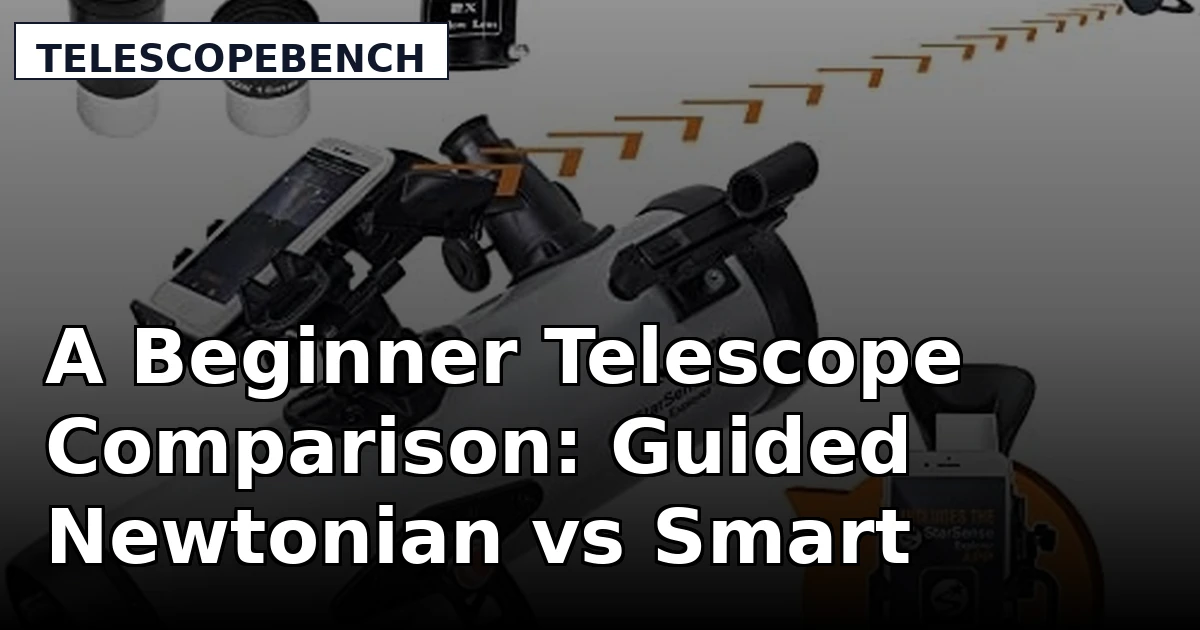
Most first telescope purchases fail for the same reason, and it is rarely the optics. Someone shops by aperture and magnification, takes the new scope out once, cannot find anything worth looking at, and the tube ends up in a closet. A beginner telescope comparison that starts with the mount and the pointing method, instead of the biggest number printed on the box, is a much better use of an evening than reading spec sheets.
The four telescopes here come from three different philosophies. One is a Newtonian reflector on a manual alt-azimuth mount that leans on your phone to tell you where to push. One is a compact 90mm travel kit that packs down into a bag with its accessories. Two are app-controlled smart telescopes that skip the eyepiece altogether and send images to a screen. The deciding question with any of them is not which one is the most powerful. It is which one you will still be carrying outside on a cold Tuesday in February.
Related: How Much Aperture Do You Actually Need? →
Quick answer
Match the telescope to the way you will observe. If you want to learn the sky by hand and see the Moon and planets with your own eye, the Celestron StarSense Explorer LT 114AZ is the pick in this group, because its phone-guided mount helps you locate targets without a computerized hand controller. If the priority is a low entry cost and a scope that fits in a carry bag with the tripod already included, the Dianfan 90mm kit is the fit. If you want a self-contained instrument you can hold in one hand and run entirely from an app, the DWARFLAB Dwarf Mini is built for exactly that. If imaging deep-sky objects matters more than looking through an eyepiece, the ZWO Seestar S30 Pro is designed around that job.
Four useful options
| Model | Best fit | What stands out |
|---|---|---|
| Celestron StarSense Explorer LT 114AZ Newtonian Smartphone Guided Telescope | Learning the sky on a manual mount with phone assistance | 114mm Newtonian aperture with a phone dock for the StarSense Explorer app |
| Dianfan Telescope for Kids & Adults, 90mm Aperture 550mm | Low-cost travel and shared viewing | 90mm aperture in a 550mm tube, sold with tripod, adapter, bag and folding stool |
| DWARFLAB Dwarf Mini Smart Telescope | Grab-and-go imaging controlled from a phone | 1.85 lb smart telescope with fully app-based operation |
| ZWO Seestar S30 Pro Smart Telescope | App-controlled astrophotography | Self-contained imaging telescope aimed at deep-sky photos |
The guided reflector: Celestron StarSense Explorer LT 114AZ Newtonian Smartphone Guided Telescope
The appeal here is the combination of a real 114mm mirror and a pointing system that does not need batteries or a multi-star alignment routine. You set the scope down, dock your phone, and the app works out where the tube is aimed. Then it tells you which way to move. That keeps the learning curve on the sky side rather than the electronics side, which is where beginners usually get stuck.
The trade-off is that it is still a manual mount. Nothing moves on its own, and a Newtonian reflector needs its mirrors aligned to give sharp views, a skill worth learning early. Sky conditions, light pollution and how steadily you can hold the tube all shape what you see. Treat the eyepieces in the box as a starting point and plan to add one better eyepiece once you know what you enjoy looking at.
The budget travel kit: Dianfan Telescope for Kids & Adults, 90mm Aperture 550mm Astronomical Professional Telescope for Adults High Powered, Portable Travel Telescopes for Beginners with Tripod & Adapter, Bag, Folding Stool
This is the option for someone who wants a scope in the car, in a backpack, or on a picnic blanket. At 90mm of aperture and a 550mm focal length, the tube is short enough to travel and still large enough to show lunar craters, Saturn's rings on a steady night, and the brighter star clusters. The listing bundles the tripod, a phone adapter, a carry bag, and a folding stool, which matters more than it sounds, because a surprising share of a first setup's cost is the parts that do not come in the box.
Set expectations about the mount. Lightweight travel tripods are the limiting factor on any kit at this level, and a breeze or a bumped leg will show up in the eyepiece at higher power. Keep magnifications moderate, observe from a sheltered spot, and this kind of scope rewards patience. It is also the easiest of the four to hand to a child or a visiting friend, which is exactly what a shared telescope should be.
The pocket smart scope: DWARFLAB Dwarf Mini Smart Telescope - 1.85lb Portable Astronomy Telescope
The Dwarf Mini changes the shape of the hobby. At 1.85 lb it is a complete portable imaging instrument, and everything happens in the app: you pick a target, the scope points itself, and the image builds on your phone screen. There is no finder to align, no eyepiece to swap, and no star hopping to learn first. For someone in a city apartment with a balcony and twenty free minutes, that is a serious advantage.
What you give up is the eyepiece view. If your idea of astronomy is putting your eye to a tube and seeing a planet with your own retina, a smart scope will not replace that feeling. It also depends on a charged phone or tablet, a working app, and a target list the software already knows. As an imaging-first instrument that fits in a day bag and removes almost every excuse not to go outside, though, it is a convincing package.
The astrophotography smart scope: ZWO Seestar S30 Pro Smart Telescope, App-Controlled Astrophotography
The Seestar S30 Pro sits at the imaging end of this group. It is app-controlled, it is astrophotography-focused, and it takes the parts of a traditional imaging workflow, the tracking mount, the guiding, the frame stacking, and puts them behind a phone interface. For someone who wants pictures of nebulae and galaxies without assembling a separate rig piece by piece, that is the entire point of the product.
The trade-off is focus. This is not really a visual telescope in the traditional sense, and it is the most expensive of the four, so it only makes sense if imaging is genuinely the goal and you will actually use the files it produces. It also ties you to the manufacturer's app and its target catalogue. If what you want is to learn the constellations by heart, a manual scope will teach you faster. If you want images, this is the shortest path in this comparison.
Prices and availability may change. Product images, names, and retailer links must be matched by verified ASIN. Do not state a current price, rating, stock status, or measured result without current evidence.
What actually decides whether a telescope gets used
Aperture is the diameter of the main mirror or lens, and it sets how much light the scope collects and how much detail it can resolve. It is the single most important optical specification, which is why the 114mm Newtonian in this group has a real advantage over the 90mm tube on faint objects. But aperture is only half the story. The mount is the other half, and arguably the larger half, because a large scope on a shaky tripod shows less than a small scope on a solid one.
Magnification is not a specification you should shop by. It is a derived number: the focal length of the telescope divided by the focal length of the eyepiece. Any telescope can be pushed past the point where the image breaks down, and the practical ceiling depends on aperture, optics and the steadiness of the air above you. When a box advertises an enormous top magnification, that number describes an eyepiece combination, not what the scope will actually deliver on a real night.
Two more factors matter more than most buyers expect. Light pollution determines what is visible from your own yard, and it is why a short drive to darker sky beats almost any equipment upgrade. Portability determines how often the scope comes out at all, and a scope that lives in a closet is worth less than a smaller one that lives by the back door. Eyepieces are the last variable: the ones included with any beginner scope are a starting point, and one good replacement eyepiece usually changes the view more than any other small purchase.
How guided mounts and smart scopes find objects
The four scopes here solve the "where is it?" problem in three different ways. The Celestron uses your phone as a pointing aid on a manual mount. The Dianfan relies on the traditional method: a finder, a star chart, and patience. The two smart telescopes point themselves and put the result on a screen. Understanding that difference is the core of this beginner telescope comparison.
- Decide what you actually want to look at. The Moon and planets reward aperture and steady air. Nebulae and galaxies reward dark sky and, often, a camera.
- Decide whether you want to observe with your eye or view on a screen. That single choice eliminates half the options immediately.
- Match the mount to your site. A balcony, a windy field and a dark-sky trip all favor different levels of stability and weight.
- Set a total budget that includes accessories, not just the tube, because a carrying case, a better eyepiece and a red light add up.
- Commit to a first month of regular sessions. Ten short nights under the sky teach more than any spec sheet, and they tell you whether the scope you chose was the right shape for your life.
Practical guidance before you buy
- Judge every telescope by its mount first. Wobble at the eyepiece is the fastest way to lose interest.
- Buy for aperture within your portability limit, not for the largest magnification number in the listing.
- Plan from the start to replace the included eyepieces, and budget for one mid-range eyepiece.
- Learn the sky in parallel with the gear: a star chart and a planisphere cost little and pay off every session.
- Give any scope at least a month of real use before deciding it was a mistake, and keep a short log of what you saw each night.
Which option should you choose?
Choose the Celestron StarSense Explorer LT 114AZ Newtonian Smartphone Guided Telescope when you want to learn the sky yourself, want a genuine 114mm reflector, and want your phone to handle the finding rather than the viewing. Choose the Dianfan Telescope for Kids & Adults, 90mm Aperture 550mm when cost and portability come first and you want a complete kit, tripod and bag included, that can be handed to a beginner without explanation. Choose the DWARFLAB Dwarf Mini Smart Telescope when you want a 1.85 lb scope you can carry anywhere and run entirely from an app. Choose the ZWO Seestar S30 Pro Smart Telescope when astrophotography, not visual observing, is the reason you are buying.
One caveat applies to all four. Smart telescopes depend on their apps and on a charged phone, manual scopes depend on your willingness to learn the sky, and every one of them depends on the mount holding steady and the optics being correctly aligned. Nothing here replaces a dark site and a clear night, and no specification on a box tells you how a scope will feel in your hands at 11 p.m. in the cold.
The bottom line
These four instruments are not competing for the same buyer. The Celestron StarSense Explorer LT 114AZ keeps a real 114mm Newtonian in the mix with phone-assisted pointing. The Dianfan 90mm kit is the low-cost, packable, shareable option. The DWARFLAB Dwarf Mini is the one you can slip into a bag and operate with one thumb. The ZWO Seestar S30 Pro is the imaging-first choice. Pick the one that matches how you will observe, then give it enough nights outside to prove it was the right call.