Related: Best Telescope for a Backyard With Streetlights: What Actually Works
Most people who quit astronomy do not quit because the sky got boring. They quit because the telescope they bought could not hold a steady image, and nobody told them that the mount is the telescope. I have spent twenty years teaching people to look up and twelve of those years running a public observatory, and I have watched the same failure repeat itself: a decent optical tube on a tripod that shivers, a finder that is harder to align than the scope, and a magnification number printed on the box that the optics cannot deliver.
A beginner telescope setup is not one purchase. It is an optical tube, a mount that can actually carry it, a way to find things in the dark, and, if the tube is a Newtonian, a collimation tool you will use more often than you expect. Get those pieces right and you will be outside every clear night. Get them wrong and the scope ends up in a closet by February.
Here are the four pieces I would put in a first setup, in the order I would buy them, plus the checks I run on every scope before I recommend it to someone who has never owned one.
Celestron StarSense Explorer DX 130AZ Smartphone Guided Newtonian Telescope
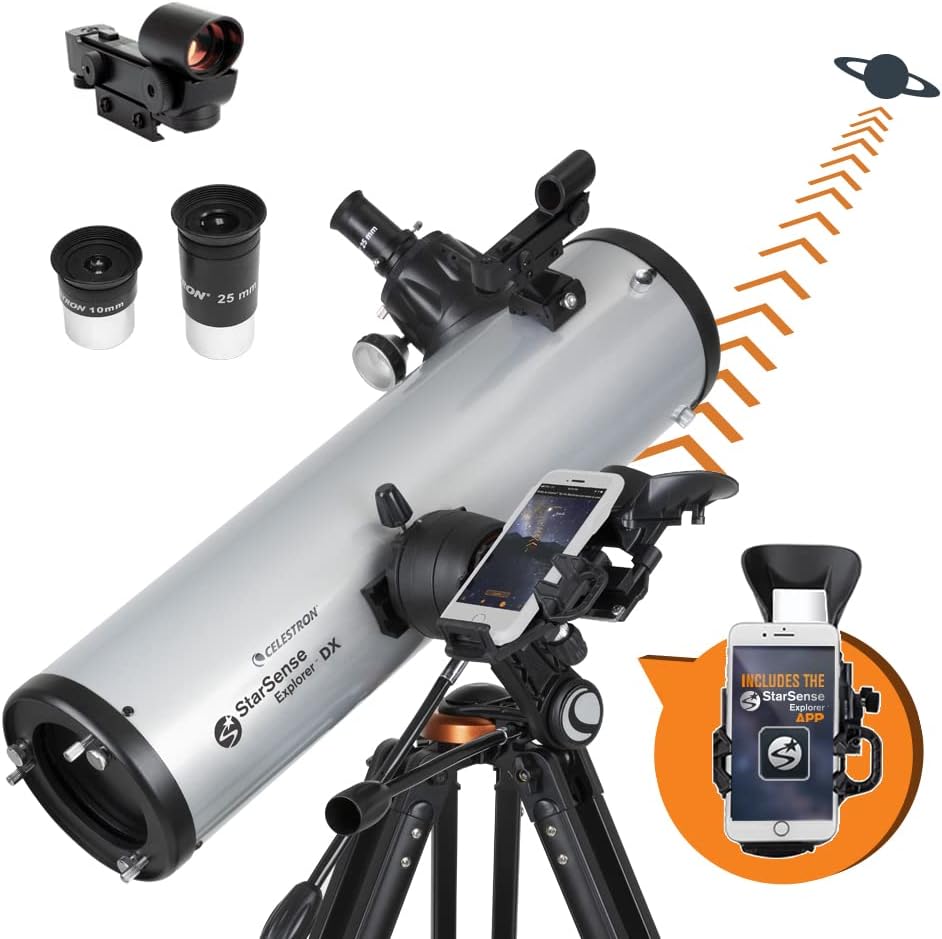
This is the one I hand to a beginner when I want them to succeed on night one. The StarSense Explorer DX 130AZ is a 130mm Newtonian on an alt-az mount, and the trick is in the name: your phone does the finding. You dock the phone, the app uses the camera to work out where the scope is pointed, and it tells you which way to nudge. There is no star alignment routine, no hand controller menu tree, and no entering the date, time, and coordinates while your fingers go numb.
Aperture is king for visual observing, and 130mm of mirror is enough to show Saturn's rings, Jupiter's cloud belts and its four bright moons, the Orion Nebula, the Ring Nebula, and a long list of globular and open clusters. That is a real telescope, not a bird killer.
Two honest caveats. First, it is a Newtonian, which means the mirrors need to be aligned. It arrives close, and a bumpy car ride knocks it out. Buy a collimation tool with the scope, not six months later. Second, the mount is alt-az and the tube is modest in mass, so this is a visual instrument rather than an imaging rig. Also budget for one better eyepiece, because the eyepiece that ships with any scope is a suggestion, not a tool.
Celestron SkyMaster Pro 20x80 Astronomy Binoculars
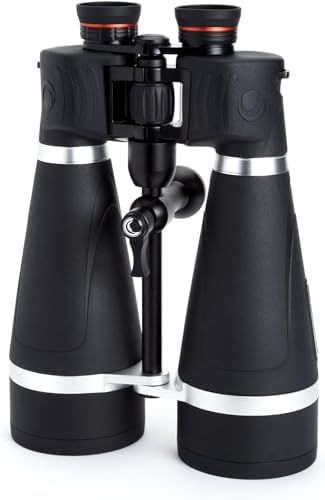
Binoculars are the most underrated first instrument in astronomy, and the SkyMaster Pro 20x80 is the pair I point people toward when they want to learn the sky rather than hunt objects one at a time. Two eyes beat one eye for comfort, the 80mm objectives gather real light, and sweeping the Milky Way or the Pleiades at 20x is a genuinely different experience from looking through a tube.
The honest catch is that 20x is far too much magnification to hand-hold. These need a tripod, and a solid one, which puts them in the same "the mount is the telescope" territory as everything else. Mount them properly and they will show you lunar craters, Jupiter's moons, the Andromeda Galaxy, and star fields a narrow refractor will never frame.
They are not a replacement for aperture on the planets. A 130mm Newtonian will out-resolve them on Saturn every night of the week. What they are is a companion instrument that gets used when you have twenty minutes and no patience for setup.
Gskyer Telescope 600x90mm AZ Astronomical Refractor Telescope
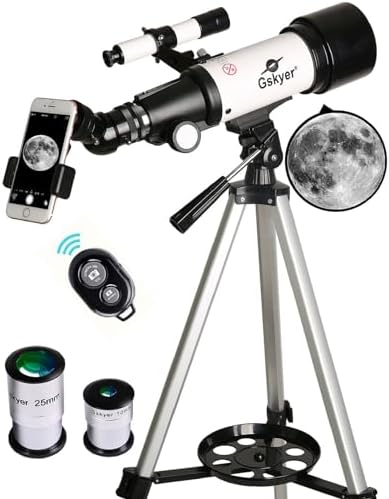
The Gskyer 600x90mm is the classic refractor shape: a 90mm lens, a 600mm focal length, and an alt-az mount. Refractors have one enormous advantage for beginners, which is that they hold collimation. There is nothing to align, nothing to adjust, and nothing to knock out of true. You take it outside and it works. That is worth a lot to someone who does not yet know what collimation means.
The 90mm aperture is the limit here. On the Moon and the brighter planets it does well, and it doubles as a spotting scope for birds and distant ridgelines, which is a legitimate reason to own one. Deep-sky objects will look like faint smudges under suburban skies, because that is what 90mm delivers on galaxies and nebulae.
The mount is the part to check. Give the tube a tap and see how long the image takes to settle. If it keeps wobbling for seconds, you will fight it every time you focus. And ignore the magnification claims on the box. A useful rule of thumb is about 2x per millimeter of aperture on a good night, which puts a 90mm refractor near 180x no matter what the packaging suggests. Chasing a bigger number on a small scope only shows you a dim, blurry mess.
SVBONY Laser Collimator for Newtonian Alignment
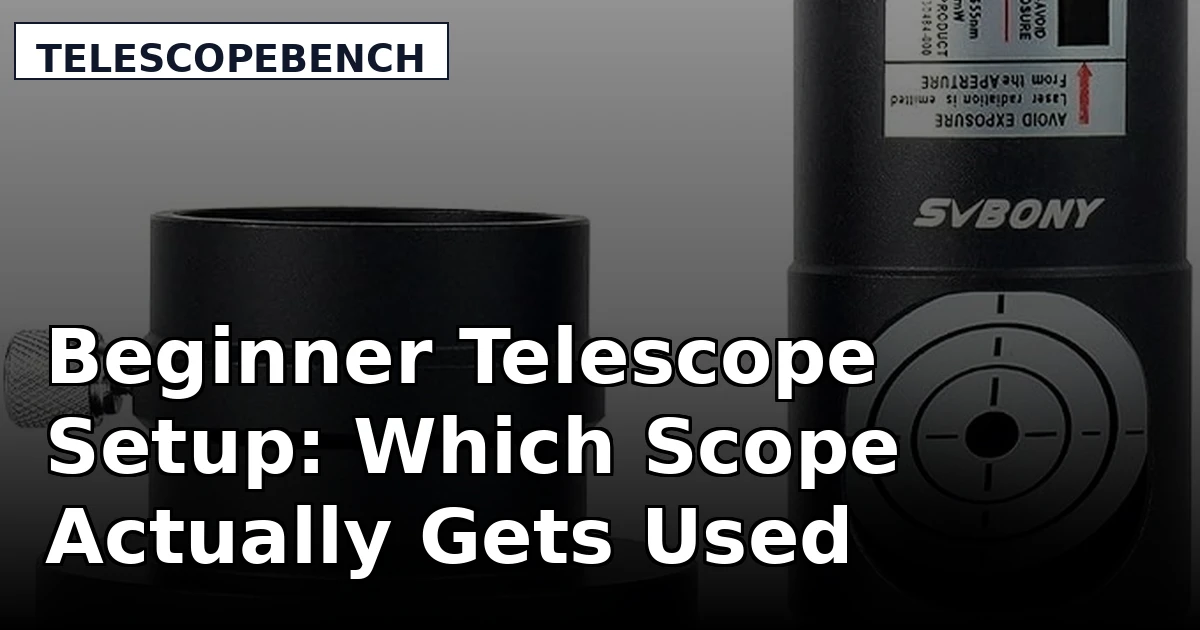
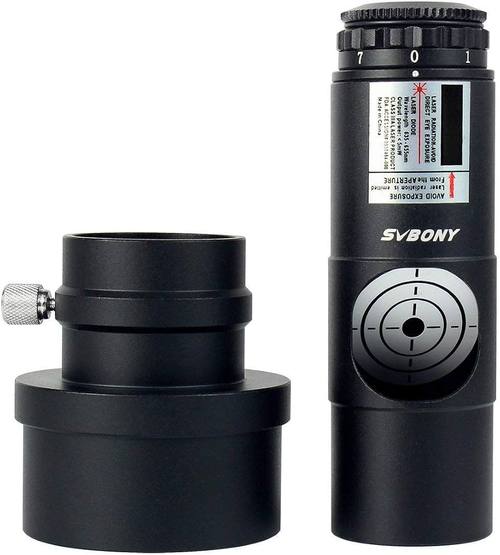
This is the least glamorous item in a beginner telescope setup and the one that most often decides whether a Newtonian performs. The SVBONY laser collimator fits both 1.25 inch and 2 inch focusers, which covers the StarSense DX 130AZ and most other Newtonians you are likely to buy. You drop it in the focuser, switch it on, and adjust the mirrors until the beam lands where it should. A few minutes of work, and the difference between a mushy view and a sharp one.
Two things to know. Budget lasers are sometimes themselves out of alignment, so it is worth checking yours against a wall before you trust it, and a collimation cap or a star test makes a good sanity check. And collimation is not a one-time chore. Any Newtonian that rides in a car needs a check when it arrives at the dark site. Keep the tool in the same bag as the scope.
How I evaluate a beginner telescope setup
I run the same four checks on every scope, and I do not recommend one to a first-time buyer until it passes all four.
Does the mount hold steady at high power? This is the first test and the one that eliminates the most scopes. Focus on a bright star, tap the tube lightly, and count. A mount that settles in about a second is usable. A mount that keeps ringing for three or four seconds will ruin every high-power view you attempt, no matter how good the optics are.
Are the optics actually sharp and in alignment? For a refractor that means a star test and a look along the Moon's terminator. For a Newtonian it means a collimation check before anything else. Out of collimation equals blurry views, always, and it is the most common reason a good telescope gets blamed for being bad.
Could a true beginner use it on night one? This is the test that separates keepers from dust collectors. If someone who has never touched a telescope needs an hour and a phone call before they see anything, the scope is not beginner friendly, whatever the box says.
Would I recommend it to someone who has never owned a scope? That is the final filter. If the answer is no, the product does not belong in a beginner telescope setup, even if it is a fine instrument for someone with experience.
What the numbers on the box actually mean
Aperture, the diameter of the main mirror or lens, is the only spec that really matters for visual observing. It determines how much light you collect and how much detail you can resolve. A 130mm mirror will beat a 90mm lens on faint objects every time.
Magnification is a consequence, not a feature. It comes from the eyepiece, not the tube, which is why a scope advertised at a huge magnification is usually sold with a cheap eyepiece that cannot reach it usefully. Useful magnification tops out around 2x per millimeter of aperture, and often less when the atmosphere is unsteady.
Mount type decides how the scope feels in use. A manual alt-az mount is simple and light. A GoTo or app-guided mount finds objects for you, which is a convenience and not a substitute for knowing the sky, though app-guided systems like StarSense have made the alignment step far less painful than the old hand controllers.
Collimation is the fourth number nobody prints on the box. For any Newtonian, budget for a collimation tool on day one.
The beginner telescope setup reference table
| Piece | Role in the setup | Check this first | Price |
|---|---|---|---|
 Visit on Amazon → Visit on Amazon →StarSense Explorer DX 130AZ |
Main scope, app-guided 130mm Newtonian | Mirror alignment out of the box | $499.95 |
 Visit on Amazon → Visit on Amazon →SkyMaster Pro 20x80 |
Wide-field companion for learning the sky | Tripod and mounting bracket | $299.99 |
 Visit on Amazon → Visit on Amazon →Gskyer 600x90mm |
Refractor for Moon and planets, nothing to align | Mount settle time after a tap | $269.99 |
 Visit on Amazon → Visit on Amazon →SVBONY laser collimator |
Keeps the Newtonian performing | Whether the laser itself is aligned | $24.69 |
The order I would buy them: the Newtonian first if you want one scope that does everything a beginner needs, the collimator in the same order, the refractor instead if you want zero maintenance and care most about the Moon, and the binoculars whenever you want to learn the constellations faster than any finder will teach you.
Should you buy the Celestron StarSense Explorer DX 130AZ?
Yes, if you want one telescope that a beginner can actually operate. 130mm is real aperture, the phone-guided pointing removes the hardest part of the learning curve, and it is the scope in this group I would hand to someone who has never used one. Buy the collimator at the same time and plan on one better eyepiece.
Should you buy the Celestron SkyMaster Pro 20x80?
Yes, as a second instrument, and yes as a first instrument if you are honest about wanting to learn the sky before you learn a mount. It is not a planet killer and it will not replace aperture. But mounted on a steady tripod it shows you things you will not find any other way, and it gets used on nights when setting up a scope feels like too much work.
Should you buy the Gskyer 600x90mm?
Yes, if you want a telescope with nothing to adjust and you care most about the Moon and the brighter planets. It is also the most portable and the most dual-purpose of the group. Skip it if you are chasing galaxies, and do not believe the magnification numbers on the box.
Should you buy the SVBONY laser collimator?
Yes, and buy it with the Newtonian rather than after it. It is the cheapest item here and it protects the performance of the most expensive one. A 130mm mirror that is out of alignment performs like a much smaller telescope, and you will blame the scope instead of the alignment.