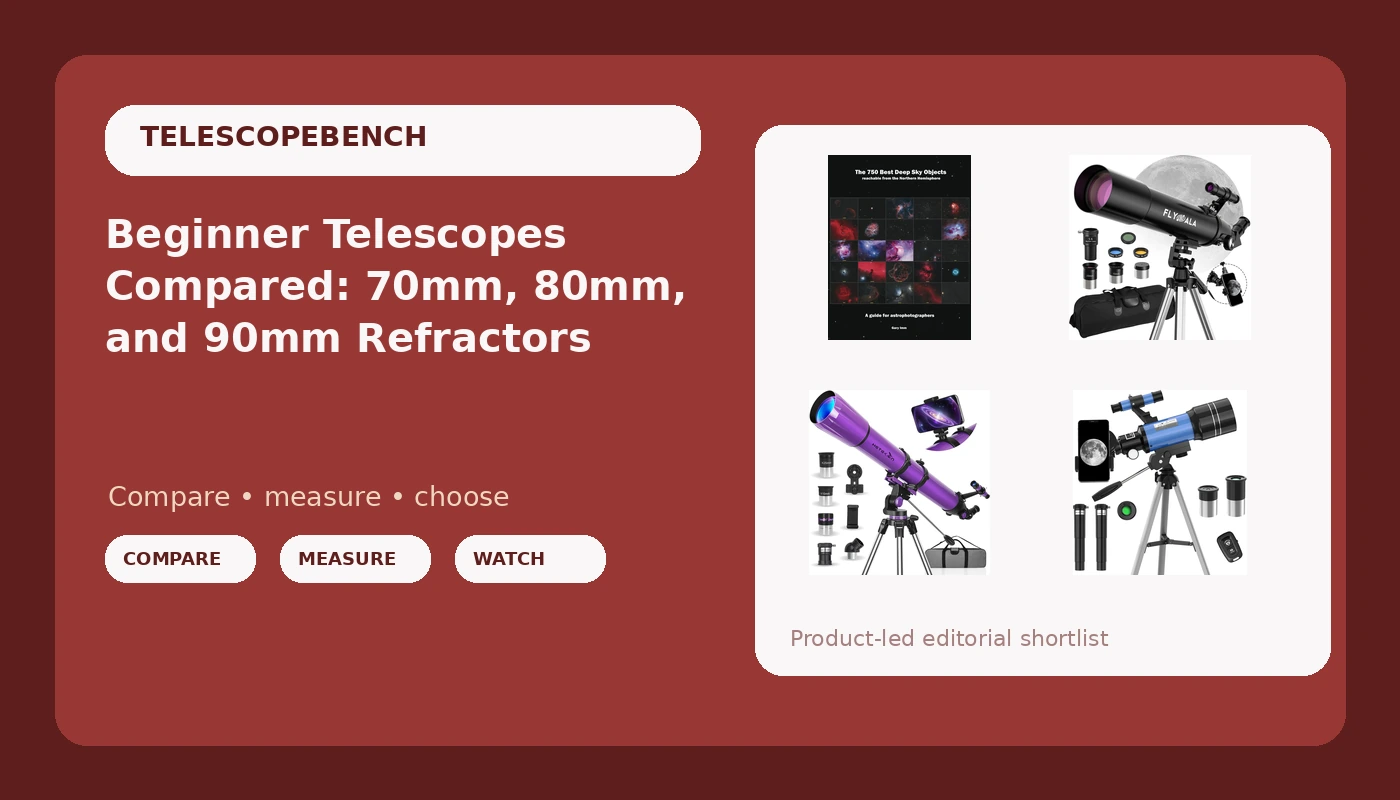
Related: How to Pick a Telescope Mount You Won't Fight
Magnification is the biggest lie in amateur astronomy. Walk down the telescope aisle and every box shouts a number: 150X, 600X, 750X. None of those numbers tell you anything about what you will actually see. Aperture tells you how much light the telescope gathers. The mount tells you whether that light ever lands steady in the eyepiece. Everything else on the carton is marketing.
I have spent twenty years teaching people to look up, twelve of them running a public observatory, and I have watched a lot of beginner telescopes get used exactly once. The pattern barely changes. The optics were fine. The mount wobbled. The finderscope was harder to align than the telescope. The eyepiece in the box was a suggestion, not a tool. By night three the scope was in the garage, and the person who bought it had decided astronomy was boring.
So when I look at beginner telescopes, I look at four things in this order: the mount, the aperture, the focal length, and what comes in the box. The three refractors below cover the practical range of what a first scope can be, and the fourth item is the book that keeps you at the eyepiece once you get there.
A 70mm Refractor That Actually Leaves the House
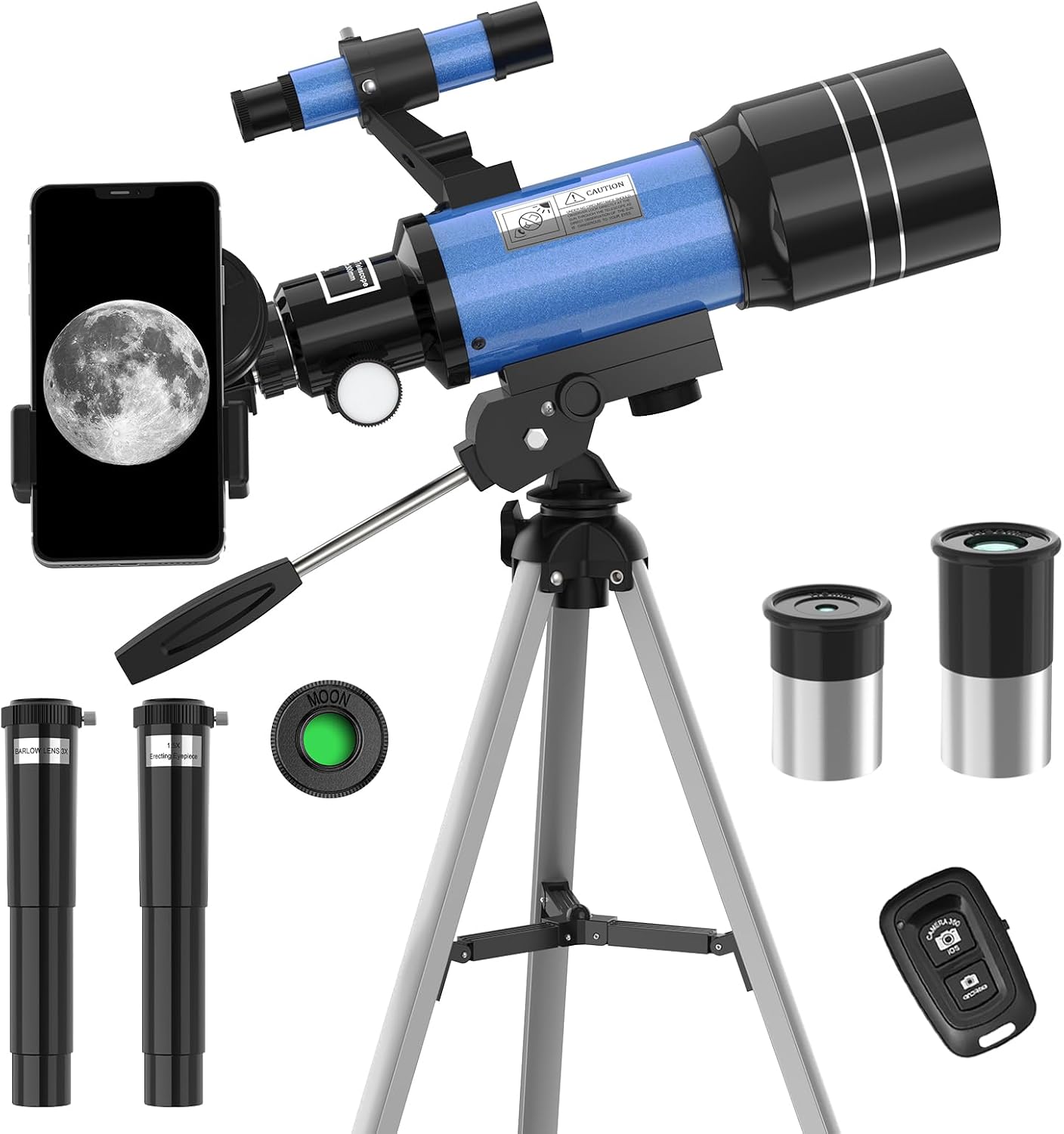
Small refractors get dismissed as toys, and most of them earn that. This one is a different animal because of what it is built for: 70mm of aperture, a 300mm focal length, fully multi-coated optics, and a phone adapter included. That combination is a travel kit, not a shelf ornament.
Here is the math that matters. A 300mm focal length with a 20mm eyepiece gives you 15X. Swap in a 10mm and you get 30X. That is a wide field telescope, and wide field is underrated. It will show the moon in genuinely satisfying detail, Jupiter as a disk with its four bright moons lined up beside it, Saturn's rings as a clean oval, and star fields that larger scopes cannot fit into one view: the Pleiades, the Beehive, the Double Cluster. It will not show you faint galaxies. No 70mm will, and anyone who tells you otherwise is selling something.
What I would check before trusting it is the tripod. A 70mm tube weighs almost nothing, and manufacturers know it, so this is the class where mounts get flimsiest. Set it up, tap the tube gently, and count how long the image takes to settle. If it is still wobbling after two seconds, you will be fighting it at anything above 30X, and fighting the mount is how people quit.
The phone adapter is a real feature, not a gimmick. Holding a phone against an eyepiece by hand never works. A bracket that clamps the phone in place gets you a moon photo on night one, and that photo is what brings a kid back out the next clear night.
The 80mm Refractor: The Step Most Beginners Should Take
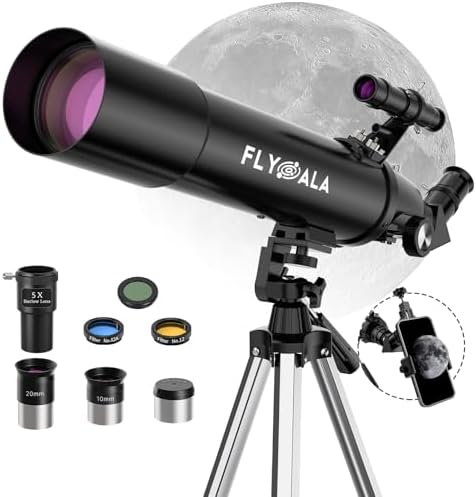
If you only read one section of this guide, read this one. An 80mm aperture with a 600mm focal length is roughly f/7.5, which is the sweet spot for a small refractor: enough light gathering to pull in the brighter deep sky objects, enough focal length to push power on the moon and planets, and still short enough to ride a modest mount without drama.
The numbers, done honestly. A 25mm eyepiece gives you 24X. A 10mm gives you 60X. A 6mm gives you 100X. The practical ceiling on a good night is around 160X, which is about twice the aperture in millimeters, and that is where lunar craters and Jupiter's cloud belts start to show structure. The 750X printed on the box would require an eyepiece so short that the image would be dim, soft, and empty. Ignore it. Every manufacturer does this, and it is the single most misleading habit in the hobby.
Compared with the 70mm, this scope gathers meaningfully more light and resolves finer detail, so globular clusters stop looking like fuzzy smudges and start breaking into stars at the edges. It is heavier, but it still comes out in one trip, which is the test that matters more than any spec sheet.
Two things to plan for. First, budget for one decent eyepiece upgrade, because the eyepieces in this class are usually the weakest link, not the optics. Second, check the focuser and the diagonal when it arrives. A refractor rarely needs collimation, but a loose focuser will drive you crazy at high power.
The 90mm Refractor: Most Aperture, Narrowest View
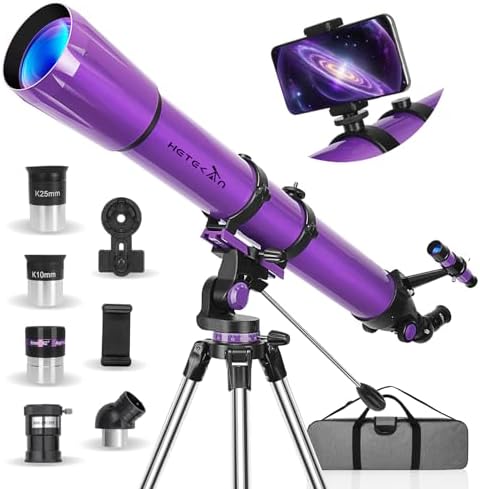
A 90mm aperture with a 1000mm focal length works out to about f/11, and that changes the personality of the scope. Long focal length means high power comes easily: a 25mm eyepiece gives 40X, a 10mm gives 100X, and a 6mm gives about 167X, right at the practical ceiling for this aperture. Lunar craters, the polar caps and dark markings on Mars when it is close, the Cassini division in Saturn's rings on a steady night, tight double stars. This is the lunar and planetary scope of the group.
The trade is field of view. At 1000mm you are looking through a narrower straw, so the Pleiades will not fit and finding objects by star hopping takes more patience. And a longer tube puts more leverage on the mount, which means a light tripod that was marginal under an 80mm tube will be genuinely frustrating here. Check the stability before anything else, because aperture you cannot hold steady is aperture you cannot use.
One more thing, and I mean this seriously: it comes in purple. A telescope a kid is excited to carry outside gets used, and a telescope that stays in the closet gathers dust no matter how good the glass is. If the color is what gets it out the door, the color is a feature.
The Book That Makes Any of These Worth Owning
A telescope finds nothing on its own. It shows you whatever you point it at, which means the bottleneck is almost never the optics, it is knowing where to point. That is why a deep sky atlas belongs in the same order as the scope, especially if you skipped a computerized mount.
The 750 Best Deep Sky Objects is a target list with positions and descriptions, organized so you can work through it season by season. That structure matters more than it sounds. A beginner with a list of 750 objects and a small refractor will see more in one autumn than a beginner with a bigger scope and no plan will see all year. Pair it with a red flashlight and a planisphere and you have a complete kit.
The Reference Table
Same four products, sorted by what each one is actually for. If you are deciding between them, start here and read the row that matches how you observe.
| Product | Aperture | Focal length | Best for | What to know |
|---|---|---|---|---|
 Visit on Amazon → Visit on Amazon →70mm travel refractor |
70mm | 300mm | Moon, wide star fields, travel and camping | Lightest mount of the three, plan on 15X to 60X, phone adapter included |
 Visit on Amazon → Visit on Amazon →80mm refractor |
80mm | 600mm | The middle path: moon, planets, brighter clusters | Best balance here, real ceiling around 160X, budget for one better eyepiece |
 Visit on Amazon → Visit on Amazon →90mm refractor |
90mm | 1000mm | Lunar and planetary detail, double stars | Longest tube, most leverage on the mount, narrowest field of view |
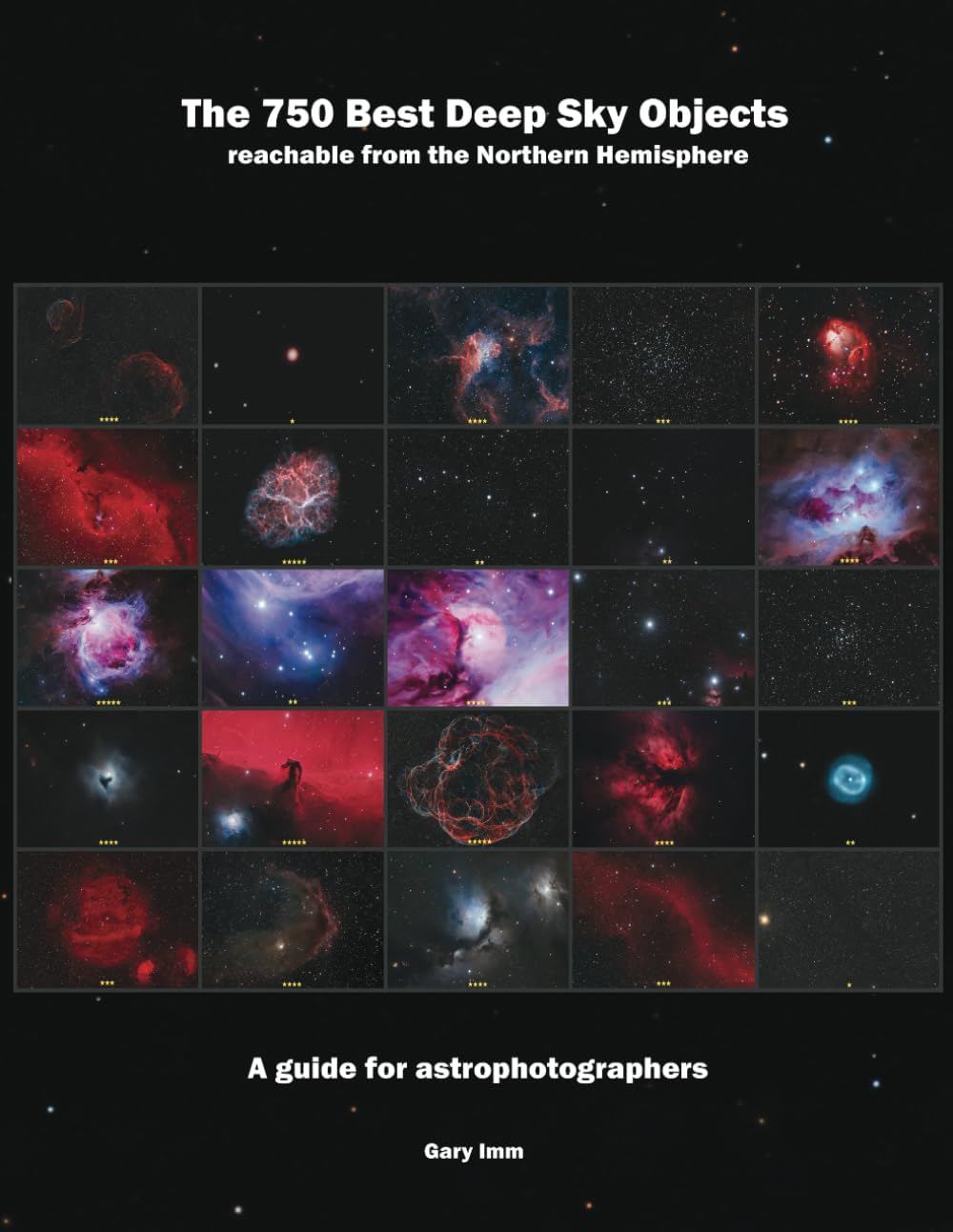 Visit on Amazon → Visit on Amazon →The 750 Best Deep Sky Objects |
Not a telescope | Not a telescope | Finding targets and building a plan | The upgrade that makes a small scope feel bigger |
What I Check on Any Beginner Telescope
The mount, first and always. Set the scope up, aim at something bright, and tap the tube. Count the seconds until the image stops moving. Under one second is fine. Two seconds is workable at low power. Three seconds means the scope will teach you frustration instead of astronomy. There is no optical fix for a wobbly tripod.
The optics, at the eyepiece. Point at the moon at moderate power and look for a sharp terminator, the line between light and shadow, with crisp crater edges. Then swing to a bright star and defocus slightly. You want a clean, round donut, not a lopsided blob. An out of round donut on a refractor usually means a misaligned diagonal or a pinched lens, and it is worth exchanging.
The finder. A finderscope that is harder to align than the telescope is worse than useless. Get it aligned in daylight on a distant chimney or streetlight, not at night on a star, and do it before your first session. This one step saves more observing time than any accessory you can buy.
The included eyepieces. They are a suggestion, not a tool. Use them, learn the scope, and then buy one good eyepiece in the 25mm range and one in the 10mm range. That upgrade will do more for your views than any other purchase.
The beginner test. Hand it to someone who has never used a telescope and say nothing. If they find the moon and get it focused inside ten minutes, the scope is designed well. If they need you standing over them, the problem is the telescope, not the person.
How the Numbers Compare
Exit pupil is the number nobody talks about and it explains everything. Divide aperture by magnification and you get the width of the light cone entering your eye. A 2mm exit pupil, which is 35X in the 70mm, 40X in the 80mm, and 45X in the 90mm, is the sweet spot where most deep sky objects look their best. That is why the smallest scope here is not useless. It just reaches its best views at lower power.
Useful maximum magnification runs about twice the aperture in millimeters, so roughly 140X for the 70mm, 160X for the 80mm, and 180X for the 90mm, and only on nights when the atmosphere cooperates. Any number above that on a box is a promise the optics cannot keep. When a package claims 750X, what it is really telling you is that nobody at the company expects you to try it.
Chromatic aberration is the other thing to understand about refractors in this range. Bright objects like the moon and Jupiter will show a thin purple fringe at high power. It is normal, it is not a defect, and it does not stop you from seeing detail. If a purple halo around the moon would ruin your night, you need a different design and a much bigger budget.
Should You Buy the 70mm Travel Refractor?
Yes, if the scope needs to leave the house. This is the one that goes in a backpack, gets set up in five minutes, and gets used on a camping trip. It shows the moon, Jupiter and its moons, Saturn's rings, and the wide clusters beautifully, and the phone adapter turns a first look into a photo you keep. Just accept the ceiling: 70mm is a wide field instrument, and the mount is the part to inspect the day it arrives.
Should You Buy the 80mm Refractor?
For most people reading this, yes. It gathers more light than the 70mm, holds higher power on the moon and planets, and still carries outside in one trip. It is the scope I would put in front of a family that wants one telescope to do everything reasonably well, and the one I would tell a beginner to stretch for over the smallest option.
Should You Buy the 90mm Refractor?
If you observe from one spot, you have a steady mount, and the moon and planets are what you care about, yes. The 1000mm focal length makes high power easy and the extra aperture makes it rewarding. If you want to sweep star fields and travel, the 80mm will make you happier. And if the purple finish is what gets a kid outside, that counts for more than any spec on this page.
The Bottom Line
The best beginner telescope is the one that actually gets used. A 70mm that lives in your car beats a 90mm that lives in the closet, and a book of 750 targets beats both if it keeps you observing instead of hunting. Check the mount before you check the magnification, plan on replacing one eyepiece, and get the scope outside within a week of it arriving. Saturn through any of these three, on a steady night, is the thing that turns a purchase into a hobby.