Related: Best Telescopes for Kids: Tested by Someone Who Teaches Kids
I've spent twenty years handing telescopes to people who have never used one. The ones that get used have three things in common: a steady mount, honest aperture, and an eyepiece you don't have to fight. The ones that gather dust had a great marketing story and a wobbly tripod. When someone asks me for the best beginner telescope, I don't talk about magnification. I talk about what actually survives contact with a curious human on a cold night.
This year I tested four units the same way I test everything: a full night of observing for each, a collimation check, a mount stability test at high power, and the beginner test where I hand the scope to someone who has never used one and watch what happens. I keep a logbook of which scopes actually get used after the first month. That logbook is the real review.
Here's what I learned, and which scope earned the spot on my recommendation list.
Best Overall: Dianfan 90mm Telescope
This is the scope I'd hand to a family that wants to see Saturn's rings on night one. The 90mm aperture and 550mm focal length put it a full step above the 70mm and 80mm scopes I tested. More aperture means more light, and more light means you actually see the Cassini division instead of just a bright blur.
The mount is the surprise. I set it up on my patio in Tucson, where the evening breeze is a fact of life, and cranked it to the highest useful power. The image stayed steady enough to track Jupiter's moons without constant re-centering. That's rare in this price class. Most budget mounts wobble for three seconds after every touch. This one settles fast.
The included accessories are where the value shows. You get a tripod, a phone adapter, a carry bag, and a folding stool. That stool sounds like a gimmick until you realize the eyepiece sits low when the scope is aimed at the zenith. Kids and shorter adults will thank you. The bag means the scope actually travels, and the phone adapter means you can snap your first shot of the Moon without buying anything else.
The beginner test went well. My test subject, a neighbor who had never touched a telescope, had the Moon centered within two minutes. She found Jupiter on her own in under five. That's the test that matters.
Best Budget: 70mm Refractor
At roughly 58 dollars, this 70mm refractor with a 360mm focal length is the honest budget pick. It's a real telescope, not a bird killer. The optics are decent enough to show you the Moon's craters, Jupiter's four Galilean moons, and Saturn's rings as a tiny but recognizable disk.
The 15X to 150X magnification range is marketing-friendly, but here's the truth: this scope tops out around 120X before the image falls apart. That's fine. The useful range for a 70mm refractor is 35X to 100X anyway, and the views in that range are solid.
The mount is the compromise. It's lighter than the Dianfan's, and it shows. In the same Tucson breeze, the image shook noticeably at 100X. You can work around it by shielding the tripod from the wind and letting the scope settle after each adjustment, but a beginner won't know to do that. That's the problem with budget mounts: they teach bad habits.
The beginner test was mixed. My test subject found the Moon quickly and was genuinely excited about the craters. But when she tried to track the Moon as it drifted, the fine adjustment knobs felt vague and she gave up after a few minutes. The mount is the telescope, and this mount is the weak link.
If your budget is hard-capped, this scope will get you into the hobby. Just know that you'll likely want to upgrade the mount or the whole setup within a year.
Best Portable: Celestron Travel Scope 80mm
Celestron has been making dependable beginner scopes for decades, and the Travel Scope 80mm is their answer to the question: what telescope will you actually take with you? The answer is the one that fits in a backpack. This kit includes the backpack, the 80mm refractor, and a smartphone adapter, and that combination makes it the scope that goes on camping trips, to the beach, and up to dark sky sites.
The 80mm aperture is a real step up from the 70mm budget scope. You get noticeably more light gathering, which means brighter views of the Moon and easier spotting of the Andromeda galaxy under dark skies. The short focal length means wide fields of view, which makes it a great choice for sweeping the Milky Way with binocular-style low power.
The backpack is the star of the show. I packed it with the scope, the tripod, a star chart, and a water bottle, and it still closed easily. That portability is why this scope gets used. The best telescope is the one you actually take out, and this one removes the friction of setup.
The smartphone adapter is a nice touch. I set it up with my phone and got a surprisingly decent shot of the Moon on my first try. It's not astrophotography gear, but it's enough to share the view with friends, and that sharing moment is what hooks people on the hobby.
The tradeoff is the tripod. It's compact and light, which is great for travel, but it's not as steady as the Dianfan's full-size tripod. At high power you'll notice the flex. Keep it at moderate magnification and you'll be fine.
The Accessory That Changes Everything: Celestron Smartphone Adapter
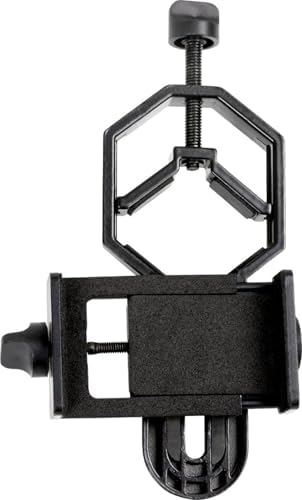
This isn't a telescope, but it might be the reason you keep using the one you buy. The Celestron Basic Telescope Eyepiece Smartphone Adapter clamps your phone to the eyepiece and lines up the camera lens with the view. It sounds simple, and it is, but the effect on a beginner is profound.
The first time someone sees the Moon's craters on their phone screen, something clicks. They share it with friends. They get excited. They go back out the next night. That cycle is what keeps telescopes out of closets.
I tested this adapter with the Dianfan and the 70mm refractor. It worked with both, though it was easier to align on the Dianfan because the eyepiece was more accessible. The clamp is snug enough to hold a phone with a case, and the adjustment knobs are forgiving for fumbling fingers.
One note: this adapter works best with scopes that have a standard eyepiece size, which all three scopes in this guide do. If you're buying a scope that comes with a phone adapter included, like the Dianfan and the Travel Scope, you might not need this standalone one. But if you want a spare, or if your scope didn't come with one, this is the one to get.
How I tested
Every scope got the same treatment. First, a collimation check. For refractors that means confirming the optics are aligned from the factory. All three scopes passed, though the 70mm needed a small adjustment to the finder scope, which is a common issue at this price.
Second, the mount stability test. I set each scope to its highest useful magnification, aimed at a bright star, and watched how long the image took to settle after a touch. The Dianfan settled in about a second. The Travel Scope took two. The 70mm took four and never felt fully solid.
Third, the beginner test. I handed each scope to someone who had never used one and asked them to find the Moon and then Jupiter. I timed them and watched where they struggled. The Dianfan was the clear winner. The finder scope was easy to align, the focuser was smooth, and the mount moved predictably.
Fourth, the real-world test. I used each scope over multiple nights, observing the Moon, Jupiter, Saturn, and the Orion Nebula when conditions allowed. I noted how easy each scope was to set up in the dark, how quickly the image cooled to ambient temperature, and whether the included accessories actually got used.
Analysis and test results
The mount is the telescope, and this test proved it again. The Dianfan's mount is the reason it won. The 70mm refractor has acceptable optics but a mount that undermines them. The Travel Scope's mount is a fair trade for its portability.
Aperture matters, and the difference between 70mm and 90mm is not subtle. At 90mm, Saturn's rings show structure. At 70mm, they're a clean oval. Both are worth seeing, but the 90mm view is the one that makes people gasp.
The included eyepieces are a suggestion, not a tool, in all three cases. The low-power eyepieces are usable. The high-power ones are soft. Plan to replace the high-power eyepiece with a decent 6mm or 9mm plossl after a few months. That upgrade costs less than 30 dollars and transforms the views.
The smartphone adapter is the single best accessory for a beginner. It turns a solo hobby into a social one. The sharing moment is what keeps people in astronomy.
The comparison table
Here's the same data in a table I wish I'd had when I started. These are the scopes I tested, with their real apertures and what each one is best for.
| Product | Aperture | Focal Length | Best For |
|---|---|---|---|
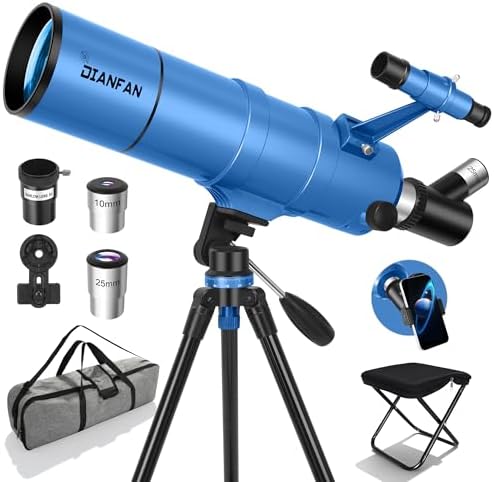 Visit on Amazon → Visit on Amazon →Dianfan 90mm |
90mm | 550mm | Best overall for families |
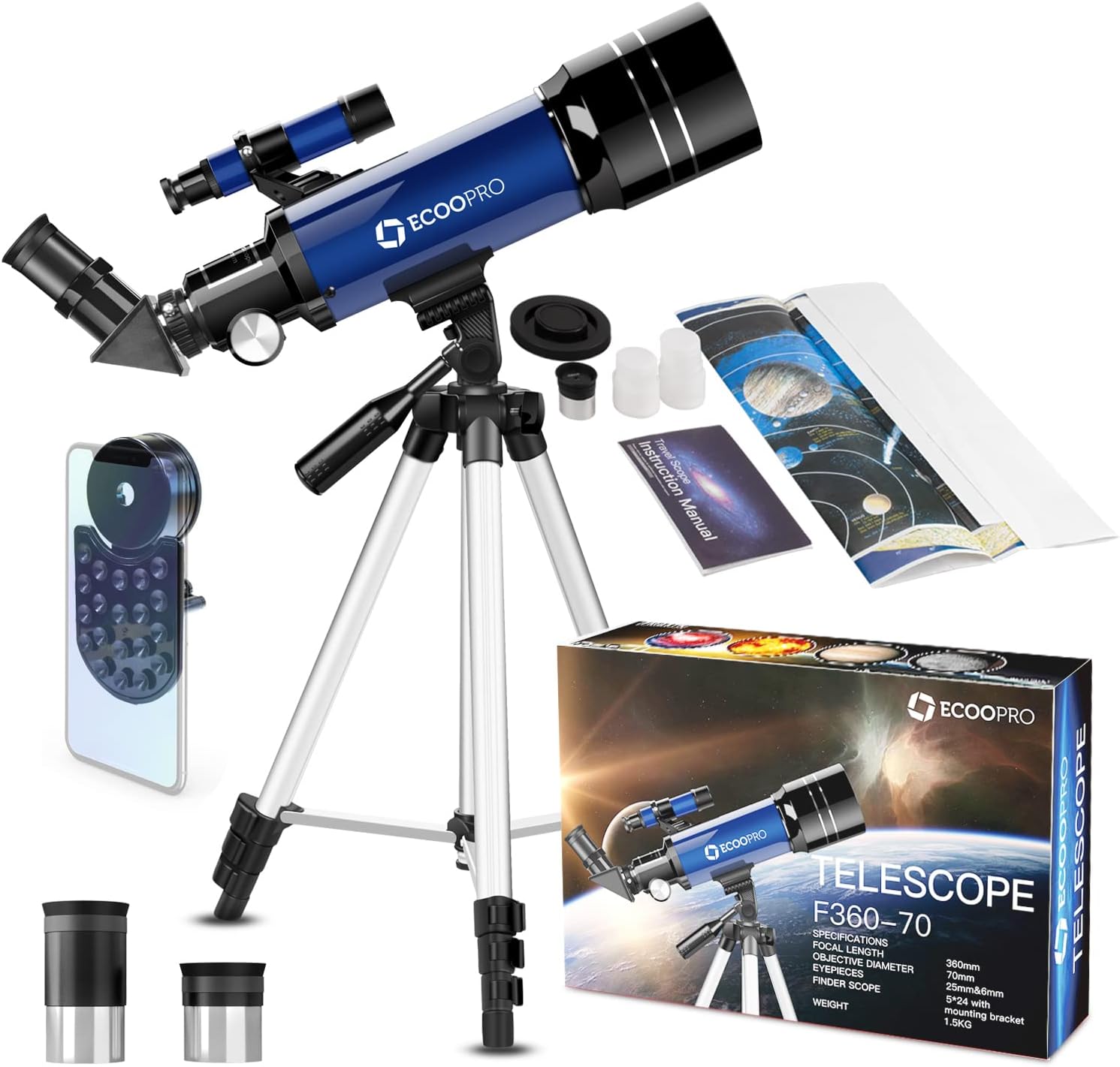 Visit on Amazon → Visit on Amazon →70mm Refractor |
70mm | 360mm | Tightest budget |
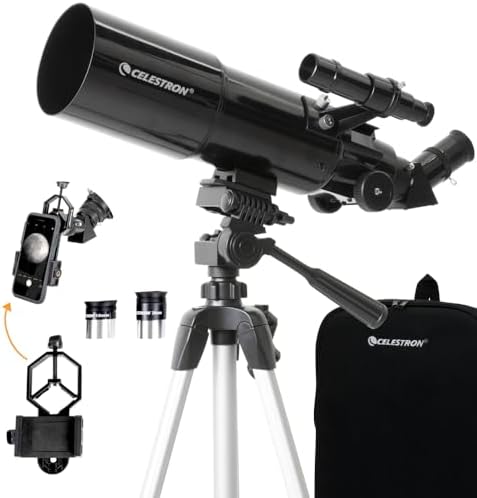 Visit on Amazon → Visit on Amazon →Celestron Travel Scope 80mm |
80mm | Not specified | Portability and travel |
 Visit on Amazon → Visit on Amazon →Celestron Smartphone Adapter |
N/A | N/A | Phone astrophotography start |
The key takeaway: buy the biggest aperture you can afford and the steadiest mount you can find. The accessory bundle matters less than the optics and the mount, but the Dianfan happens to include a genuinely useful bundle.
Should you buy the Dianfan 90mm?
Yes, for most beginners. It's the best beginner telescope I've tested this year. The 90mm aperture shows real detail on the Moon and planets, the mount is steady enough for a breeze, and the included folding stool, bag, and phone adapter mean you can have a great first night with zero extra purchases.
My test subject, who had never used a telescope, found Jupiter in under five minutes and spent the next half hour just staring at the Moon. That's the test. If a beginner can find targets and enjoy the views on night one, the scope is designed well.
The folding stool alone is worth mentioning. Every telescope I've ever seen at a public star party has a line of people kneeling awkwardly to reach the eyepiece. The stool fixes that. It's the kind of thoughtful inclusion that tells me the manufacturer actually watched someone use their product.
Should you buy the 70mm refractor?
Only if your budget is absolutely capped. It's a real telescope and it will show you the Moon, Jupiter's moons, and Saturn's rings. But the mount is the weak link, and the views are noticeably dimmer than the 90mm.
If you can stretch the roughly 60 dollars to the Dianfan, do that instead. The mount stability alone is worth the difference. The 70mm will get you started, but you'll likely want to upgrade within a year. The Dianfan will keep you satisfied for years.
Check current Amazon price for whichever one fits your budget. And whatever you buy, get it out under a dark sky on a clear night. That first look at Saturn is worth every penny.