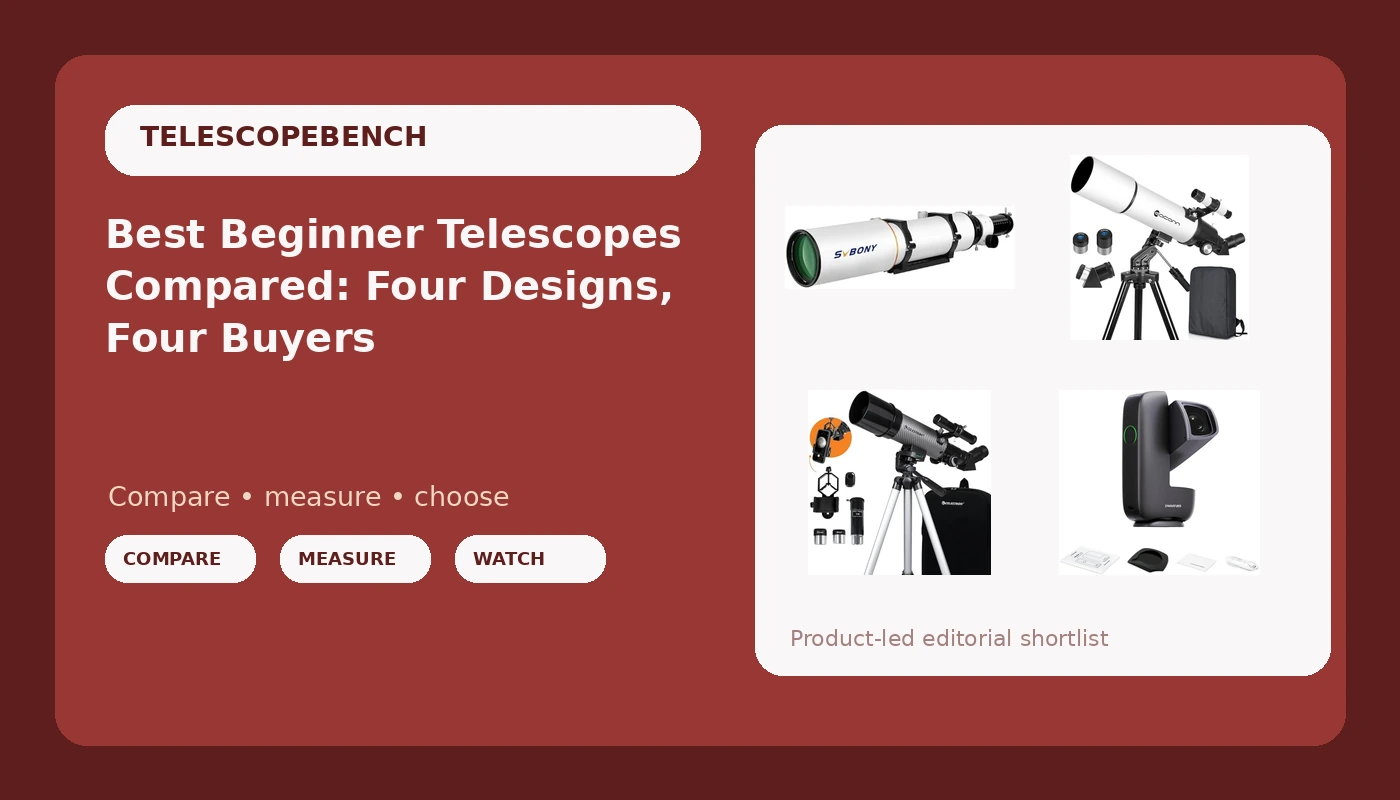
I have spent twenty years pointing telescopes at the sky for other people, twelve of them running a public observatory in Tucson, and the pattern has never once changed. The scope that gets used is the one whose mount does not fight back. That is the frame I bring to every beginner telescope comparison, because the four scopes below are not four versions of one idea. They are four different answers to the question of what a first telescope should be.
Two of them are small refractors that ride in a backpack. One is a 102mm ED refractor for people who care more about the view than the packing list. One is a 1.85 lb smart telescope that hands the whole experience to your phone. None of them is junk. They are aimed at different people, and the most common mistake I see is a first-time buyer choosing the one that sounds most impressive instead of the one that matches how they actually observe.
The scope I would hand to most first-time buyers is the 80mm travel refractor, because 80mm of aperture in a backpack is enough to show the moon, Saturn, Jupiter and a handful of bright deep-sky objects, and it is the size that actually leaves the closet. The long answer involves mounts, eyepieces, and the honest limits of aperture, which is what the rest of this article is about.
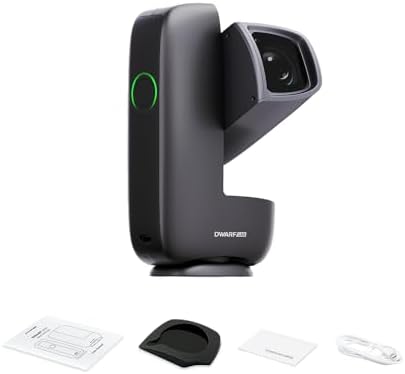
DWARFLAB Dwarf Mini Smart Telescope
1.85 lb means it goes anywhere, sets up in minutes, and produces images instead of demanding patience at an eyepiece
It is imaging on a phone screen, not the eyepiece experience, and a small aperture still limits what it can pull in
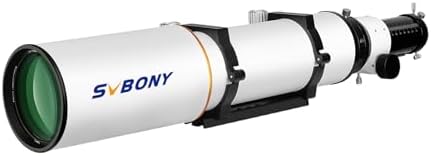
SVBONY SV503 102mm F7 ED Refractor
102mm of aperture with ED glass, the most light gathering and resolution here, and the one tube you can grow into
It demands a serious mount, and the mount is where this purchase either works or falls apart
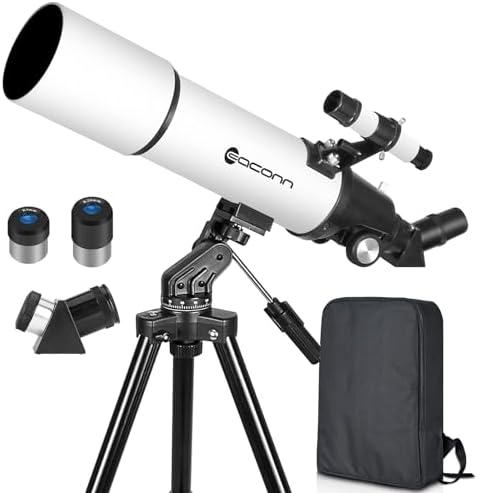
80mm Aperture 600mm Travel Refractor
Aperture and portability in one package, with a backpack included for dark-sky nights away from the porch
At this price the bundled eyepieces and the tripod are the first parts I would inspect
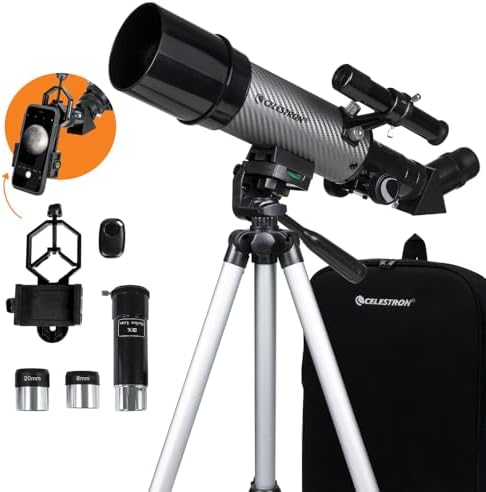
Celestron Travel Scope 60DX
The lightest and most packable option here, with fully coated glass optics and a phone adapter included for moon shots
60mm is the smallest aperture in this group, and aperture is what decides how much deep sky you can see
Prices and availability were captured from Amazon Creators API and may change.
Mount first, optics second
Every telescope is two purchases: the optics and the thing that holds the optics. Beginners spend about 90 percent of their attention on the first and get about 90 percent of their frustration from the second. I have watched a family fight a spindly tripod for forty minutes on a perfectly clear night, and I have watched a kid with a tiny scope on a solid mount find four objects in the same forty minutes. Guess which one came back the next week.
The test I use is simple and you can run it in your driveway. Point at anything bright, go to high power, and tap the tube lightly with one finger. Count how long the image keeps moving. If it settles before two seconds, the mount is doing its job. If it keeps swinging, you will stop carrying the scope outside, and the optics will not matter at all.
This is also where magnification marketing falls apart. A box that promises 500x on a scope with a 60mm lens is selling you empty magnification: a bigger, blurrier version of the same object. The old rule of thumb is about 2x per millimeter of aperture on a steady night, which means roughly 120x for a 60mm scope, about 160x for 80mm, and around 200x for 102mm. Here in Tucson the atmosphere often caps you nearer 200x to 250x no matter what you own. Buy aperture, not a number printed on a box.
What 102mm of ED glass actually buys you
The SVBONY SV503 is the only scope in this comparison built around optical quality rather than packing size. The name tells you the two specs that matter: 102mm of aperture at f/7, with ED glass in the objective.
Aperture is the single most important number on any telescope, because it sets both how much light you collect and how finely you can resolve detail. A 102mm lens gathers roughly 1.6 times the light of an 80mm and close to three times the light of a 60mm. That gap shows up as fainter stars in clusters, more separation in double stars, and more detail along the moon's terminator. The ED element is there to control false color, the purple and green fringing that shows up on the moon's limb and on Jupiter in cheaper refractors. ED glass is not a marketing word in this class. It is the reason the view stays clean when you push the power up.
An f/7 focal ratio is also forgiving to eyepieces, which matters more than beginners expect. Slower optics are gentler on simple eyepiece designs, so a modest eyepiece looks better here than it would in a fast, short tube.
The trade-off is the mount, and it is a real one. A tube this size has leverage. Every vibration you feed into the tripod gets multiplied by the length of the tube, so this scope needs a mount rated comfortably above the weight of the tube and head, not one that technically holds it. If you already own a decent alt-az or equatorial mount, this is the most capable optical tube in this group and the one that will still be worth owning in five years. If you do not, budget for the mount as part of the purchase, because great glass on a shaky tripod is the most expensive way to quit astronomy.
The 80mm compromise that most people should make
The 80mm Aperture 600mm refractor is the shape of a classic first telescope: enough aperture to see something real, small enough to carry, and a backpack included so it can leave the house. That 600mm focal length works out to a moderate focal ratio, which keeps the tube short enough to be stable on a travel mount.
Eighty millimeters is the aperture where the moon stops being a white blob. Along the terminator you start seeing crater shadows with texture and depth, and the view changes night to night as the line of sunrise moves across the surface. On a steady night Saturn's rings separate from the planet somewhere around 60x to 80x, and Jupiter shows its two main cloud belts with its four bright moons strung out on either side. Bright deep-sky objects come through as well: the Orion Nebula shows structure, the Pleiades resolves into individual stars, and globular clusters like M13 become a grainy ball rather than a smudge.
The honest caveats are the accessories and the tripod. The eyepiece that ships with a scope is a suggestion, not a tool, and that is true at every price point in this article. A basic 25mm eyepiece for wide fields and something in the 9mm to 10mm range for the moon and planets will change what this scope can do more than any other upgrade you can make. Add a star chart or a copy of Turn Left at Orion, and you have a complete first kit.
On the tripod, run the two-second tap test as soon as it arrives. If it fails, you have a return window and a decision to make. A travel refractor on a solid mount is a genuinely good telescope. The same tube on a mount that shivers in a breeze is a paperweight with a lens cap.
The 60mm travel scope: lightest, and the most limited
The Celestron Travel Scope 60DX is the smallest and lightest scope here, with 60mm of aperture, fully coated glass optics, a phone adapter, and a backpack. It is aimed squarely at travel and at beginners, and it is honest about what it is.
Sixty millimeters is the aperture where you have to write your target list in advance. The moon is genuinely good: sharp, detailed along the terminator, and satisfying at 60x to 100x. Jupiter shows its two main belts and its four moons as points of light. Saturn shows a ring shape, though you will not resolve the Cassini division. Bright deep-sky objects work: the Orion Nebula, the Pleiades, the Andromeda core as a fuzzy patch. Beyond that list, galaxies and faint nebulae are mostly out of reach, and no eyepiece will fix that. Aperture is the limit.
That is not a knock on this scope. It is a knock on the idea that any telescope shows you everything. The phone adapter is the smartest thing in the box, because holding a phone up to an eyepiece to photograph the moon is the moment a lot of people get hooked, and this scope makes that easy.
The warning I give at every star party applies to this whole category. What makes people quit astronomy is not small aperture. It is bad optics on a bad mount, the department-store scope that shows nothing and shakes while showing it. A 60mm refractor with coated optics and a functional mount is not that. It is a real instrument with a real ceiling, and if you know the ceiling going in, you will enjoy it.
The smart telescope is a different hobby
The DWARFLAB Dwarf Mini weighs 1.85 lb and does something none of the other three scopes do: it replaces the eyepiece with your phone. You set it down, connect, and let it capture and stack images of what it finds. It travels in a daypack, it sets up in minutes, and it will show you fainter objects than any 60mm eyepiece scope will, because a camera can accumulate light over seconds while your eye can only collect it in real time.
I will be honest about my own bias here, because it is a bias. I tell beginners to skip computerized mounts and learn the sky with a chart, and then I run every public night on a GoTo mount, because it lets me show forty people Saturn without hunting for it. The smart scope is that same trade in a smaller package. You will learn the app, and you will learn the sky more slowly, if at all. What you get instead is convenience, portability, and images you can share.
The questions to ask yourself are practical ones. Do you want to stand at an eyepiece in the cold, or do you want to look at a screen? Will you keep it charged, and will you keep the app updated? Do you already own a phone that plays nicely with it? If the answer to the first question is "a screen," this is the scope that gets used, and the best telescope is the one you actually use.
Aperture, honestly
Here is the plain version of what aperture buys you, using the sizes in this comparison.
At 60mm you get the moon in detail, Jupiter's belts and moons, Saturn as a ringed shape, and a short list of bright deep-sky objects. At 80mm you add texture in globular clusters, more separation in double stars, and more planetary detail on steady nights. At 102mm the same objects get brighter and sharper, faint stars appear that were invisible before, and the moon at high power holds up longer before the image softens.
Notice what does not change: the objects. All four of these scopes show you the same moon. Aperture decides how much of it you see, not whether you see it. That is why I would rather see a beginner with an 80mm scope they use weekly than a 102mm tube that stays in the closet because the mount was a compromise.
The eyepieces and accessories that matter more than the scope
Every one of these scopes ships with eyepieces that are a starting point, not a finished kit. The single best upgrade for any of them is a better low-power eyepiece for wide fields, followed by a mid-power eyepiece for the moon and planets. A simple red flashlight preserves your night vision. A planisphere or a star chart app teaches you where things are. A comfortable chair matters more than most people believe, because a steady observer sees more detail than a tired one.
If you buy the 102mm tube, put your money into the mount before you put it into eyepieces. If you buy one of the travel refractors, put your money into a stable tripod before anything else. If you buy the smart scope, put your money into a power bank and a good case.
Which one is for you
Buy the 80mm travel refractor if you are new, you want to look through an eyepiece, and you want a scope that fits in a backpack. It is the best balance of aperture, portability, and price in this group, and it is my default recommendation for a first telescope.
Buy the SVBONY SV503 if you already own a mount or you are ready to buy one, and you want optics that will outlast the beginner phase. It is the most capable telescope here and the least forgiving of a bad mount.
Buy the Celestron Travel Scope 60DX if travel is the point, or if you are buying for a kid and you want the lightest possible package with a phone adapter in the box. Just go in knowing the target list is short.
Buy the DWARFLAB Dwarf Mini if you would rather see images on a screen than stand at an eyepiece, and if portability is your top priority.
The bottom line
The mount is the telescope. Aperture is king for what you can see. The bundled eyepiece is a suggestion. And the best telescope is the one that actually goes outside, which is why an 80mm refractor in a backpack beats a 102mm tube in a closet every single week of the year.