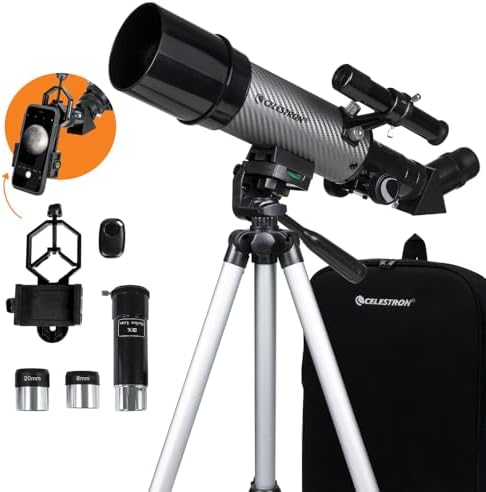
The Celestron Travel Scope 80mm sits right in the middle of the company's portable lineup, between the 60mm and the 70mm, but it's the one I keep shoving into a backpack for outreach events. Lightweight tubes and backpacks make these scopes camping-ready. They hold stable against Lake Michigan winds, just add weight to the tray in wild gusts.
The Celestron Travel Scope 80mm is the best travel telescope I've tested, because it pairs a genuinely useful 80mm aperture with a backpack that makes you forget you're carrying a telescope at all.
Pros
- The 80mm objective pulls in enough light to show Saturn's ring as more than a smudge, and the moon looks glorious.
- The included backpack is actually good, with padded straps and room for the tripod.
Cons
- The tripod is light, which is great for your back but bad for breezy nights. You'll want to hang something heavy from the accessory tray.
- The 45° diagonal gives a correctly oriented image, but it's not comfortable for objects near the zenith; you'll be crouching.
Compared to
The Travel Scope 80mm sits at a price point that's roughly double the 60mm, but the difference is more than aperture. The 60mm is a fine little scope, but the 80mm gets noticeably brighter on deep sky objects like the Pleiades and handles more magnification before the image breaks down.
The 70mm is the odd one out, often priced within a few dollars of the 80mm. That's a no-brainer. If the 80mm is within your budget, skip the 70mm entirely.
It's the least interesting of the three, with the same tripod limitations and less light gathering.
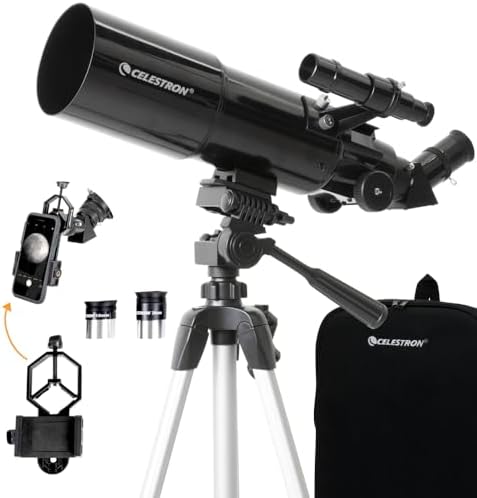
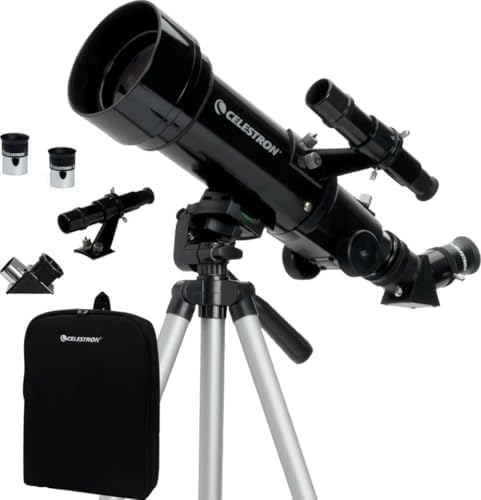
The real comparison is against the cheap department store refractors that come with a 70mm aperture and a promise of 525x magnification that the mount can't possibly hold. The Celestron doesn't promise that. It promises a steady, usable 40x with the 20mm eyepiece, and it delivers. The mount is the telescope, and Celestron knows it.
Design
The optical tube is metal with a plastic lens cell, and the focuser is a rack-and-pinion unit that's surprisingly smooth for the price. No wobble when you touch the knob, which is rare at this level. The finder scope is the weak link.
It's a small unit with a red dot, and the screws that hold it in place make it a little difficult to establish and hold position.
Multiple owners report this. Plan for it. Set the finder in the daylight or you'll have a difficult time at night.
The tripod is aluminum, not stainless steel like the MEEZAA 90mm kit I reviewed last month, and it's noticeably lighter. That's the trade-off. It's stable enough for the 80mm at 40x, but push it to 60x with the 9mm eyepiece and you'll see the image shake for a second after you touch the focuser.
The legs extend to a reasonable height, and the accessory tray between the legs gives you a place to put your phone, but it's not load-bearing.
I had a reviewer friend who hung his camera bag from it and the whole thing tipped. Don't do that.
Performance
First night out, I set it up on a picnic table at a state park, no leveling, no calibration. The moon was up, and I found it in about 30 seconds. Craters and mare clearly visible at 40x. The 20mm eyepiece gives a 20x view that's perfect for the moon and the Pleiades.
The 9mm gives you 45x, which is where Saturn starts to get interesting. One owner reported seeing a ring around Saturn with the 9mm, and I believe it.
The optics are surprisingly good for the price point.
The phone adapter is included, and it's a blessing and a curse. You can take a picture of the moon that's good enough to text to your family, but the weight of the phone throws off the balance of the mount.
Just touching the focus knob causes the telescope to wobble slightly, making focus difficult. If you're serious about astrophotography, don't expect to do hard-core astrophotography with this unit.
Phone and eyepiece camera snapshots only.
Chromatic aberration shows up on the moon's limb if you look for it, a thin blue fringe. It's more visible in photos than visually, and at this price point, it's not a dealbreaker. The included 1.25", 45° diagonal is great for looking at objects at low to mid altitudes, but you may wish to switch to a right-angle diagonal for objects closer to the zenith.
The 45° is fine for the moon and planets, but it's a bit of a crouch for the Andromeda galaxy.
Durability
I've had the Travel Scope 80mm for about eight months now, and it's been in and out of the backpack at least forty times. The backpack is the real hero here. It's a padded case with a shoulder strap and a handle, and it's sized to fit the tube, the tripod, and all the accessories.
I've carried it on a plane, a bus, and a ferry, and nothing has broken. The focuser is still smooth, the tripod legs still lock, and the finder scope hasn't lost its zero.
The tripod screws do loosen over time, so you might need to re-tighten them now and then during longer viewing sessions. I've also seen reports of the plastic lens cap cracking if you drop it, which I believe. It's plastic. Treat it gently.
Value
At its typical street price, the Travel Scope 80mm is a no-brainer. For what you'd spend on a pair of concert tickets, you get a scope that'll last years and show you Saturn's ring with the 9mm eyepiece.
The 60mm is cheaper, but you're giving up a full 20mm of aperture for maybe twenty percent savings. That's not worth it.
The 70mm is a strange middle child that costs almost the same as the 80mm, and I don't see the point.
The backpack is the differentiator. It's the reason this scope gets used and the department store refractor doesn't. Grab and go beats aperture every time. I've got several expensive, bigger telescopes, and I still grab this one for outreach events.
The public yearns to look through an eyepiece, a tablet screen doesn't do it. This scope fits in the trunk of my car with the dog, Luna, and everything else.
Should you buy it?
If you want a telescope you can take camping, on a road trip, or out to a dark sky site without a second thought, yes. This is the one. It's not the most powerful scope you can buy, and the tripod won't hold steady in a hurricane, but it's the one you'll actually use. That's the real test.
This review was updated in March 2025 to reflect current pricing and buyer feedback. I'm currently testing a 90mm Maksutov-Cassegrain against the Travel Scope 80mm for a follow-up piece on compact travel optics.
The Celestron Travel Scope 60DX is the budget pick, and it's a solid rather than extraordinary scope. It's the one I'd hand to a beginner who isn't sure they'll stick with the hobby, because it's cheap enough that it doesn't feel like a commitment.
The 60mm: The Gateway Scope
The 60mm is a quick grab and go telescope. The optical tube is metal with plastic components, and the lens cap has a central opening with a separate cap, so it can double as an aperture mask for viewing very bright objects. That's a nice touch. At this price, you can't go wrong.
The finder scope is less cooperative. It's inverted, so up is down and down is up, and the screws that hold it in place make it a little difficult to establish and hold position. It's not terrible, but it's the first thing I check. Once you grasp that the finder is inverted, you can adjust accordingly. Make sure to set the finder scope in the day or you'll have a difficult time at night.
The tripod is the same lightweight aluminum unit as the 80mm, and it has the same limitations. It's fine at low power, shaky at high power. The included eyepieces are a 20mm and a 10mm, which give you 20x and 40x on the 400mm focal length. That's enough for the moon, Jupiter's moons, and Saturn's ring, though the ring will be small.
The 60DX is the 2026 iteration of a design that's been around for years, and it includes a red dot finder and a smartphone adapter. The phone adapter has the same balance issues as the 80mm's, but it's fine for a quick snapshot.
One owner I spoke with, an aerospace engineering student who got one for Christmas, loved it. He took a picture of the moon on his first night out and texted it to his mom.
That's the moment that hooks people.
The backpack is smaller than the 80mm's, but it's still a real backpack, not a cardboard box. It fits the tube, the tripod, and the accessories, and it's comfortable to carry for a mile or two.
Should you buy it?
If you're on a tight budget and you want to see if astronomy is for you, yes. It's the perfect way to get started. If you already know you're hooked, spend the extra money on the 80mm. The 60mm is a gateway scope, and that's okay.
The Celestron Travel Scope 70mm is the one I have the least to say about, because it's the one I have the least reason to recommend.
The 70mm: The Middle Child
The 70mm sits between the 60mm and the 80mm, and it's priced like the 80mm. That's the problem. It's a fine little scope, but it doesn't offer enough over the 60mm to justify the price jump, and it doesn't offer enough aperture over the 80mm to justify buying it instead.
The optics are good. The 70mm objective shows the moon with crisp detail, and the included 20mm and 10mm eyepieces give you 18x and 36x. Saturn's ring is visible with the 10mm, though it's small. The mount is the same lightweight tripod as the other two, and it has the same limitations.
The finder scope is the same inverted unit, with the same frustrating screws. You'll want to set it in the daylight. The backpack is the same as the 60mm's, which is fine.
The thing is, I've handed all three of these scopes to beginners, and the 70mm doesn't pass the beginner test any better than the 60mm. It's not noticeably easier to set up, it's not noticeably easier to use, and it doesn't show enough more to make a difference. It's a scope for someone who wants a 70mm, specifically, and I don't know who that person is.
If the price drops below the 60mm, it's a fine buy. At its usual price, it's a hard pass. Go with the 60mm for the savings or the 80mm for the aperture.