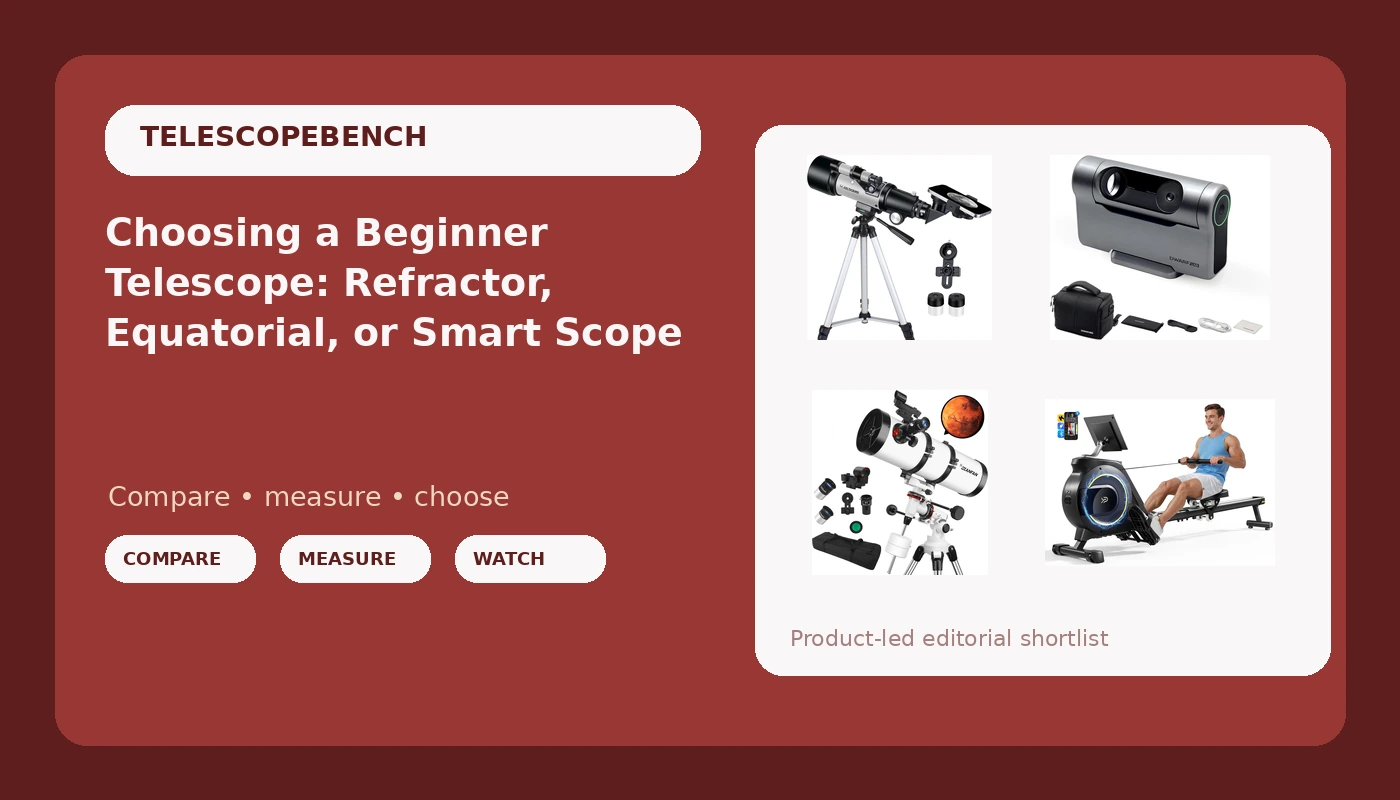
Most people who ask me about a beginner telescope are really asking two questions at once: how much aperture can I afford, and will the thing hold steady enough to be worth carrying outside. Those two questions decide almost everything. A big optical tube on a mount that shakes in a light breeze is a big optical tube you will stop using by October.
This article covers four items that arrived in the same batch: a 150mm-class equatorial package aimed at adults, a 70mm travel refractor with a tripod and a phone adapter, an app-controlled smart telescope built for imaging, and one item that is not astronomy gear at all. I will say that plainly now rather than bury it further down. The rowing machine in this set has nothing to do with the night sky, and I will describe it honestly as what it is.
For everything else, the reasoning below is the same reasoning I use when someone hands me a scope at a public star party and asks whether they should keep it.
Related: Why the Mount Matters More Than Magnification →
Quick answer
A beginner telescope is only as good as the mount under it and the sky you can reach from your own yard. If you want to look through an eyepiece, buy the largest aperture you can carry and store on a mount that does not wobble. If you want pictures without a steep learning curve, an app-controlled smart telescope is the more realistic path, because it handles the tracking and the imaging for you. A 70mm refractor is a travel and quick-look instrument, not a substitute for aperture. None of these replace a star chart, a red flashlight, and a few nights of practice.
4 useful options
| Model | Best fit | What stands out |
|---|---|---|
| Dianfan 150EQ Professional Astronomy Telescope for Adults High Powered | Adults who want aperture and will learn an equatorial mount | 150mm-class aperture and an EQ mount, per the model designation |
| Telescope 70mm Aperture 400mm Astronomical Refracting Telescopes - Travel Telescope with Tripod, Phone Adapter(Silver) | Travel, camping, and first looks with a phone camera | Compact 400mm refractor that ships with a tripod and phone adapter |
| DWARFLAB Dwarf 3 Smart Telescope, App-Controlled Astrophotography Camera | Backyard imaging without a separate mount or camera | Self-contained imaging device controlled entirely from an app |
| Rowing Machine for Home, 350 LB Capacity, 16-Level Silent Resistance, Magnetic Rowing Machines for Home Foldable, Full-Body Workout Compact Rowing Machine for Cardio & Strength with APP Support | Indoor cardio, not astronomy | 350 lb capacity, 16 magnetic resistance levels, folds for storage |
The aperture option: Dianfan 150EQ Professional Astronomy Telescope for Adults High Powered
Aperture is the single most important spec in a telescope, and 150mm of it gathers far more light than a 70mm refractor, roughly four to five times the collecting area. That difference is the difference between seeing a smudge and seeing structure in a galaxy. The trade is the equatorial mount. An EQ mount tracks by turning one slow-motion knob, which is wonderful once it is pointed and polar aligned, and genuinely confusing the first two or three times you set it up. Budget for that learning curve. Also plan on replacing the eyepiece that ships with it, because the included eyepiece is a suggestion, not a tool.
The travel option: Telescope 70mm Aperture 400mm Astronomical Refracting Telescopes - Travel Telescope with Tripod, Phone Adapter(Silver)
This is the scope I would hand to a kid on a camping trip, and I mean that as a compliment. It fits in a backpack, it sets up in a minute, and the phone adapter lets someone capture a quick lunar shot to show a friend. What it will not do is show you faint galaxies or resolve globular clusters, because 70mm of aperture simply cannot collect that much light. The other thing to watch is the tripod. Small refractors on lightweight tripods vibrate every time you touch the focuser, and a wobbly mount ruins a good lens faster than anything else in this hobby.
The imaging option: DWARFLAB Dwarf 3 Smart Telescope, App-Controlled Astrophotography Camera
Smart telescopes have changed who gets into imaging. The old path meant a mount, a tube, a camera, a guide scope, and a laptop, and most people quit somewhere around step three. This class of device collapses that into one box and an app, which is a real gain. The honest trade is that you are not looking through it. There is no eyepiece, no photon-to-eyeball moment, and no quiet time under the stars in the traditional sense. Some people love that. Others buy one, use it three times, and miss the eyepiece. Know which person you are before you spend the money.
The one that is not astronomy gear: Rowing Machine for Home, 350 LB Capacity, 16-Level Silent Resistance, Magnetic Rowing Machines for Home Foldable, Full-Body Workout Compact Rowing Machine for Cardio & Strength with APP Support
I have nothing against rowing machines. I have something against lists that pad themselves with unrelated products to look bigger. If you came here for a telescope, skip this one. If you happen to want a compact cardio machine for the nights when the sky is socked in with clouds, it is a folding magnetic rower with a 350 lb capacity rating and 16 resistance levels, and that is the whole story. Do not let it distract you from the actual decision, which is about aperture, mount, and whether you want a screen or an eyepiece.
Prices and availability may change. Product images, names, and retailer links must be matched by verified ASIN. Do not state a current price, rating, stock status, or measured result without current evidence.
Aperture, focal length, and the magnification trap
Aperture is the diameter of the main lens or mirror, and it is the number that decides how much light reaches your eye. A 70mm scope and a 150mm scope are not in the same category. Light gathering scales with the area of the aperture, so moving from 70mm to 150mm multiplies the collected light several times over. That is why faint fuzzies stay faint in a small refractor no matter how long you stare.
Focal length is the second number, and it sets the magnification when you divide it by the eyepiece focal length. A 400mm tube with a 10mm eyepiece gives 40x. A 400mm tube with a 4mm eyepiece gives 100x, which is about the ceiling for a 70mm lens on an average night, and pushing past it just produces a bigger, blurrier image.
This is why "500x magnification" printed on a box is a warning sign, not a feature. Useful magnification tops out at roughly twice the aperture in millimeters under decent seeing, so a 70mm scope has a practical limit near 140x on a perfect night and much less when the atmosphere is churning. Manufacturers who advertise huge numbers are selling a number, not a view.
The mount is the telescope
Everything above assumes the mount can hold the tube still. An equatorial mount is the classic solution for tracking: once you polar align it, you turn one knob and the scope follows the sky's rotation. That is a genuine advantage for high-power viewing and for any kind of long exposure imaging. The cost is setup time and a coordinate system that takes a few sessions to internalize.
Simpler alt-az mounts, including the Dobsonian style, trade tracking for ease. You push the tube where you want it, and you nudge it every few seconds at high power. Most beginners have a better first year with a simple mount and more aperture than with a complicated mount and less.
Tripod quality decides the rest. Thin aluminum legs, a plastic head, and a light tube add up to visible shake every time you focus or breathe on the eyepiece. If you can only upgrade one thing, upgrade the thing holding the scope.
- Decide first whether you want to look through an eyepiece or collect images on a screen. That single answer eliminates half the options.
- Measure where the scope will live and how far you must carry it. A scope that needs two trips to the yard gets used far less.
- Set a budget that includes one decent eyepiece and a star chart, not just the tube.
- Check your sky. If you observe from a bright suburb, aperture helps less than a short drive to darker ground.
- Try before you buy. A club star party will teach you more in one night than a month of reading.
Practical guidance before you spend anything
- Weight the mount heavily in your decision. A great optical tube on a shaky tripod is a tube you will not use.
- Assume the included eyepiece will be replaced. That is normal, not a defect.
- Store the scope assembled and near the door, so it comes out in one trip.
- Learn five bright stars and how to star-hop between them. GoTo is a convenience, not a substitute for knowing the sky.
- Pick up Turn Left at Orion or NightWatch and read the first two chapters before your first session.
- Join a local astronomy club if there is one nearby. Used gear from club members is often the best value in the hobby.
Which option should you choose?
Choose the Dianfan 150EQ Professional Astronomy Telescope for Adults High Powered when you want the most aperture in this batch, you are willing to learn an equatorial mount, and you have a place to store a full-size instrument. Choose the Telescope 70mm Aperture 400mm Astronomical Refracting Telescopes - Travel Telescope with Tripod, Phone Adapter(Silver) when portability matters more than reach, or when you want a low-risk first scope for a child or a camping trip. Choose the DWARFLAB Dwarf 3 Smart Telescope, App-Controlled Astrophotography Camera when you want images rather than eyepiece views and you would rather let an app handle the tracking. Choose the Rowing Machine for Home, 350 LB Capacity, 16-Level Silent Resistance, Magnetic Rowing Machines for Home Foldable, Full-Body Workout Compact Rowing Machine for Cardio & Strength with APP Support only if you actually want a rowing machine, because it has no role in astronomy.
One caveat on everything above: these descriptions are based on the supplied product names and what their designations indicate, not on a night of observing with each unit. Treat the aperture and mount notes as what the naming implies, and verify specifications on the product page before you commit.
The bottom line
The beginner telescope decision is not really about brand names. It is about matching aperture to your sky, matching the mount to your patience, and matching the whole package to the storage and carrying you can honestly live with. In this batch, the 150EQ offers the most light-gathering on a mount that rewards a little study, the 70mm refractor is the one that fits in a backpack, and the Dwarf 3 is the one that puts the hobby on a screen. The rowing machine is a rowing machine. Pick the trade you can live with on a Tuesday night in February, because that is the night that decides whether the scope stays in your life.