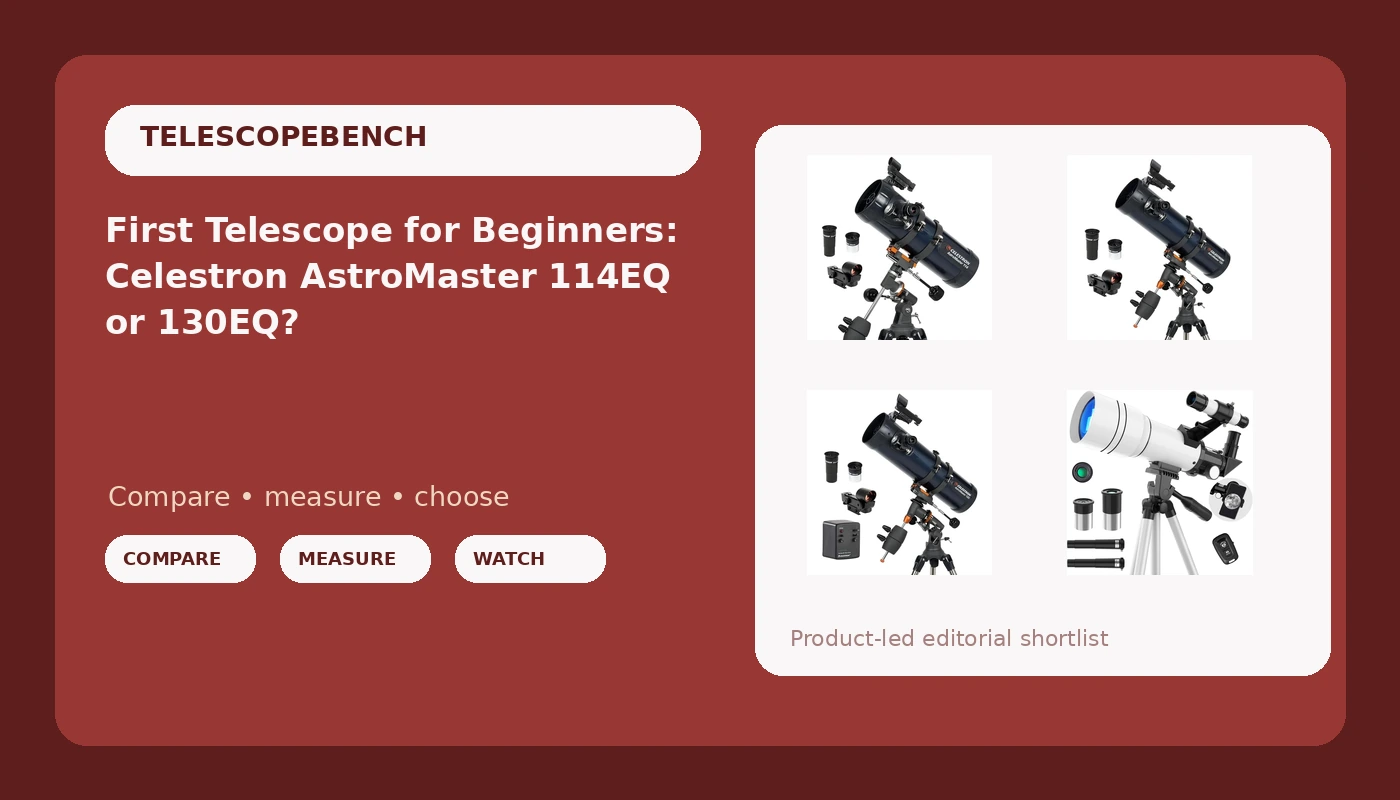
Shopping for a first telescope for beginners is where most astronomy hobbies are either born or buried, and the difference usually is not the brand on the tube. It is whether the scope shows you something worth staying up for in the first week: craters along the lunar terminator, the rings of Saturn, a double star split cleanly at 100x. A telescope that delivers that keeps you coming back outside. A telescope that delivers a shaky, dim smudge gets retired to a closet by spring, and the person who bought it decides astronomy is boring rather than deciding that particular scope was the problem.
The four telescopes here sit at very different points on that curve. One is a compact 70mm refractor with a phone adapter and a wide magnification range. Three are Celestron AstroMaster Newtonian reflectors on equatorial mounts, two of them 130mm and one 114mm, with the third of those adding a motor drive so the scope tracks the sky for you. This is not a ranking. It is an explanation of what each design does well, what it asks of you, and which one fits the way you actually observe.
Related: How to Set Up an Equatorial Mount Without Losing Your Mind →
Quick answer
Aperture and mount decide what you see; the rest of the spec sheet is detail. The 70mm refracting telescope is the lightest and simplest of the four and needs no mirror alignment, so it is the easiest place to start and the easiest to carry. The Celestron AstroMaster 114EQ and 130EQ are Newtonian reflectors on equatorial mounts, and the 130mm versions gather more light than the 114mm, which matters most on deep-sky objects. The AstroMaster 130EQ-MD adds motorized tracking to the 130mm optical tube, so whatever you are looking at stays in the eyepiece instead of drifting out while you wait your turn.
Four useful options
| Model | Best fit | What stands out |
|---|---|---|
| Telescope for Kids and Adults, 70mm refractor | A first scope that is light, simple, and shared with kids | 70mm aperture, 300mm focal length refractor with 15X-150X magnification, fully multi-coated optics, and a phone adapter |
| Celestron AstroMaster 114EQ | Family stargazing on a modest budget | 114mm aperture Newtonian reflector on an equatorial mount |
| Celestron AstroMaster 130EQ | Deep-sky beginners who want more light gathering | 130mm aperture Newtonian reflector on an equatorial mount |
| Celestron AstroMaster 130EQ-MD | Observers who want the mount to track for them | 130mm aperture Newtonian reflector with motorized tracking |
The simplest entry point: Telescope for Kids and Adults, 70mm refractor
The appeal of a refractor at this size is that light enters the front lens and goes straight to the eyepiece. There is no secondary mirror to knock out of alignment and no collimation ritual before every session, which is a real advantage for a scope that gets handed to a nine-year-old. It is also the only telescope in this group with a phone adapter included, and shooting a short video of the Moon through the eyepiece is a genuinely good way to keep a kid interested in the hobby.
The trade-off is aperture, and it is not a small one. A 70mm objective simply does not collect the light that a 114mm or 130mm mirror does, so galaxies and nebulae that look like faint gray smudges in the bigger scopes look like nothing at all here. The 300mm focal length also means the scope is built for wide, bright targets: the Moon, the brighter planets, the Orion Nebula, the Pleiades, daytime terrestrial viewing. It will show you Jupiter as a disc with a hint of its moons. It will not show you spiral structure in a galaxy, and no magnification number will change that.
The family reflector: Celestron AstroMaster 114EQ
Moving from 70mm to 114mm is a bigger jump than the numbers suggest. Light gathering scales with the area of the objective, not its diameter, so the 114mm mirror collects far more light than a 70mm lens. That extra light is what turns a faint smudge into a shape you can actually describe, and it is why reflectors dominate beginner recommendations once the budget allows.
What you accept in exchange is maintenance and setup. Newtonian reflectors need their mirrors aligned, and the equatorial mount has to be pointed at the celestial pole before it tracks properly. Neither task is difficult, but both take practice, and a beginner who skips polar alignment will find that the scope drifts out of the field of view and the slow-motion controls feel like they fight back. This is the mount-first reality of any equatorial telescope: the optics are fine, but the mount decides whether the session is pleasant or exhausting.
The deep-sky option: Celestron AstroMaster 130EQ
The 130mm mirror is the largest aperture in this group, and for visual observing that is the number that matters most. Globular clusters start to resolve into individual stars instead of looking like fuzzy balls. The Ring Nebula and the Dumbbell Nebula become recognizable objects rather than targets you suspect you might have found. Open clusters, which are the best first deep-sky targets for any beginner, look genuinely impressive.
The mount is essentially the same class of equatorial mount as the 114EQ, which means the same requirement: learn polar alignment, or spend every session nudging. A larger aperture also means a slightly larger tube, so this is not the telescope you carry out in one hand with a cup of coffee in the other. If your observing spot is a balcony or a small backyard with a clear view of the southern sky, that is fine. If it is a two-block walk to a dark field, think honestly about how many trips you are willing to make.
The tracking option: Celestron AstroMaster 130EQ-MD
Tracking is the quality-of-life feature that experienced observers stop noticing and beginners notice immediately. Without a motor, a planet at high magnification drifts across the field of view in seconds, and every observer change means re-centering the object before the next person can look. With the motor drive running, the object stays put. For a family scope where four people are queuing up to see Saturn, that difference is enormous, and it is the main reason to pay more for the same 130mm aperture.
The catch is that tracking only works if the mount is polar aligned reasonably well. A motor drive on a misaligned equatorial mount does not fix the drift; it just moves the drift somewhere else. So this scope rewards the beginner who is willing to spend twenty minutes learning how the mount points at the pole, and punishes the one who is not. If the idea of alignment homework sounds like a dealbreaker, the motor is not the feature you should be paying for.
Prices and availability may change. Product images, names, and retailer links must be matched by verified ASIN. Do not state a current price, rating, stock status, or measured result without current evidence.
Why aperture beats magnification on the spec sheet
Magnification is the number printed largest on the box and the least useful number in the decision. A telescope's useful magnification is limited by its aperture, roughly 50x per inch of objective diameter under good seeing conditions. A 70mm objective is about 2.75 inches, so somewhere around 140x is the practical ceiling, which means the top of that 15X to 150X range is already at the edge of what the optics can support on a steady night. A 114mm or 130mm mirror supports noticeably more, and more importantly, it supports brighter images at every magnification.
This is why the "500x" or "600x" claims on department-store scopes are a warning sign rather than a selling point. Empty magnification, where the image gets bigger and mushier with no added detail, is the fastest way to convince a new observer that the Moon is boring. What you want is the largest aperture you will actually set up, used at magnifications the atmosphere will allow. On most nights in most backyards, that ceiling is set by the air, not the telescope.
The eyepieces in the box deserve a mention too. Kit eyepieces are functional but rarely comfortable, with tight eye relief and narrow apparent fields. Budgeting for one decent wide-field eyepiece and one higher-power eyepiece will improve a beginner's experience more than any other single purchase, and those eyepieces move with you to the next telescope.
What an equatorial mount actually asks of you
An equatorial mount has one axis pointed at the celestial pole and one axis for declination. Once that polar alignment is done, following any object means turning a single knob, which is why equatorial mounts are the traditional answer for tracking. The catch is the alignment step itself, and it is the step beginners skip.
Motorized tracking, as on the AstroMaster 130EQ-MD, builds on the same principle: the drive turns the polar axis at the same rate the sky appears to rotate. It is not GoTo. There is no hand controller database finding objects for you, no automatic alignment routine. You still find targets yourself, with a finder and a star chart, which is a skill worth having and the reason a paper atlas like Turn Left at Orion stays useful long after the scope arrives.
- Decide what you actually want to look at: Moon and planets, or faint deep-sky objects.
- Set a total budget that includes at least one replacement eyepiece, not just the telescope.
- Judge the mount before the optics, since a steady mount is what makes higher magnification usable.
- Decide honestly whether you will learn polar alignment, because every equatorial scope here depends on it.
- Measure the storage spot and the walk to your observing site before committing to a tube size.
Practical guidance for the first month
- Keep the telescope assembled and near the door. A scope that takes three trips to set up gets used once a month.
- Let the optics reach outdoor temperature before you judge the view, since a warm mirror or lens shows soft, wobbly images.
- Start every session at the lowest magnification you have, find the target, then step up power once it is centered.
- Observe the Moon when it is a crescent or quarter rather than full, when shadow along the terminator reveals crater detail.
- Get away from porch lights and give your eyes twenty minutes to dark adapt, because aperture cannot fix a light-polluted view.
Which option should you choose?
Choose the Telescope for Kids and Adults, 70mm refractor when you want the lightest, simplest possible start with no mirror alignment, and your main targets are the Moon, the brighter planets, and daytime views with a phone adapter along for the ride. Choose the Celestron AstroMaster 114EQ when family stargazing is the goal and you want a real reflector's light gathering without stepping up to the largest tube in the group. Choose the Celestron AstroMaster 130EQ when deep-sky objects are the point and you want the most aperture here, accepting that you will learn polar alignment to get the most from it. Choose the Celestron AstroMaster 130EQ-MD when you want that same 130mm aperture but with motorized tracking, so objects stay centered while several people take turns at the eyepiece.
A caveat worth stating plainly: these are descriptions of the designs and the specifications each product is sold with, not a claim that one telescope will outperform another on any given night. Seeing conditions, light pollution, eyepieces, and how well the mount is aligned will change what you see far more than the difference between two adjacent apertures. Any of these scopes can disappoint if it stays in the closet, and any of them can be the telescope that gets someone hooked.
The bottom line
For a first telescope for beginners, buy the largest aperture you will genuinely carry outside, and accept the mount that comes with it. The 70mm refractor is the easiest on-ramp and the most forgiving of neglect. The Celestron AstroMaster 114EQ is the modest step into reflector territory. The 130EQ is the aperture pick for deep-sky work. The 130EQ-MD is the same aperture with tracking, and tracking is what makes a shared scope pleasant instead of frantic. Check the current Amazon price on each and match the scope to the observing you will actually do, not the observing you imagine doing.