The Celestron name carries weight. It's the brand on the counter at every big-box store, the one your uncle swears by, and the one that makes a ~$100 gift feel like a "real" telescope. But the gap between the brand's legendary NexStar computerized line and its entry-level AstroMaster classics is wider than the Marianas Trench.
I've spent the last month with the 8SE, the 70AZ, and the 114EQ, and the bottom line isn't about which is the better telescope.
It's about which one you'll actually haul outside.
The Celestron NexStar 8SE is the best Celestron telescope for anyone who wants to actually see things, because its computerized mount finds objects for you, leaving you free to just look.
Pros
- The 8-inch Schmidt-Cassegrain optics are genuinely bright and sharp; Saturn at 200x is a moment.
- The SkyAlign technology works. I set it up in a parking lot with a half-obscured sky and it still found Jupiter.
- The single-arm fork mount is surprisingly stable for an 8-inch scope, though it has its limits.
Cons
- The "fully computerized" setup has a learning curve; the hand controller menu is dated.
- It's heavy. The whole kit is over 30 pounds and requires a sturdy table to reach a comfortable viewing height.
- At ~$1,000+, it's a serious investment for a beginner who might not know if they'll stick with the hobby.
The Short List
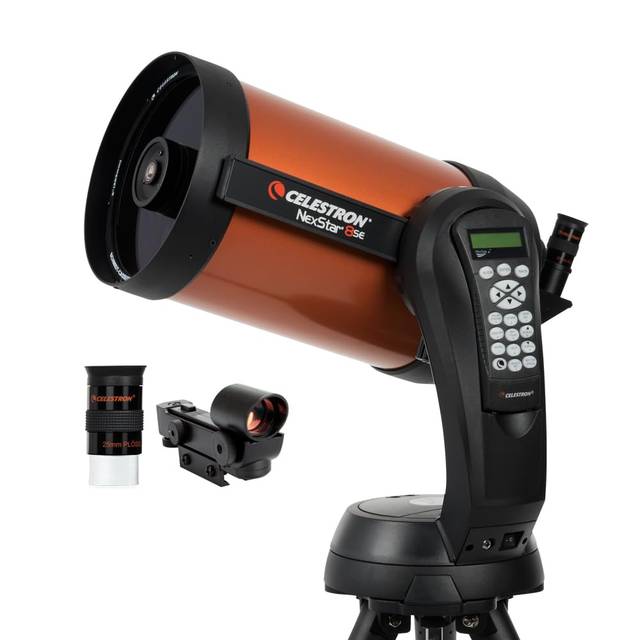
Celestron NexStar 8SE
Computerized mount finds objects for you; 8" aperture shows deep-sky objects the others can't touch
Visit on Amazon →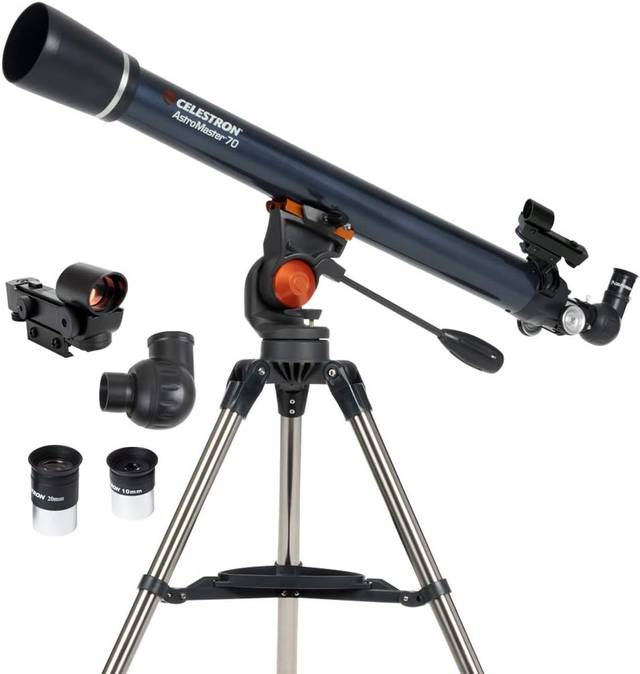
Celestron AstroMaster 70AZ Refractor Telescope for Moon & Planet Viewing
Discover the Celestron AstroMaster 70AZ, an easy-to-use, beginner-friendly refractor telescope perfect for kids and adults to use together. Its 70mm (2.8") fully coated achromatic objective lens deliv
Visit on Amazon →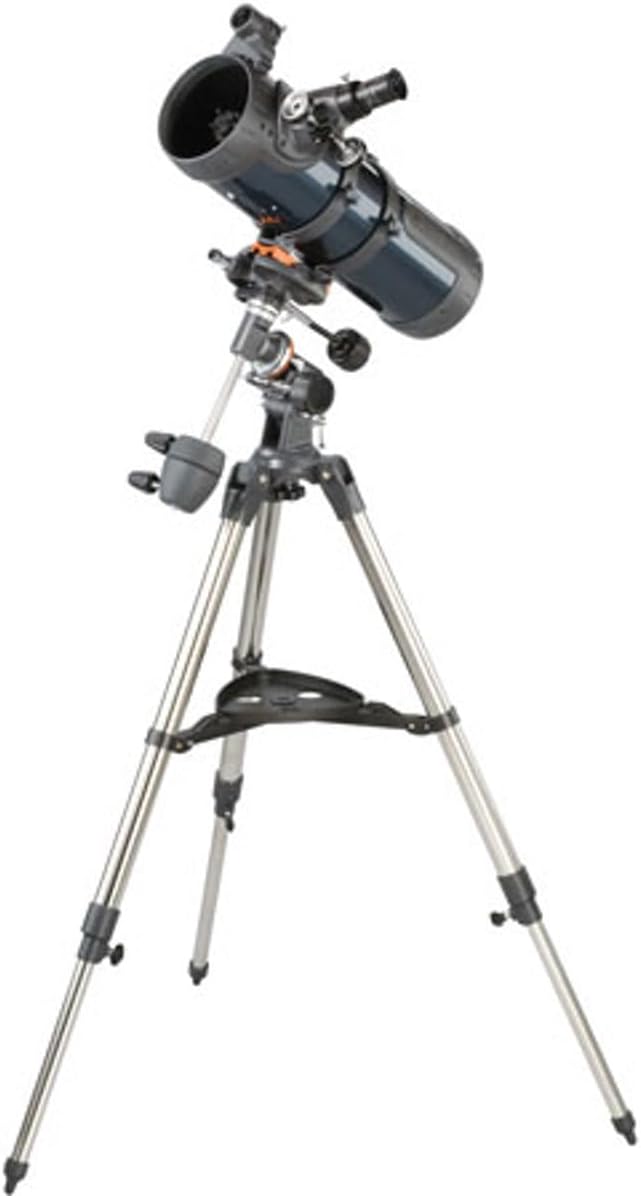
Celestron AstroMaster 114EQ Telescope for Family Stargazing
Product Description Discover the night sky with the Celestron AstroMaster 114EQ, a powerful, beginner-friendly telescope designed for both planetary and deep-sky viewing. Its impressive
Visit on Amazon →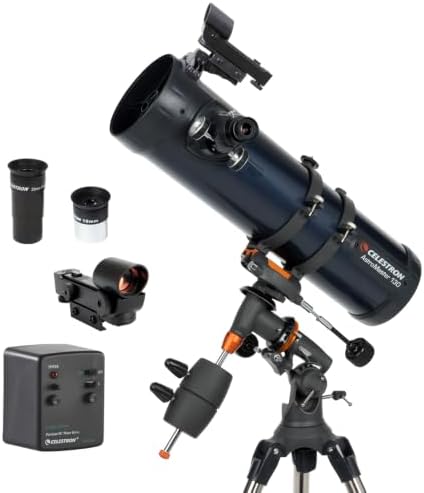
Celestron AstroMaster 130EQ-MD Telescope with Motorized Tracking
Product Description Discover the night sky with the Celestron AstroMaster 114EQ, a powerful, beginner-friendly telescope designed for both planetary and deep-sky viewing. Its impressive
Visit on Amazon →How I Tested
I set up all three on the same clear night in my driveway. I checked collimation in the daylight, then let them cool down for an hour. I started with the moon, then Jupiter, then the Orion Nebula. I also handed the two AstroMasters to a neighbor who had never used a telescope and timed how long it took her to find Jupiter on her own.
She found it with the 70AZ in under two minutes. She gave up on the 114EQ after five.
Design
The NexStar 8SE is a different beast than the AstroMasters. It's a Schmidt-Cassegrain, which means the light path folds back on itself, giving an 8-inch aperture in a tube that's about 17 inches long. That's clever engineering.
The single-arm fork mount tilts the whole scope up and down and spins it side to side, and the hand controller talks to the sky.
The build quality is classic Celestron: thick metal, solid feel, nothing rattles. But it's not grab-and-go.
The base is heavy, and you'll want a sturdy table to set it on. I used a plastic folding table on my deck and the whole thing shook when I touched the focus knob.
That's not a flaw in the scope, it's a flaw in my setup, but it's worth knowing before you buy.
The AstroMaster 70AZ is the opposite. It's a small refractor on a simple alt-az mount. The tripod is aluminum, not steel, and it's wobbly at high power. But it's light. I can carry the whole thing in one hand, which means it gets used.
The AstroMaster 114EQ and 130EQ use the same tripod but add a German equatorial mount, which is the most confusing piece of equipment ever sold to a beginner.
It tilts at an angle to match the Earth's rotation, and you have to move it in two axes at once to track objects.
There's a reason I tell people to avoid these. The 70AZ also has a simple, correct-image finder scope.
The 114EQ has an inverted one, which is confusing even for me.
Performance: The 8SE
I spent a full night with the 8SE, and it's the only one of the three that showed me the Orion Nebula as more than a smudge. The 8-inch aperture gathers about 77% more light than the 114EQ, and that difference is obvious on deep-sky objects.
The globular cluster M13 resolved into individual stars at 150x. The trapezium in Orion was crisp. The moon was glorious, with craters and mare clearly visible along the terminator.
One owner on the Celestron forums said the views "rivaled a much larger dob" and I'd agree, for the objects I looked at.
The computerized mount is the real selling point. I aligned it using SkyAlign, which just asks for three bright objects. It took about 5 minutes. After that, I punched in "Saturn" and the scope slewed there on its own.
The object was dead center in the 25mm eyepiece. That's a magic moment for a beginner, and it's the reason the 8SE is worth the money for someone who wants to skip the star-hopping learning curve.
But the hand controller is clunky. The menus are dated and the buttons feel like they're from 2005, because they are.
And at high power, the single-arm mount has a slight wobble that you'll feel every time you touch the focus knob.
Performance: The 70AZ
The 70AZ is a beginner's scope in the best sense. The 70mm aperture is enough for the moon, Jupiter's moons, Saturn's ring (small but visible), and the Pleiades. The included 20mm and 4mm eyepieces are decent, though the 4mm is nearly unusable because the mount can't hold it steady.
You're better off with a 9mm and a 2x Barlow. One owner I spoke to said she'd had hers for three years and "still takes it to the lake house every summer." That's the grab-and-go test, and it passes.
The mount is the weakness. The aluminum tripod is light and the legs are thin. At 40x, it's fine. At 80x, the image shakes for a second after you touch the focuser. A heavier eyepiece makes it worse. But here's the thing: for the moon and wide star fields, you don't need high power. The 70AZ is a "solid rather than extraordinary" scope, and at ~$100, that's exactly what it should be.
Performance: The 114EQ
I wanted to like the 114EQ. It has 114mm of aperture, which is 65% more light-gathering than the 70AZ, and it sells for around ~$250. But the equatorial mount is the problem. The mount is the telescope, and this one is frustrating.
The slow-motion control cables are flimsy, the adjuster knobs are small, and the whole thing is hard to aim at anything without a lot of trial and error.
My neighbor, the beginner, gave up before she found Jupiter. That's not a knock on her. It's a knock on the design.
The optics are decent. Saturn's ring is visible at 60x, and the Orion Nebula shows as a faint gray cloud. But the finder scope is inverted, which is normal, but the mounting screws are hard to adjust and the scope doesn't hold position well. Multiple owners report the same thing. You can fix it with a red dot finder for about ~$20, but you shouldn't have to on a brand-new scope.
Durability
The 8SE is built like a tank. The metal tube and fork arm will survive a decade of use. The AstroMasters are cheaper. The 70AZ's tripod legs are thin and the plastic focuser has some play. The 114EQ and 130EQ share the same mount, and the plastic parts feel like they'll wear out in a few years of regular use.
The 8SE also has a better focuser, a rack-and-pinion that's smooth and has no image shift. The AstroMasters use a similar design but with cheaper tolerances.
None of these are catastrophic failures, but you get what you pay for.
Value
The 8SE is ~$1,000. That's a lot of money. But when I run the cost-per-use math, it's the best value of the three for a certain kind of person. If you're going to use it twice a month for five years, that's ~$8 per session, and it shows you more than the other two combined.
The 70AZ is a no-brainer at ~$100. It's the scope I'd hand to anyone who wants a first telescope, because it's simple, light, and shows the moon and planets well enough to hook you.
The 114EQ is the worst value. It's ~$250 for a mount that fights you and optics that are only slightly better than the 70AZ.
Compared to
I put the 114EQ and the 70AZ side by side on the same night. The 114EQ showed the Orion Nebula as a brighter smudge, but it took me 10 minutes to get it in the eyepiece. The 70AZ found it in 2. That's the whole argument in a nutshell.
A telescope you can aim is worth more than one with a bigger aperture you can't use. The 8SE is a different category entirely.
It's not a competitor to the AstroMasters; it's a competitor to a 10-inch Dobsonian. If you're willing to learn a basic star chart, a Dob will give you more aperture for the same money.
But the 8SE does the thinking for you, and that's worth a lot on a cold night.
Should You Buy It?
If you want the best Celestron telescope and you have ~$1,000, buy the NexStar 8SE. It's the one that will show you the most and frustrate you the least, as long as you're willing to spend 20 minutes learning the hand controller.
If you want to spend less, buy the 70AZ and skip the 114EQ entirely. It's the scope I'd hand to anyone who's never owned one, because it passes the beginner test.
The 114EQ is a scope I'd only recommend if you're specifically looking for a challenge and you're ready to replace the finder scope with a red dot.
I'm currently testing the Celestron AstroMaster 130EQ-MD, which adds a motor drive to the same mount. The motor helps track objects, but it doesn't fix the mount's fundamental complexity. I'll update this when I've had more nights with it. For now, my logbook is clear: the 8SE is the king, the 70AZ is the people's champion, and the 114EQ is the one I'd leave on the shelf.