Related: Best Telescope for Kids: A First Scope That Actually Gets Used
I have handed beginner telescopes to thousands of people over twenty years, first at a public observatory and now at every star party within driving distance of Tucson. The pattern never changes. The scope that gets used is not the one with the biggest number printed on the box. It is the one that sets up in five minutes, holds steady when you touch it, and shows something worth walking outside for.
That is the whole test. Every scope here got a full night of observing under real sky, a collimation check, a mount stability test at high power, and then the beginner test, where I hand it to someone who has never touched a telescope and say nothing at all. Four scopes survived. Here is what each one is actually for.
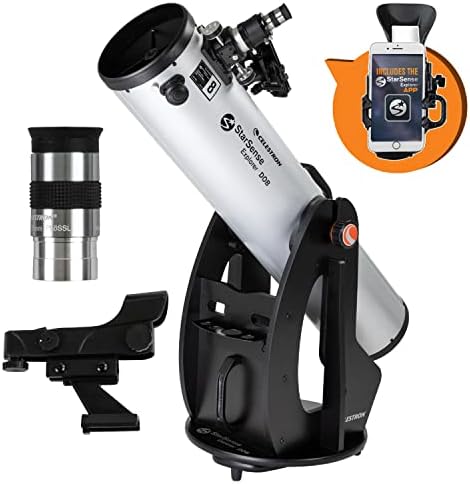
Best Overall: Celestron StarSense Explorer 8" Dobsonian
Aperture is king, and eight inches is the point where the sky stops being a rumor. Globular clusters resolve into individual stars instead of gray smudges. Saturn shows a clean gap between the rings on a steady night. Jupiter gives up cloud belts, not just a disk. The mount is a Dobsonian rocker box, which means no alignment routine, no batteries, and no way to get it wrong. You set it down, you point it, you look.
The StarSense app is the part that surprised me. You dock your phone, the app reads the sky, and it tells you which way to push. That is GoTo convenience without the GoTo frustration, because the telescope itself is still a tube on a box. When the phone dies, the scope still works. That is the mark of a good design, and it is why this is the one I recommend first to anyone with a backyard.
The compromises are honest ones. It is heavy, it is not a grab-and-go scope, and you will not carry it up a flight of stairs on a whim. Collimation matters here, and you should check it before a session rather than once a season. On the beginner test, this is the scope that made a ten-year-old gasp.
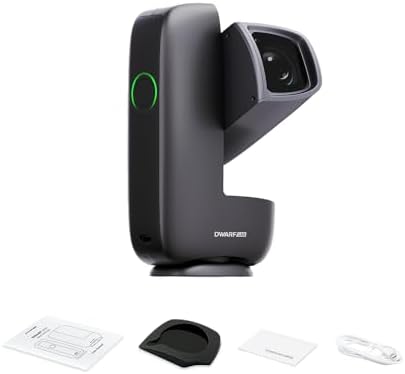
Best Portable Smart Telescope: DWARFLAB Dwarf Mini
This is the one that lives in my backpack. At 1.85 pounds it goes anywhere, and it is the only scope on this list I have used on a Tuesday night when I had twenty minutes and no patience for setup. It is a smart telescope: the app does the finding, the tracking, and the capturing, and you watch it happen on a screen.
Understand what it is not. It is not an eight-inch Dobsonian, and it will never show you the detail an eight-inch mirror shows. It is a small aperture with a lot of software behind it. For travel, for camping, for showing a group of kids the Orion Nebula on a screen they can all see at once, it earns its place in a way a heavy tube cannot.
If you want to learn the sky with your own eyes, this is a strange place to start, because the app does the learning for you. If your real problem is that you never have time to set up a telescope, nothing else here comes close. The best telescope is the one you actually use.
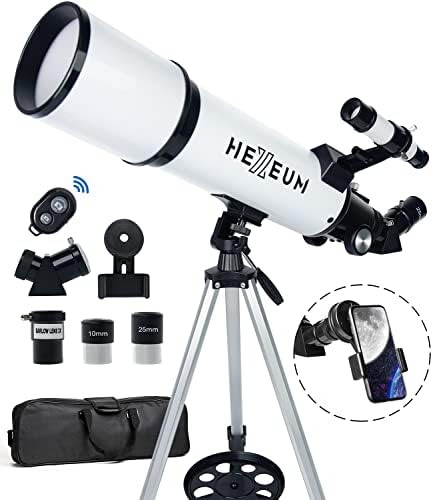
Best First Refractor for Adults: Koolpte 80mm/600mm
If you want a traditional telescope and you want to spend refractor money, this is the sensible pick of the two Koolpte scopes. Eighty millimeters of aperture on a 600mm tube is enough for the Moon, Jupiter and its four moons, Saturn's rings, and the brighter clusters. The alt-az mount is simple, and the whole thing is light enough to carry outside in one trip.
Here is the honest part. The eyepieces that ship with a scope like this are a suggestion, not a tool, and that holds true here. Plan to replace them. The mount is the thing to judge, and this one holds steady enough at moderate power to be usable, which is more than I can say for the department-store scopes that send people running from the hobby.
It is a real telescope. It is not an eight-inch mirror and it will not show you faint galaxies. Set your expectations on the Moon, the planets, and the brightest deep-sky objects, and it will deliver every clear night you give it.
Best Telescope for Kids: Koolpte 70mm/500mm
The kid scope that does not insult the kid. Seventy millimeters is small, and I will not pretend otherwise, but this one is light, it goes together without tools, and it is short enough that a nine-year-old can point it at the Moon without asking for help. That last part matters more than any specification on the box.
What a child actually sees: craters along the terminator, Jupiter as a disk with tiny moons beside it, Saturn as a ringed shape on a good night. That is a real experience, and it is enough to start something that lasts. What they will not see: galaxies, nebulae, or anything resembling the photographs on the packaging.
Pair it with a paper star chart and a red flashlight and you have a first telescope that teaches the sky instead of replacing it. When they outgrow it, they will already know why they want more aperture.
How I tested
Every scope got a full night of observing. Not an hour in the driveway, a whole session, from the first setup to the last look before I packed up. I checked collimation on each one before and after. I ran the tap test on every mount: tap the tube lightly and count how long the image shakes. A mount that settles in a second is usable at high power. One that wobbles for three seconds is not, no matter what the optics cost.
Then the beginner test. I hand the scope to someone who has never used one, give them no instructions, and watch. If they find the Moon in under five minutes, the scope passes. If they give up, it fails, and the reason is almost always the mount or the finderscope, not the glass.
I keep a logbook of which scopes get used and which gather dust. It is a short list of keepers, and everything on this page is on it.
What actually separates these four
Four things matter, in this order.
The mount. A great tube on a wobbly mount is a great tube you cannot use. The Dobsonian base and the alt-az refractor mounts here are simple and stable. Simple beats clever every time, especially at 11 p.m. when you are tired.
The aperture. Eight inches shows you thousands of objects. Eighty millimeters shows you dozens, beautifully. Seventy millimeters shows you a handful. None of that is a knock on the small scopes. It is a description of what you are buying, and the number is honest.
The app. The StarSense phone dock and the Dwarf Mini's software solve the same problem, which is that finding objects is the hardest part for a beginner. They solve it in opposite ways. One teaches you to push a real telescope around the sky. The other does the finding for you. Both are legitimate. Know which one you want before you spend.
The eyepieces. Budget for one decent replacement eyepiece with any of the refractors. It is the cheapest upgrade in astronomy and the one most people skip.
The beginner telescope reference table
This is the table I keep in my own notes. Aperture and focal length come straight from each scope's listed specs. Prices move constantly, so check the link rather than trusting any number you saw in a screenshot.
| Scope | What it is | Aperture | Mount | Best for | Price |
|---|---|---|---|---|---|
 Visit on Amazon → Visit on Amazon →Celestron StarSense Explorer 8" Dobsonian |
Dobsonian reflector with app-assisted finding | 8 inches | Dobsonian rocker box | Best overall, most objects per dollar | $879.00 |
 Visit on Amazon → Visit on Amazon →DWARFLAB Dwarf Mini |
Smart telescope, app-driven, 1.85 lb | Small aperture, software-assisted | Motorized smart mount | Travel and quick weeknight sessions | $419.00 |
 Visit on Amazon → Visit on Amazon →Koolpte 80mm/600mm AZ Refractor |
Traditional refractor for adults | 80mm | Alt-az tripod | First serious scope on a budget | $128.69 |
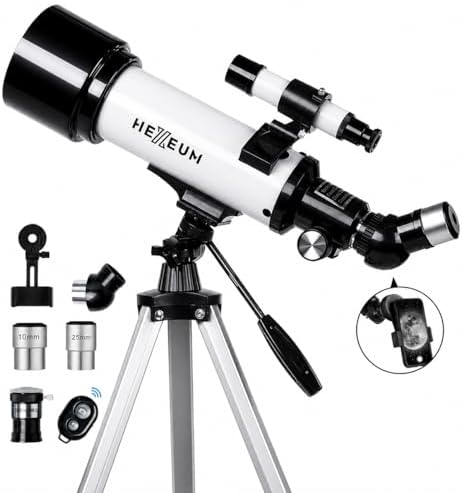 Visit on Amazon → Visit on Amazon →Koolpte 70mm/500mm AZ Refractor |
Light refractor sized for children | 70mm | Alt-az tripod | Kids and the Moon | $89.99 |
Should you buy the Celestron StarSense Explorer 8" Dobsonian?
Yes, if you have a closet to store it in and a car to move it. It is the most telescope you can get for the money, the mount cannot be misaligned, and the phone dock shortens the learning curve without taking the sky away from you. On the beginner test it produced a gasp instead of a shrug, and that is the whole point.
Should you buy the DWARFLAB Dwarf Mini?
Yes, if your problem is time rather than money. It goes in a backpack, it works in five minutes, and it shows a group of people the same object at once. But if you want to learn the sky with your own eye pressed to an eyepiece, start with the Dobsonian or the 80mm refractor and let the app come later.
Should you buy the Koolpte 80mm/600mm?
Yes, if you want a first refractor and you accept what 80mm can do. Replace the eyepieces, learn the Moon and the planets cold, and upgrade when you have worn this one out. It is a real telescope, and it is a fair place to start.
Should you buy the Koolpte 70mm/500mm?
Yes, for a child who has shown real interest and asked real questions. It is light, it is simple, and it puts the Moon in reach of a nine-year-old without adult help. Do not buy it for yourself expecting deep sky. Buy it for the kid, and stand back.