I have taught astronomy in Tucson for 20 years and run a public observatory for 12 of them, which means I have watched a lot of people buy a first telescope and then watched a lot of those telescopes end up in a closet. The pattern is boringly consistent. The scope that actually gets used is rarely the one with the biggest number printed on the box. It is the one whose mount holds still, whose aperture actually shows something worth looking at, and whose owner can set it up in the dark without an argument. So when someone asks me to compare the best beginner telescopes, I start with the mount and the aperture and work backward to the hardware.
That is what this comparison does. Four scopes, four different answers to the same question: a Celestron NexStar 8SE Computerized Telescope, which is a Schmidt-Cassegrain with a computerized mount; a MEEZAA 90mm refractor; a Celticbird 80mm refractor; and the Gskyer 70mm travel scope that shows up in every beginner conversation. Two of the four come as bundles with bags and phone adapters. One is a serious instrument that will outlast the beginner phase. One is a scope you buy because it fits in a backpack.
The short answer: the Celestron NexStar 8SE is the only telescope in this group with enough aperture to keep you interested past the first month, and Celestron's GoTo alignment is the most forgiving of any I have used. If the 8SE is out of reach, the MEEZAA 90mm is the strongest of the three small refractors for lunar and planetary viewing. The Gskyer 70mm makes sense only if portability is the whole point.
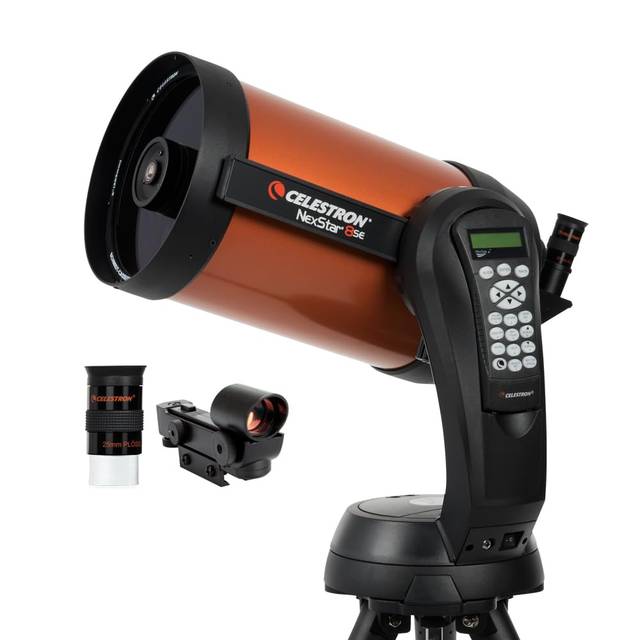
Celestron NexStar 8SE Computerized Telescope, Schmidt-Cassegrain
Real aperture, tracking mount, the one scope here that shows deep-sky objects as more than smudges
Heaviest and priciest of the four, and GoTo adds a power supply and an alignment routine to every session
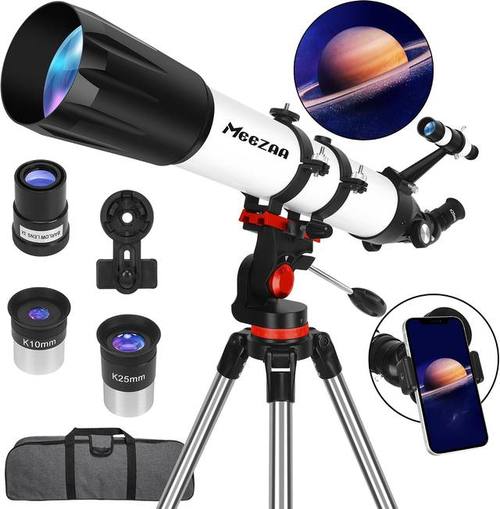
MEEZAA Telescope for Adults High Powered, 90mm Aperture 800mm Refractor
Largest lens of the three refractors, longest focal ratio, easiest on inexpensive eyepieces
Still 90mm, so faint fuzzies stay faint, and the bundle is the sparsest of the group
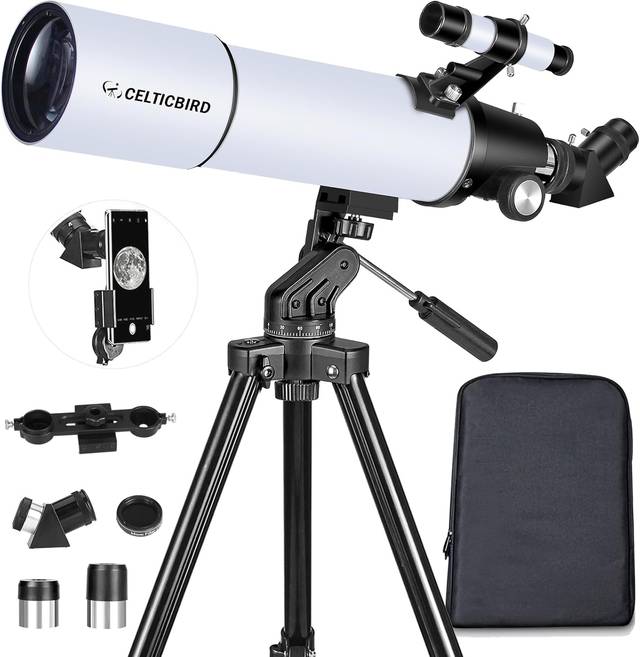
Celticbird Telescope for Adults High Powered, 80mm Aperture 600mm AZ Mount Refractor Telescope for Kids Beginners - Portable Telescopes for Adults Astronomy with Backpack, Phone Adapter, Moon Filter
Good middle aperture, backpack plus moon filter make it a complete starter kit
Bumping up against the 90mm on price while giving up aperture, and the accessories tempt you into phone photos before you can find anything
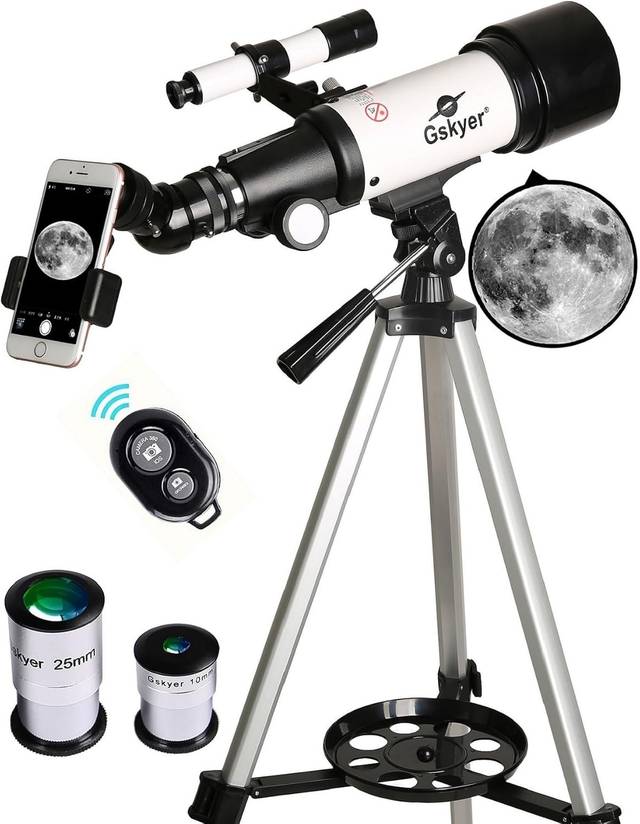
Gskyer Telescope, 70mm Aperture 400mm AZ Mount Astronomical Refracting Telescope for Kids Beginners - Travel Telescope with Carry Bag, Phone Adapter and Wireless Remote.
Lightest and smallest footprint, genuinely packable, the classic first-scope price
Least aperture of the four, so planets are small and deep sky is mostly a rumor
Prices and availability were captured from Amazon Creators API and may change.
What these four telescopes actually are
Aperture, the diameter of the front lens or the main mirror, is the one number that decides what you can see. Light gathering scales with the square of aperture, so the 8-inch Schmidt-Cassegrain here collects roughly eight times as much light as the 70mm refractor. That is not a spec-sheet footnote. It is the difference between a galaxy being a smudge you have to hunt for and a galaxy being an object you can study.
The other three are refractors with lenses of 70mm, 80mm and 90mm on alt-azimuth mounts, all aimed at the same buyer: someone who wants quick setup, a small package, and a good look at the moon, the planets and a handful of the brightest deep-sky objects. Their focal ratios run from about f/5.7 on the 70mm to f/7.5 on the 80mm to about f/8.9 on the 90mm. A longer focal ratio is gentler on inexpensive eyepieces and shows less false color around the moon and bright planets, which is a real advantage the 90mm holds over its two smaller siblings.
None of these are terrible telescopes. All four are limited by aperture in ways no accessory can fix. If you know that going in, you can be happy with any of them, and unhappy with any of them if you expect Hubble pictures.
The Celestron NexStar 8SE: the only real-aperture scope here
The 8SE is the odd one out and the one I would hand to a motivated adult. Eight inches of aperture, a Schmidt-Cassegrain tube that stays short enough to carry in one piece, and a computerized mount that tracks whatever you point it at so the object stays in the eyepiece instead of drifting out while you go find a chair.
Celestron's NexStar alignment is the most forgiving GoTo routine I have worked with, and forgiving matters more than accurate. A GoTo mount you cannot align is a GoTo mount you stop using. What you give up is simplicity: every session now includes power, a level tripod and a two or three star alignment before you see anything. Any single-arm GoTo mount is also a compromise between portability and absolute rigidity, and you accept a little more vibration in exchange for a package one person can carry out the door.
The MEEZAA 90mm: the best of the small refractors
The MEEZAA 90mm with its 800mm focal length is the one I would recommend to a beginner who wants a refractor and does not want to think about mirrors, collimation or power cables. Ninety millimeters is the most aperture you can get in this size class, and the longer focal ratio means the moon at high power looks crisp rather than fringed with color.
What it will do: crater detail on the moon that will make a kid go quiet, Jupiter as a disc with cloud belts visible on a steady night, Saturn's rings separated from the planet, the Orion Nebula as a glowing patch rather than a point. What it will not do: show you spiral structure, resolve globular clusters into stars, or make faint galaxies anything but a challenge. Check the current listing for exactly what comes in the box, because the bundle here is thinner than the other two refractors.
Ignore the magnification claims on refractors in this class. The old rule of thumb is about 50x per inch of aperture, which puts the honest ceiling for a 90mm scope near 180x on a good night, and a 70mm scope near 140x. Anyone promising 500x is selling you an empty image.
The Celticbird 80mm: the bundle is the story
The Celticbird is an 80mm, 600mm refractor, which lands it squarely between the other two. It gives up 10mm of aperture to the MEEZAA and roughly a stop of focal ratio, and it comes with the accessories that beginners actually ask me about: a backpack, a phone adapter and a moon filter.
The backpack is the genuinely useful item if you travel with a scope. The moon filter is the right first accessory, because the full moon is uncomfortably bright in any telescope and a filter turns it from a white glare into a surface you can study. The phone adapter is the one I would treat with caution. Holding a phone over an eyepiece gets you a snapshot of the moon, and that is roughly the honest limit of it. Real astrophotography needs a tracking mount, a camera and a lot of patience, and none of that is in this box. Use the adapter for the moon, then put the phone away and look with your eye.
The Gskyer 70mm: the travel scope
The Gskyer is the smallest scope here: 70mm of aperture, 400mm of focal length, an alt-az mount, and a bundle that includes a carry bag, a phone adapter and a wireless remote. It is the scope I recommend when the alternative is no telescope at all, because it lives in a closet or a car trunk and comes out on a whim.
Seventy millimeters is enough for the moon, Jupiter and its four bright moons, Saturn's rings as a small but real shape, and the brightest clusters. It is not enough for serious deep-sky work, and the short focal ratio means inexpensive eyepieces will show color fringing on bright objects. If you buy it, buy it for what it is: a light, packable, low commitment first scope that will teach you the sky and then leave you wanting more.
The mount is the telescope
Here is the thing I repeat at every star party: the mount is the telescope. A great optical tube on a mount that shakes in a breeze is a great tube you cannot use. Every time you touch the focuser, the image wobbles, and by the time it settles the object has drifted. That is what makes people quit, not the optics.
All three refractors here use alt-azimuth mounts, which are simple, intuitive and fine at low to medium power. The 8SE uses a computerized alt-az mount, which adds tracking and object finding but also adds setup steps. If you go the GoTo route, remember that it is a convenience, not a substitute for knowing the sky. Learn three constellations and how to star hop with a chart, because when the batteries die or the alignment fails, that knowledge is the difference between a usable night and a packed-up car.
What ships in the box, and what to replace
The eyepiece that comes with a telescope is a suggestion, not a tool. That is true at every price in this comparison, and it is the single upgrade that changes what you see the most. A better eyepiece with more comfortable eye relief will do more for your observing than any filter, any phone adapter, and most accessories sold alongside beginner scopes. Plan for it in your budget from day one.
Two other notes for the refractors: a sturdy table or a hard surface under the tripod feet does more for stability than anything you can buy, and setting up on grass or a wooden deck is asking for vibration. For the 8SE, budget for a reliable power source, because a GoTo mount that dies mid-session is a doorstop.
Which one should you buy?
Buy the 8SE if you are an adult with a real interest, a place to store it, and the patience to learn an alignment routine. It is the scope that will still show you something new in five years, and the one that will make a kid gasp at Saturn.
Buy the MEEZAA 90mm if you want the simplest possible good view of the moon and planets with no power, no mirrors and no alignment. Buy the Celticbird 80mm instead if the backpack matters to you and you want the moon filter and phone adapter in the same box. Bundle contents change, so check the current listing before you decide between those two.
Buy the Gskyer 70mm if the telescope has to fit in a bag, live in a small apartment, or survive being handed to a child. It is a real telescope at a beginner price, and it will show you the moon in detail. It is also the one you will outgrow first.
What I tell people at star parties
The best telescope is the one you actually use. A bigger scope that stays in the closet loses to a small one that goes outside every clear night, every single time. Whatever you pick from this list, point it at the moon first, then Jupiter, then Saturn, then a bright cluster. Learn those four objects well and you will have learned more than most people who own a telescope for a decade.