How To Find The North Star
The North Star is advertised as the one constant in the sky, the thing that never moves, the anchor for every beginner star chart. But is it really that easy to spot? I've spent twenty years teaching people to look up, twelve of them running a public observatory, and I can tell you: most people cannot find Polaris on their first try.
They look for the brightest star in the sky and grab Venus by mistake. I've watched it happen hundreds of times.
So here's the honest version, from someone who's stood in a freezing field pointing at the same patch of sky for two decades.
The Big Problem With Finding Polaris
It's not actually that bright. That's the whole issue. Polaris is a decent 2nd magnitude star, but it's not the brightest thing up there. It's not even close. People expect a beacon, and instead they get a moderately bright star that sits in a fairly empty patch of sky. If you don't know what you're looking for, you'll walk right past it.
The second problem is light pollution. From a city backyard, you might only see a dozen or so stars total. Polaris can hide in that mess. I've had beginners stand under a suburban sky and tell me they can't find the Big Dipper, which is the whole gateway to Polaris. If you can't see the Dipper, you can't use the standard method.
So the real first step isn't finding Polaris. It's finding a darker sky. You don't need a remote observatory, but you do need to get away from direct streetlights. A backyard with a good sightline to the north works. A school field works. Even a parking lot on the edge of town works. The darker the sky, the easier this gets.
The Big Dipper Method, Explained Like You're Standing Next To Me
Here's the method I teach every single person who walks into my observatory. Find the Big Dipper. It's high in the northeast in spring, lower in the north in autumn, and in winter it's climbing up the northeastern sky.
The Dipper is made of seven stars, and the two that form the outer edge of the bowl, the ones opposite the handle, are called the Pointer Stars.
Dubhe and Merak. Draw a line from Merak, the bottom one, up through Dubhe, the top one, and keep going about five times that distance.
You'll land on Polaris.
That's it. Five times the distance between the Pointer Stars. It sounds simple, and it is, once you've done it a few times. But here's the thing nobody tells you: the Big Dipper rotates around Polaris all night.
In the evening it's on one side of the pole, by 2am it's on the other. The line you draw changes direction, but the distance stays the same.
Once you find the Dipper, you can always find Polaris, no matter where the Dipper is in its circle.
I've taught this to kids as young as six and grandparents in their eighties. The ones who get it fastest are the ones who stop looking for a bright star and start looking for a pattern. The Dipper is the pattern. Polaris is just the payoff.
What If You Can't See The Big Dipper?
This happens. From the southern United States, the Dipper dips below the horizon in late autumn. From most of Europe, it's circumpolar, meaning it never sets, but it can be low and hard to see through atmospheric haze. If you can't see the Dipper, you need a backup method.
Cassiopeia is the answer. It's a W shape, or an M, depending on how it's oriented, and it sits on the opposite side of Polaris from the Big Dipper. The W is made of five stars, and the middle point of the W points roughly toward Polaris.
It's not as precise as the Dipper method, but it gets you in the neighborhood. From there, you scan for the moderately bright star that doesn't move.
That's Polaris.
I've also used the constellation Cepheus, which sits between Cassiopeia and the Dipper, as a bridge. It's a house shape, and the point of the roof points at Polaris. But honestly, Cassiopeia is easier to spot because the W shape is so distinctive. I'd start there.
The Trick That Makes It Stick
Here's the thing I've learned from handing telescopes to thousands of beginners: you can tell someone how to find Polaris a hundred times, but they won't remember until they've done it themselves. So here's what I do at outreach events.
I find the Big Dipper for them, then I make them trace the line with their finger, all the way to Polaris.
Then I make them do it again, but this time I don't point. I just say "find the Dipper." They find it, they trace the line, they land on Polaris, and they're hooked.
That's the moment it clicks. The sky stops being a random scatter of dots and becomes a map. And once you can find Polaris, you can find everything else. The entire northern sky rotates around that one star. Learn it once, and you've got a reference point for the rest of your life.
One thing I'll add: don't bother with star-finder apps for this. I recommend Stellarium for a lot of things, and I use it constantly, but for learning to find Polaris with your own eyes, the app is a crutch. Put the phone away. Look up. Find the Dipper. Trace the line. That's how you learn it.
What You'll Actually See When You Get There
Polaris isn't a single star, technically. It's a triple system, but you'll never split it with your eye or even with a small telescope. Through an 80mm refractor, which I keep on a shelf by the door for grab-and-go nights, Polaris looks like a steady, slightly yellowish star.
It doesn't twinkle as much as other stars because it's near the pole, and the light path through the atmosphere is more stable.
Through a telescope, you can see a faint companion star, Polaris B, if the seeing is good and you have enough aperture. It's a test of your optics and your sky conditions. I've shown it to people with a 90mm scope on a good night, and I've failed to see it on mediocre nights. It's a nice challenge, but it's not the point. The point is the direction.
Why This Matters For Telescope Users
Here's the practical application. If you've got a telescope with an equatorial mount, you need to align it on Polaris to track objects across the sky. That's the whole reason beginners are told to find the North Star in the first place.
But here's my honest advice, and I've been saying this for years: skip the equatorial mount. Don't complicate your life with those fancy equatorial reflectors.
Get an alt-az mount, the simple up-down, left-right kind, and you don't need to align anything. You just point and look.
I've seen too many beginners buy an equatorial mount because it looks serious, then give up because they can't figure out the alignment. The mount is the telescope. If the mount fights you, the scope ends up in a closet. I'd rather have a cheap refractor on a steady alt-az mount than a fancy reflector on an equatorial mount I have to wrestle with every night.
That said, knowing where north is still matters. Even with an alt-az mount, you want to know which direction to point. And once you know where Polaris is, you always know where north is. It's a life skill, honestly. I've used Polaris to orient myself on hikes, in parking lots, and once in a friend's backyard when I was trying to figure out which way their house faced.
The Bottom Line
Finding the North Star isn't hard, but it requires you to stop looking for a bright star and start looking for a pattern. Find the Big Dipper, trace the line between the two Pointer Stars, go about five times that distance, and you're there. If you can't see the Dipper, use Cassiopeia. Practice it a few times on a clear night, and it'll stick forever.
I've watched thousands of people learn this, and the ones who succeed are the ones who actually go outside and try. Not the ones who read about it. The sky is the best teacher. The first time you find Polaris on your own, you'll feel something shift. The sky goes from a random scatter to a map, and you're no longer lost in it.
If you're looking for a telescope to start this journey, grab something simple. A grab-and-go refractor on a steady mount is all you need. I've reviewed a few that fit the bill, like the telescope I recommend below, which has a stainless steel tripod that holds steady and costs less than a dinner out for two.
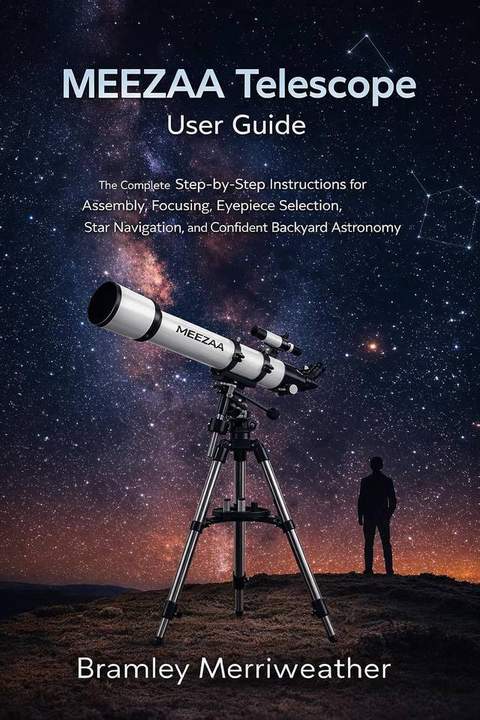
At this price, you can't go wrong. It's solid rather than extraordinary, but that's enough for a first scope. The mount is sturdy, the optics are decent, and you'll see the moon's craters and Saturn's ring with the included eyepieces. Just set up the finder scope in the daylight, or you'll have a difficult time at night.
Go outside. Find the Dipper. Trace the line. The North Star is waiting.