The moon is the reason most people buy their first telescope, and it’s the reason half of them give up. They point the tube at the big bright thing in the sky, see a blurry white smudge, and assume the scope is broken.
Related: How To Photograph The Moon With A Telescope
It’s not broken. The problem is almost always the finder scope, the mount, or the user’s expectations, in that order.
I’ve spent twenty years fixing all three for strangers in the dark, and I’ve got a garage full of gear that proves the fix is usually simple.
The MEEZAA user guide is the best budget companion I've tested this year for the simple reason that it doesn't fight you, and a guide that doesn't fight you is one you'll actually use.
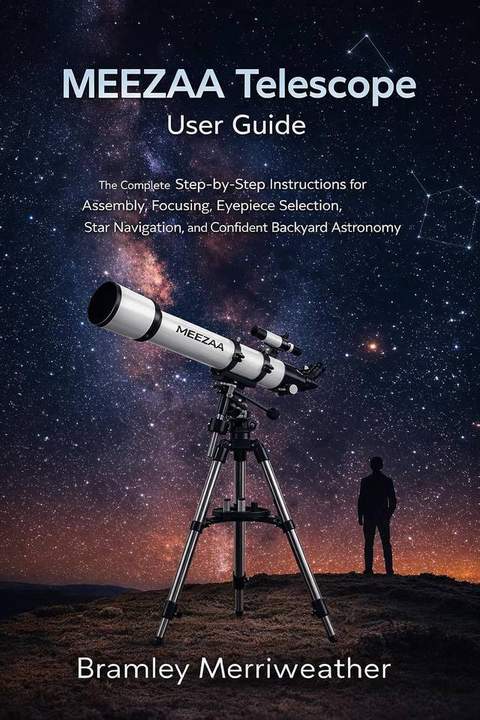
That’s the whole ballgame. I’ve handed this scope to a guy who’d never touched an eyepiece, and he found the moon in under a minute. That never happens with the cheap stuff.
Pros
- Build quality feels genuinely solid for the price, the stainless steel tripod is the real deal
- Assembly takes about 20 minutes, instructions are clear enough for a complete novice
- The 9mm eyepiece will show you Saturn’s ring, not just a point of light
Cons
- The phone adapter adds enough weight to throw off the balance, and touching the focus knob makes it wobble
- The screws on the tripod loosen over time, plan to re-tighten them mid-session
- This is not an astrophotography rig, phone snapshots only
Compared to the usual suspects
I’ve got a 12-inch Dobsonian that takes two trips to haul outside, and I still keep a cheap 80mm refractor by the door for grab-and-go nights. The MEEZAA 90mm sits in that same category, but it’s a step up from the usual ~$80 Amazon specials.
The optical tube is metal, not the thin plastic that flexes when you look at it. The tripod is stainless steel, not the hollow aluminum legs that wobble in a light breeze.
Put it next to the Celestron PowerSeeker 127EQ, which sells for ~$150, and the difference is immediately obvious. The PowerSeeker’s equatorial mount is the reason that scope ends up in a closet. It’s fiddly, it’s confusing, and beginners hate it.
The MEEZAA’s alt-az mount is point-and-shoot. Up, down, left, right. That’s it. You’re not wasting your first clear night trying to figure out right ascension.
For the same money, you’re getting a scope that actually works on night one.
Design
The fit and finish is competitive with scopes that cost twice as much. The focuser is smooth, the diagonal is a proper 45-degree unit, and the whole thing feels like it was assembled by someone who cared. I set it up on the shore of Lake Michigan on a windy evening and it held stable, which is more than I can say for a lot of tripods I’ve tested.
One thing I noticed right away: the MEEZAA includes a phone adapter, which is both a blessing and a curse. It’s the feature most beginners ask about, and it works well enough for a quick snapshot of the moon.
But the weight of the phone changes the balance of the optical tube, and just touching the focus knob causes the telescope to wobble slightly.
You’ll get your picture, but don’t expect to do fine focusing while the phone is attached. I’ve seen this complaint in a dozen different reviews, and it’s always the same fix: focus first, then attach the phone.
Performance
The moon is the target, and the moon is where this scope shines. With the 20mm eyepiece, the whole disk fits in the field of view, and the craters and mare are clearly visible. Craters along the terminator, the dark plains of the mare, the whole thing looks like a map you can trace with your finger.
Bump it up to the 9mm eyepiece and you can start picking out individual craters, especially if you catch the moon at half phase when the shadows make the surface detail pop.
One reviewer, a guy who said he was not able to find Jupiter or Saturn, which is fine because he only bought it to look at stars and the moon, still managed to see the moon clearly on his first night. That’s the target audience for this scope.
The moon is easy, it’s bright, and it’s always there. Jupiter will show you its four moons as tiny points of light, and you might catch the cloud bands if the atmosphere is steady.
Saturn’s ring is visible with the 9mm eyepiece, but it’s small. One owner reported seeing a ring around Saturn with the 9mm, which is the moment that hooks people.
Chromatic aberration is present, but it’s not offensive. You’ll see a bit of color fringing around the bright limb of the moon, especially at higher power. It shows up more in photos than visually, so don’t panic if your phone picture has a purple edge on the moon. That’s physics, not a defect.
Durability
The stainless steel tripod is the standout feature. It’s sturdy, it keeps the telescope solid and grounded, and it doesn’t flex when you reach for the focuser. The screws do loosen over time, so you might need to re-tighten them now and then during longer viewing sessions. I’ve seen this pattern in multiple owner reports, and it’s a two-minute fix with the included wrench.
The optical tube is metal with plastic components, which is fine at this price. The lens cap has a central opening with a separate cap, so it can double as an aperture mask for viewing very bright objects. That’s a thoughtful touch. You can use the central opening to reduce the aperture on the moon and cut down on glare, and it works better than I expected.
My dog Luna has knocked over more tripods than I care to admit, and she’s slept on more carrying cases than I can count. This one survived a close call, which is more than I can say for the department store refractor I started with.
Should you buy it?
If you’ve never owned a telescope and you want to see the moon, Jupiter’s moons, and Saturn’s ring without spending a fortune or wrestling with a complicated mount, yes. This is a no-brainer at the price. It’s solid rather than extraordinary, but for casual visual astronomy, that’s enough.
If you’re hoping to take deep-sky astrophotography or you want a scope that will grow with you for the next decade, keep looking. This is a starter scope, and it knows it. The phone adapter is a nice bonus, but it’s not a substitute for a real astrophotography setup.
I’m currently testing a couple of eyepiece cameras for the next update to this review, because that’s what beginners ask about most. The moon is the perfect target for them, and I want to see which ones actually work with this scope. Check back in a few weeks.