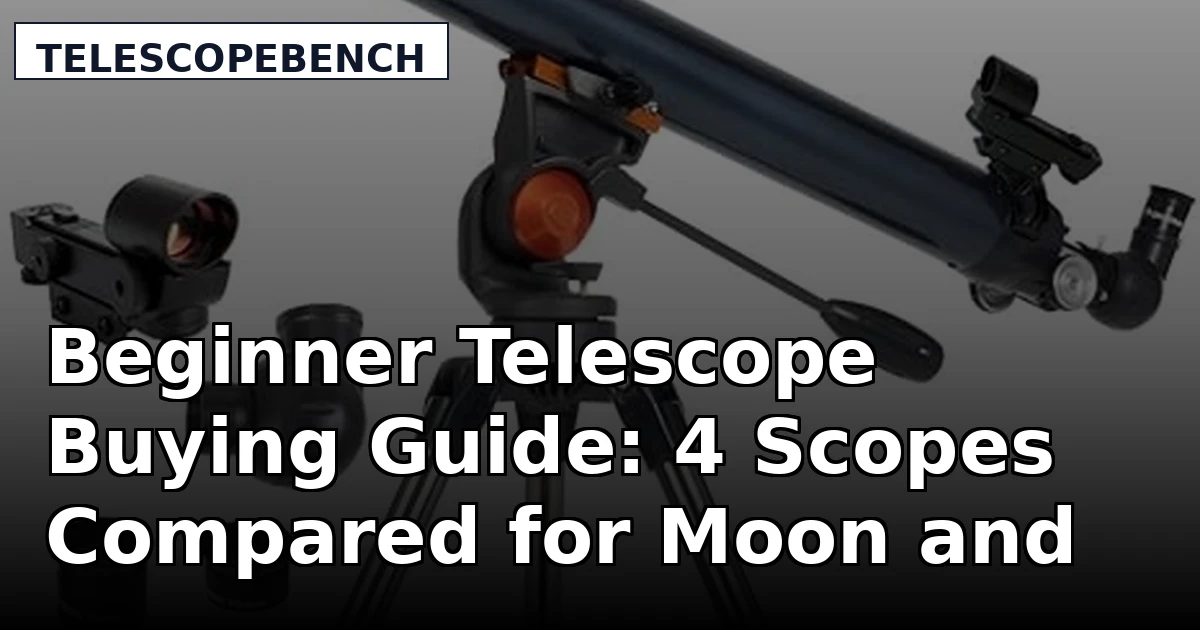
Most first telescopes are sold on a number that means almost nothing. The box promises 500x magnification, you get the scope home, you point it at Saturn, and you find a pale smear that refuses to hold still. After twenty years of teaching astronomy and running public observing nights, I can tell you that this exact disappointment ends more hobbies than any other single thing. This beginner telescope buying guide is about the three specs that actually decide whether a scope gets used: aperture, mount steadiness, and how easily the thing travels from your closet to your yard. The four instruments below cover the realistic range for a first purchase, from a packable 70mm refractor to a 90mm scope with a phone adapter and a slow-motion mount.
Related: Best Beginner Telescopes Under $300: What Actually Gets Used →
Quick answer
For a first telescope used at home, a 70mm refractor on an alt-azimuth mount is the simplest place to start, and the 90mm option here gives you more aperture in the same basic layout. A fixed 18x70 instrument is a wide-field companion rather than a general purpose telescope, and the packable 70mm Travel Scope is the one to choose when the scope has to fit in a bag. All four are reasonable first steps rather than lifetime instruments.
Four useful options
| Model | Best fit | What stands out |
|---|---|---|
| Celestron AstroMaster 70AZ Refractor Telescope for Moon & Planet Viewing | Moon and planet viewing at home | 70mm refractor on an alt-azimuth mount, positioned for lunar and planetary targets |
| Telescope, Telescopes for Adults Astronomy Professional, 90mm Aperture 1000mm High Powered Telescope for Beginners & Kids with Precision Adjustment Vertisteel AZ Mount Tripod Phone Adapter | The aperture step up | 90mm aperture and 1000mm focal length, with a phone adapter and Vertisteel AZ mount tripod |
| 18x70 Professional Astronomy for Adults High Powered | Wide-field scanning | Fixed 18x magnification with a 70mm objective |
| Celestron Travel Scope 70mm Beginner Portable Telescope with Backpack | Travel and small storage | 70mm refractor with a backpack for transport |
The classic first refractor: Celestron AstroMaster 70AZ Refractor Telescope for Moon & Planet Viewing
Refractors hold their alignment, which matters more than beginners realize. There is no collimation routine to learn on night one, and the tube is closed, so dust and dew stay outside the optics. Setup is quick, which is the quiet reason a scope like this gets used on a random Tuesday. The honest trade-off is aperture. At 70mm, the Moon is genuinely detailed, Jupiter shows its moons and cloud belts, and Saturn reads as a ringed shape rather than a dot, but galaxies and nebulae are faint grey smudges that reward dark skies and patience. The bundled eyepieces are a starting point, not a finished kit, and the tripod is the part I would check first on any first scope.
The aperture step up: Telescope, Telescopes for Adults Astronomy Professional, 90mm Aperture 1000mm High Powered Telescope for Beginners & Kids with Precision Adjustment Vertisteel AZ Mount Tripod Phone Adapter
Going from 70mm to 90mm is not a marketing bump. Light gathering scales with the area of the objective, so a 90mm lens collects roughly one and a half times the light of a 70mm, and the larger aperture supports higher useful magnification before the image turns to mush. The 1000mm focal length means this is a physically longer tube than a short 70mm, which cuts both ways: more magnification from the same eyepiece, and more demand on the mount. The precision adjustment here is the slow-motion control you will use constantly at high power, nudging the scope to keep a planet in the field while the sky drifts. The phone adapter is a genuine plus for families, since a phone snapshot of the Moon is the fastest way to get a kid hooked. Just do not mistake it for an astrophotography rig.
The fixed-magnification wide-field option: 18x70 Professional Astronomy for Adults High Powered
Here is the educator's note I give at every public night: 18x is low power by telescope standards, whatever the listing language suggests. That is not a flaw, it is a specialty. Wide fields are how you sweep the Milky Way, pick out the Pleiades, follow a comet, and learn constellations by star-hopping instead of by app. Fixed magnification also means no eyepiece collection, no collimation, and no fiddling in the dark. The limitation is equally clear: you cannot push this instrument to the magnification that splits tight double stars or shows planetary detail, and 18x70 optics are best used with support rather than held freehand for long stretches. Treat it as a second instrument, or as the thing you grab when you have ten minutes and no patience for setup.
The packable travel scope: Celestron Travel Scope 70mm Beginner Portable Telescope with Backpack
The best telescope is the one you actually use, and that sentence is the entire argument for this scope. If your sky is a city sky, a 70mm refractor that fits in a backpack and rides to a dark site will show you more than a larger instrument left in the garage. Optically it is in the same 70mm class as the AstroMaster, so lunar and planetary views are broadly comparable. The difference is the mount and the packing. Compact travel tripods are the weak link on any portable scope, and at higher magnification you will notice every wobble and every breeze. Keep the magnification moderate, set up on solid ground, and this is a genuinely useful first telescope rather than a shelf ornament.
Prices and availability may change. Product images, names, and retailer links must be matched by verified ASIN. Do not state a current price, rating, stock status, or measured result without current evidence.
What aperture actually buys you
Aperture is the diameter of the main lens or mirror, and it is the single most important number on the box. Two things scale with it. First, light gathering: a larger aperture pulls in more photons, which is what lets you see faint objects and use higher magnification without the image dimming into grey soup. Second, resolution: a larger aperture can separate finer detail, so cloud belts on Jupiter and the Cassini division in Saturn's rings become possible rather than theoretical.
The practical rule I hand to beginners is that useful magnification tops out at roughly twice the aperture in millimeters, and that is under good seeing. So a 70mm scope is a roughly 140x instrument on a steady night, and a 90mm is a roughly 180x instrument. Anything printed on a box far above that is a number produced by stacking a short eyepiece with a Barlow lens until the image is an empty, blurry disc. High magnification does not create detail. It only enlarges whatever the aperture already delivered, including the blur.
Why the mount decides whether you keep the scope
The mount is the telescope. A great optical tube on a wobbly tripod is a great tube you cannot use, and this is where cheap scopes fail hardest. What you want is a mount that settles in under a second or two after you touch it, slow-motion or precision controls for fine aiming, and legs that do not flex. Alt-azimuth mounts like the ones on these refractors are the right choice for a first scope: point at the target, track it by hand, done. Computerized GoTo mounts are convenient when they align cleanly and maddening when they do not, and alignment can easily eat the first twenty minutes of a short session.
A five-step way to decide before you buy:
- Check the aperture first and treat everything else as secondary. A 90mm objective outperforms a 70mm on faint objects, all else being equal.
- Look at the mount type and the tripod, then ask whether the legs are metal and whether there are slow-motion controls.
- Ignore the headline magnification claim and mentally cap the scope at about twice its aperture in millimeters.
- Decide how far the scope has to travel. A packable 70mm that reaches a dark site beats a bigger tube that stays in the closet.
- Ask what you want to look at. Moon and planets favor a longer focal length and higher magnification; star fields favor a wide field at low power.
Getting the most from a first telescope
- Set the scope up in daylight the first time and align the finder on a distant object, so you are not doing it in the dark.
- Let the scope sit outside for twenty to thirty minutes before observing. Temperature equalization sharpens the view noticeably.
- Start at the lowest magnification you have. Wide fields are easier to aim and far more forgiving than high power.
- Observe the Moon when it is not full. Craters and the terminator line show the most relief along the day and night boundary.
- Keep a star chart or a simple planisphere in your pocket. Knowing the sky is what makes any mount, computerized or not, worth owning.
- Store the scope assembled and near the door. Friction between you and the eyepiece is the number one reason scopes gather dust.
- Plan around the planets. When Jupiter or Saturn sits low near the horizon, atmospheric turbulence will blur it no matter what you spent.
Which option should you choose?
Choose the Celestron AstroMaster 70AZ Refractor Telescope for Moon & Planet Viewing when you want a straightforward home scope for the Moon and bright planets with nothing to align. Choose the Telescope, Telescopes for Adults Astronomy Professional, 90mm Aperture 1000mm High Powered Telescope for Beginners & Kids with Precision Adjustment Vertisteel AZ Mount Tripod Phone Adapter when you want more aperture, precision adjustment for tracking at higher power, and a phone adapter for sharing the view. Choose the 18x70 Professional Astronomy for Adults High Powered when wide-field scanning, simplicity, and zero setup are what you are after, and you accept fixed magnification. Choose the Celestron Travel Scope 70mm Beginner Portable Telescope with Backpack when the scope has to travel, fit in a backpack, or live in a small apartment.
One caveat worth stating plainly: the descriptions above come from the product listings, not from my own nights under the sky with these specific units. Before you buy, confirm the aperture, focal length, mount type, and which eyepieces are included, because those four details decide the experience far more than any headline number.
The bottom line
For a first telescope, buy aperture you can afford and a mount you can live with, then accept that the eyepieces will be replaced and the magnification claims are noise. A 70mm refractor is a real instrument that will show you lunar craters, Jupiter's moons, and Saturn's rings, and a 90mm version does the same with more light and more headroom. A fixed 18x70 is a wide-field companion, not a substitute for a telescope, and the packable 70mm is the one that goes with you. Whatever you choose, put it by the door, learn three constellations, and use it. That habit matters more than any spec on this page.