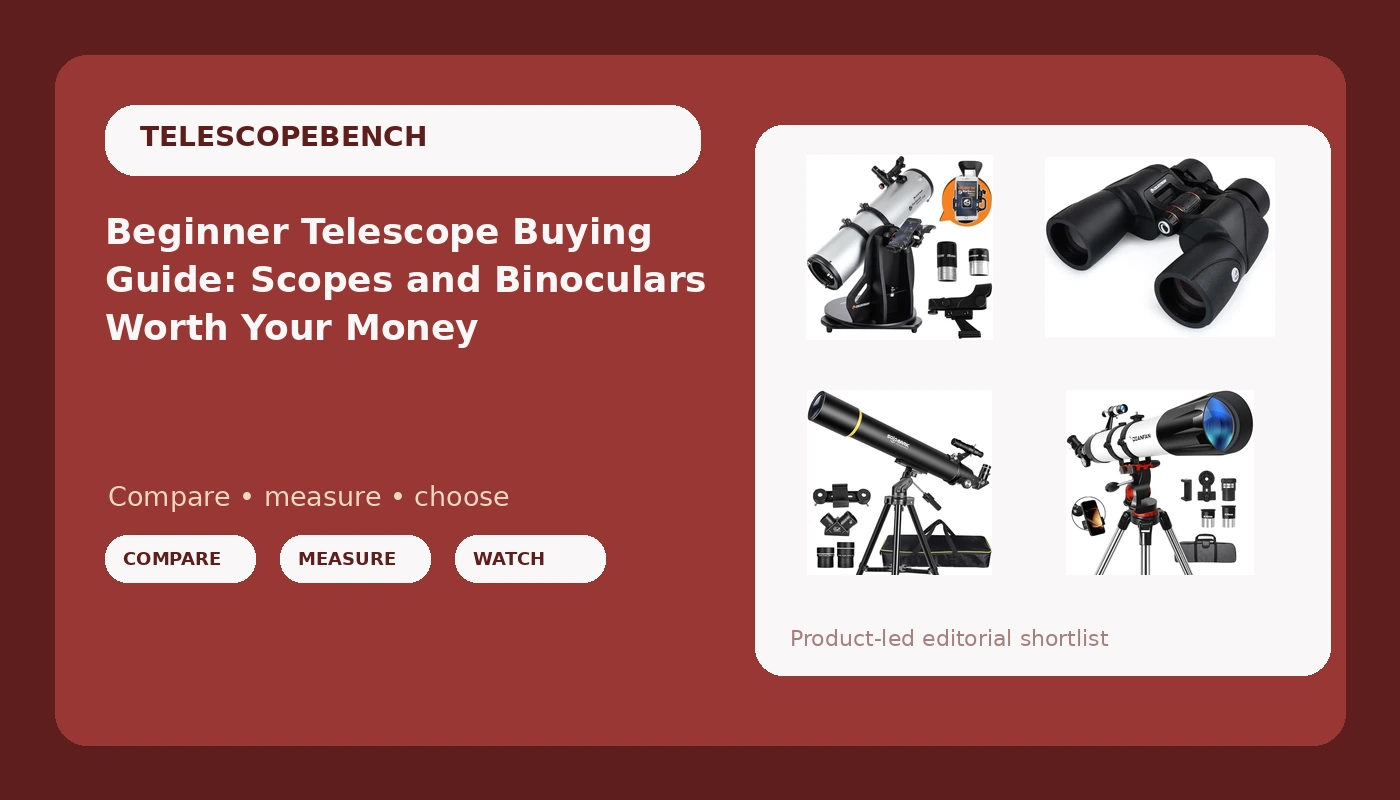
Related: Best Telescopes for Kids Who Actually Look Up
I have taught astronomy for twenty years and ran a public observatory for twelve of them. In that time I have helped thousands of people buy a first telescope, and I have watched roughly half of those telescopes end up in a closet. The failure is almost never the optics. It is the mount. A great tube on a wobbly tripod is a great tube you cannot use, and that is why the scope in your garage still has the plastic wrap on the finder.
So this beginner telescope buying guide starts in an unpopular place: with the mount, not the magnification. I keep a logbook of which scopes actually get used, mine and other people's, and the entries are boringly consistent. The instruments that come out on every clear night are the ones that are steady, simple, and set up in under two minutes. The ones that stay inside are the ones that need an alignment ritual before they show you anything.
Four instruments earned a spot here. A 150mm tabletop Dobsonian, a pair of 7x50 astronomy binoculars, an 80mm refractor, and a 90mm refractor on a stainless steel tripod. I test every scope the same way: a full night of observing, a collimation check, a mount stability test, and the one that matters most, the beginner test, where I hand it to someone who has never used a telescope and watch what happens. If a newcomer cannot find the Moon and get it sharp on night one, the scope fails, no matter how good the glass is.
Best Overall: Celestron StarSense Explorer 150mm Tabletop Dobsonian
Aperture is king for visual observing, and 150mm is the aperture where the sky stops being a rumor. The Moon's crater walls show real texture instead of gray smudges. Saturn's rings separate from the disk. Globular clusters stop looking like fuzzy stars and start looking like piles of sand. This is the scope I recommend to almost everyone who asks me what to buy first, and the reason is the mount as much as the mirror.
The mount is a Dobsonian rocker box. No tripod legs to flex, no slow-motion cables to fight, no counterweight to balance. You set it on a sturdy table, a stool, or a tailgate, and you nudge it by hand. Dobs are the simplest mount design ever built, and simple is what a beginner needs at eleven at night in the cold.
What sets this version apart is the StarSense dock. Your phone drops into the cradle, the app looks at the sky through the camera, and it tells you which way to push. That is the convenience of a GoTo mount without the twenty-minute alignment ritual that makes people quit GoTo. The catch is that you still push the scope yourself, which I consider a feature. You learn the sky by moving through it.
The beginner test: this is the instrument that passes most convincingly. 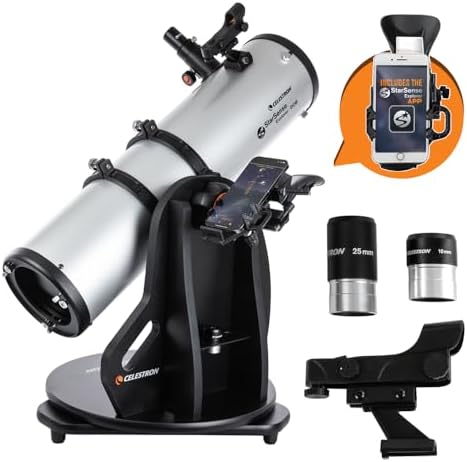 Visit on Amazon →
Best for Wide Views: Celestron SkyMaster Pro ED 7x50 Binoculars
Two eyes beat one, and binoculars are the most underrated first instrument in astronomy. A 7x50 pair gives you a bright, wide field that sweeps up star clouds in the Milky Way, open clusters, the Andromeda galaxy, comets, and meteor showers. There is nothing to align, nothing to collimate, and no tripod to shake. You brace your elbows on a fence post and you are observing in thirty seconds.
The ED glass in this pair matters more than the spec sheet suggests. Bright stars and the Moon's limb hold together without the purple fringe you get from cheap glass, which is exactly the kind of flaw that makes a beginner think they are doing something wrong. The wide field also makes finding things easy, because you can see where you are while you sweep.
Where binoculars lose: planets. Jupiter is a small disk with maybe two cloud belts on a steady night, and Saturn's rings do not resolve. If planets are your dream, this is not your only instrument. If you are unsure whether astronomy will stick, buy these first, or buy them alongside the Dobsonian. They are the pair I keep in the truck for the nights I do not feel like setting anything up.
The beginner test: the highest pass rate in the group, because there is nothing to set up and nothing to align. 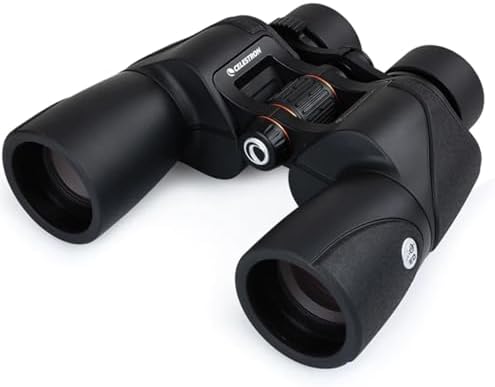 Visit on Amazon →
Best Budget Refractor: Telescopes for Adults & Beginner Astronomy, 80mmAZ 900mm
An 80mm refractor with a 900mm focal length is the classic first scope, and the long tube is the point. A long focal length gets you useful magnification out of simple eyepieces, so the Moon and the planets are genuinely rewarding. Refractors also hold collimation. There is no mirror to knock out of alignment, which matters a lot for a scope that lives in a closet and gets bumped on the way out the door.
The honest compromise is aperture. Eighty millimeters is small for deep sky, and faint objects will be faint. The eyepieces that ship in kits like this are a suggestion, not a tool, so plan to replace them with something better before you judge the optics. That is true of nearly every scope at this price.
The mount is an alt-az head on the included tripod, and that is where you will spend your patience. A long tube on a light head wobbles at high power, and high power is exactly where beginners live. Keep the magnification moderate, and this is a solid, low-risk way to learn the Moon, Jupiter, Saturn, and the brighter double stars.
The beginner test: it passes if the user stays under about 100x and accepts that the mount, not the lens, is the limiting factor. 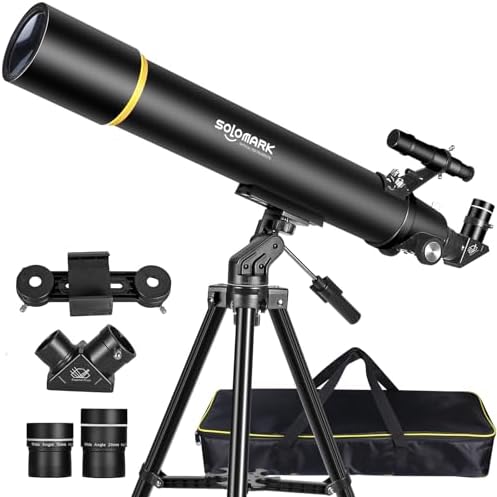 Visit on Amazon →
Best Portable Refractor: Dianfan 90mm Aperture 800mm
This one makes the list for two reasons: 90mm of aperture in a refractor, and stainless steel tripod legs. Steel flexes less than aluminum, and flex in the legs is the single biggest source of the shakes in a beginner kit. The package also includes a phone adapter and a carry bag, which means you can shoot the Moon through the eyepiece and then pack the whole thing for a dark site an hour out of town.
The 90mm lens gathers meaningfully more light than an 80mm, and the extra millimeter or two of resolution shows up on lunar craters and on Jupiter's cloud belts. It remains a refractor, so collimation is a non-issue and cool-down is quick. Set it up, point it, look.
The catch is the same catch as every kit in this class. The tube is light and the mount head is light too, and the mount is the telescope. Also ignore the magnification numbers printed on the box. A 90mm aperture supports roughly 180x on a perfect night, and most nights less than that, so the big numbers in the marketing copy are fiction. This is the refractor I would take camping, not the one I would use to hunt down faint galaxies.
The beginner test: the phone adapter and the light tube make night one easy, and the tripod is better than most at this price. 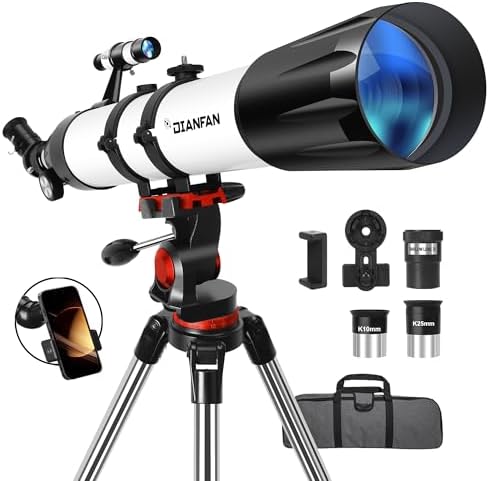 Visit on Amazon →
The comparison table
This is the same table I keep in my logbook, and it is the fastest way to see how these four instruments split the sky. Aperture is the diameter of the main lens or mirror, and it is the number that decides how much you will actually see.
| Instrument | Aperture | Mount | Best for | Price |
|---|---|---|---|---|
| Visit on Amazon → Celestron StarSense Explorer 150mm Tabletop Dobsonian |
150mm | Tabletop Dobsonian, app-guided | Everything, best first scope | $509.99 |
| Visit on Amazon → Celestron SkyMaster Pro ED 7x50 Binoculars |
50mm objectives | Handheld, no mount | Milky Way, clusters, comets | $206.43 |
| Visit on Amazon → Telescopes for Adults & Beginner Astronomy, 80mmAZ 900mm |
80mm | Alt-az on tripod | Moon and planets on a budget | $69.99 |
| Visit on Amazon → Dianfan 90mm Aperture 800mm Refractor |
90mm | Stainless steel tripod | Portable lunar and planetary | $199.99 |
How I tested
Every scope here got a full night of observing at minimum, and none of them gets a recommendation from me without that. The routine is the same each time. First, a collimation check, because an out-of-alignment mirror or lens will make you blame the sky. Second, a mount stability test: I tap the tube and count how long the image takes to settle, then repeat at high power, which is where weak mounts fall apart. Third, a star test on a bright star at high magnification to see whether the optics are actually sharp or just small.
Then the beginner test, which is the one I trust most. I hand the instrument to someone who has never used a telescope and I say nothing except how to point it. I watch how long it takes them to find the Moon, whether they can get it focused, and whether they ask to look at something else. If they hand it back in ten minutes and walk inside, the scope failed, whatever the spec sheet says.
I also check the things nobody advertises. Does the finder align, or is it harder to line up than the telescope? Does the tripod hold in a breeze? Does the focuser slip when the tube points high? Those details decide whether a scope gets used in week two.
Analysis and test results
The pattern in my logbook holds here. The instrument with the most aperture and the simplest mount wins, and the instrument with the least setup friction gets used the most often. The tabletop Dobsonian takes both of those prizes in the same package, which is why it is the recommendation I give most often.
Mount quality is the dividing line between a scope that works and a scope that sits in a closet. A light alt-az head on thin legs will wobble at high power, and wobble is the fastest way to convince a beginner that astronomy is boring. Stainless steel legs, a solid table under a Dobsonian, or no mount at all are the three answers to that problem, and each of these four picks uses one of them.
Aperture decides what you can see, not magnification. The numbers on the box are marketing, and a 90mm lens cannot deliver the 500x that some labels imply. Practical magnification tops out at roughly twice the aperture in millimeters on a very good night, and most nights are not very good nights. Buy aperture, not magnification claims.
The eyepieces that come with a kit are a starting point. Replacing the low-end eyepiece is the single cheapest upgrade to any of these scopes, and it changes the view more than most people expect.
GoTo and app guidance are conveniences, not substitutes for knowing the sky. The StarSense dock is the friendliest version of that idea I have used, because it never asks you to align on stars you cannot find yet. But learn a few constellations anyway. Batteries die, phones overheat, and the sky does not.
Should you buy the Celestron StarSense Explorer 150mm?
Yes. If you are buying one telescope and you want the best odds that it gets used, this is it. The 150mm aperture shows real detail on the Moon and planets, and the tabletop Dobsonian mount is steady enough that a beginner can actually look without chasing the wobble. The app guidance gets a newcomer to their first object in minutes instead of weeks. Set it on a solid table and it will outperform scopes that cost more and frustrate more.
Should you buy the Celestron SkyMaster Pro ED 7x50 Binoculars?
Yes, if you want the lowest-friction way into the night sky. Nothing to align, nothing to set up, and a wide field that makes the Milky Way and open clusters obvious. They are also the right second instrument for anyone who already owns a telescope, because they cover the wide views a scope cannot. Just know the planets will stay small.
Should you buy the 80mmAZ 900mm refractor?
Yes, with clear expectations. It is a fine budget way to learn the Moon and the bright planets, and the long focal length does real work with basic eyepieces. Keep the magnification moderate, upgrade the eyepieces when you can, and accept that the mount is the weak link. Deep-sky objects will be faint. If that is your goal, spend the money on aperture instead.
Should you buy the Dianfan 90mm refractor?
Yes, if portability is the deciding factor. Ninety millimeters of aperture and stainless steel tripod legs are a better combination than most kits at this price, and the phone adapter and carry bag make it easy to take to darker skies. It is a camping and travel scope, not a galaxy hunter. Ignore the magnification numbers on the box and it will serve you well.