Related: Best Beginner Telescope: What to Buy First
I have spent twenty years teaching people to look up. For twelve of those years I ran a public observatory, which means I have handed a lot of telescopes to people who had never looked through one before. Here is the pattern I see over and over. The scope that gets used is the one whose mount holds steady. The beginner telescope that ends up in a closet is almost always the one that wobbled.
Aperture gets all the attention, and it deserves a lot of it. But a great optical tube on a mount that shakes in a light breeze is a great tube you cannot use. That is the whole argument of this guide.
So this is not a spec sheet. It is the set of questions I ask before recommending anything to someone who has never owned a scope: how much aperture actually buys you, what the mount costs you in frustration, whether the finder is usable, and whether a person can point it at the Moon on night one without help. Then I walk those questions through the listings in this batch.
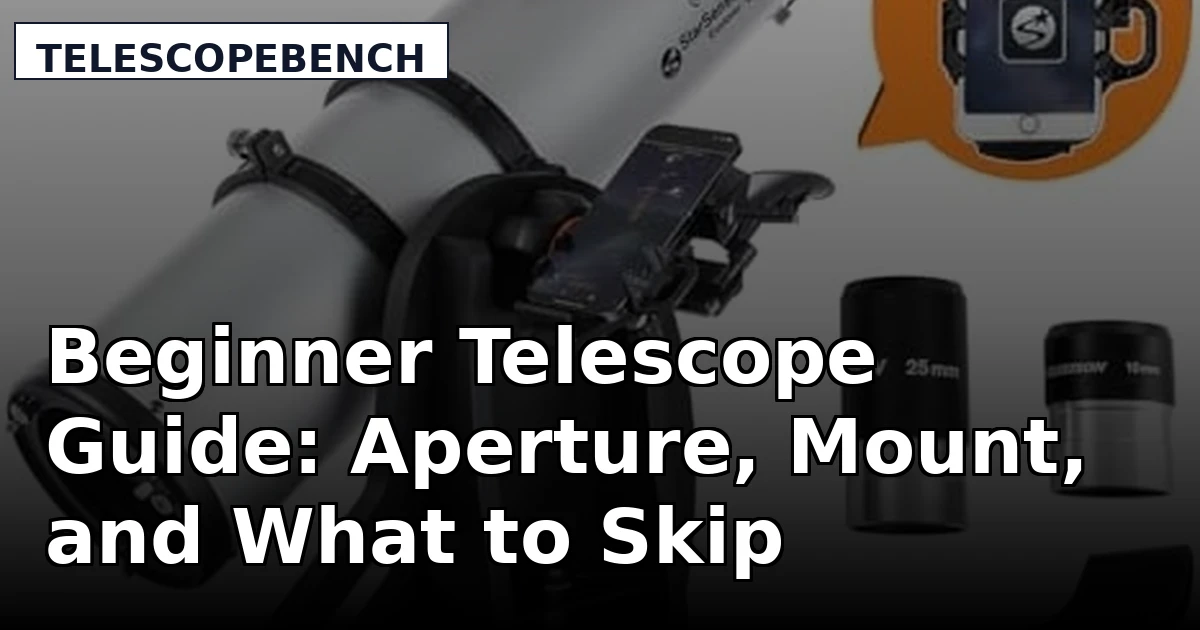
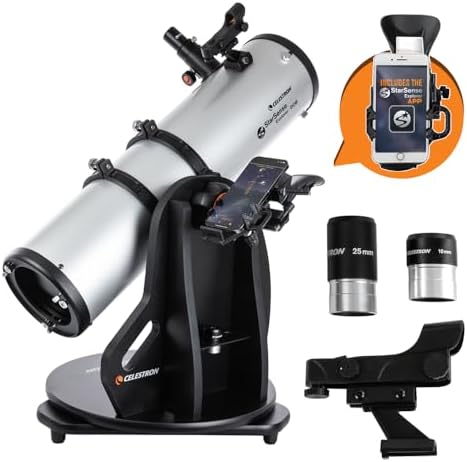
Best Overall: Celestron StarSense Explorer 150mm App-Enabled Tabletop Dobsonian
This is the one I would point a serious beginner toward first. A 150mm mirror is in a completely different league from the small refractors further down this page, and the difference shows up on the objects that make people fall in love with the hobby: the rings of Saturn, the crater shadows along the Moon's terminator, the Orion Nebula as a cloud instead of a smudge.
The mount is the reason I like it. A Dobsonian is a rocker box, not a tripod, and there are no skinny aluminum legs to flex and no slow-motion cables to fiddle with. You push the tube where you want it and it stays. For a beginner, that is the difference between an evening of observing and an evening of fighting the equipment.
The trade-off is real, though. Tabletop means tabletop. You need a sturdy table, a crate, or a stool, and a wobbly picnic table will undo everything the mount does right. It is also not a travel scope. It lives near a door and it comes out when the sky is clear, which, if you are honest with yourself, is exactly how most good telescopes get used.
StarSense is the app-enabled part, and I will say what I always say about it: this is a convenience, not a substitute for knowing the sky. When the app works, it shortens the hunt. Learn four constellations anyway. The night the app misbehaves, you will still find Jupiter.
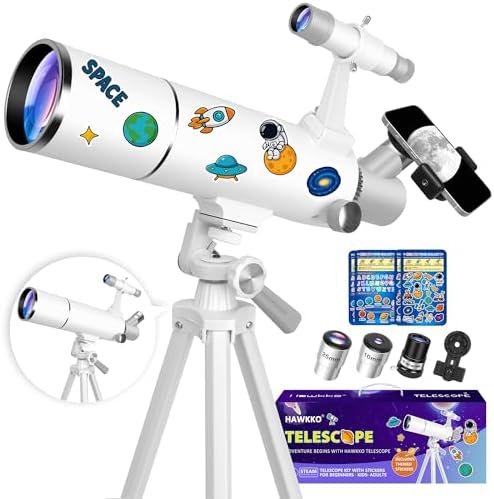
Best Budget First Scope: Hawkko 80mm Aperture 500mm Telescope for Kids 8-12 and Adults
An 80mm aperture with a 500mm focal length is the classic first refractor setup, and it is aimed squarely at kids and at adults who want to start small. Eighty millimeters is enough to show the Moon with genuine detail, to split the phases of Venus, and to catch Saturn as a ringed shape rather than a dot. That is a real accomplishment for a first scope.
What I want you to understand about this class of telescope is where the money goes. It goes to the optics and to the accessories, and the tripod is usually the compromise. A thin tripod on a refractor turns every touch into a two-second shimmy, and at higher power the shimmy becomes a blur. My advice with any scope at this level is to set it up before dark, tap the tube gently, and watch how long the image keeps moving. If it settles fast, you have something. If it keeps swinging, plan to observe from a seated position, keep the legs short, and add weight to the accessory tray.
The other thing to know is that the eyepieces that ship with a budget refractor are a suggestion, not a tool. They are there so the box has everything you need on night one. A single better eyepiece, bought later, will improve the view more than any other upgrade you can make at this price.
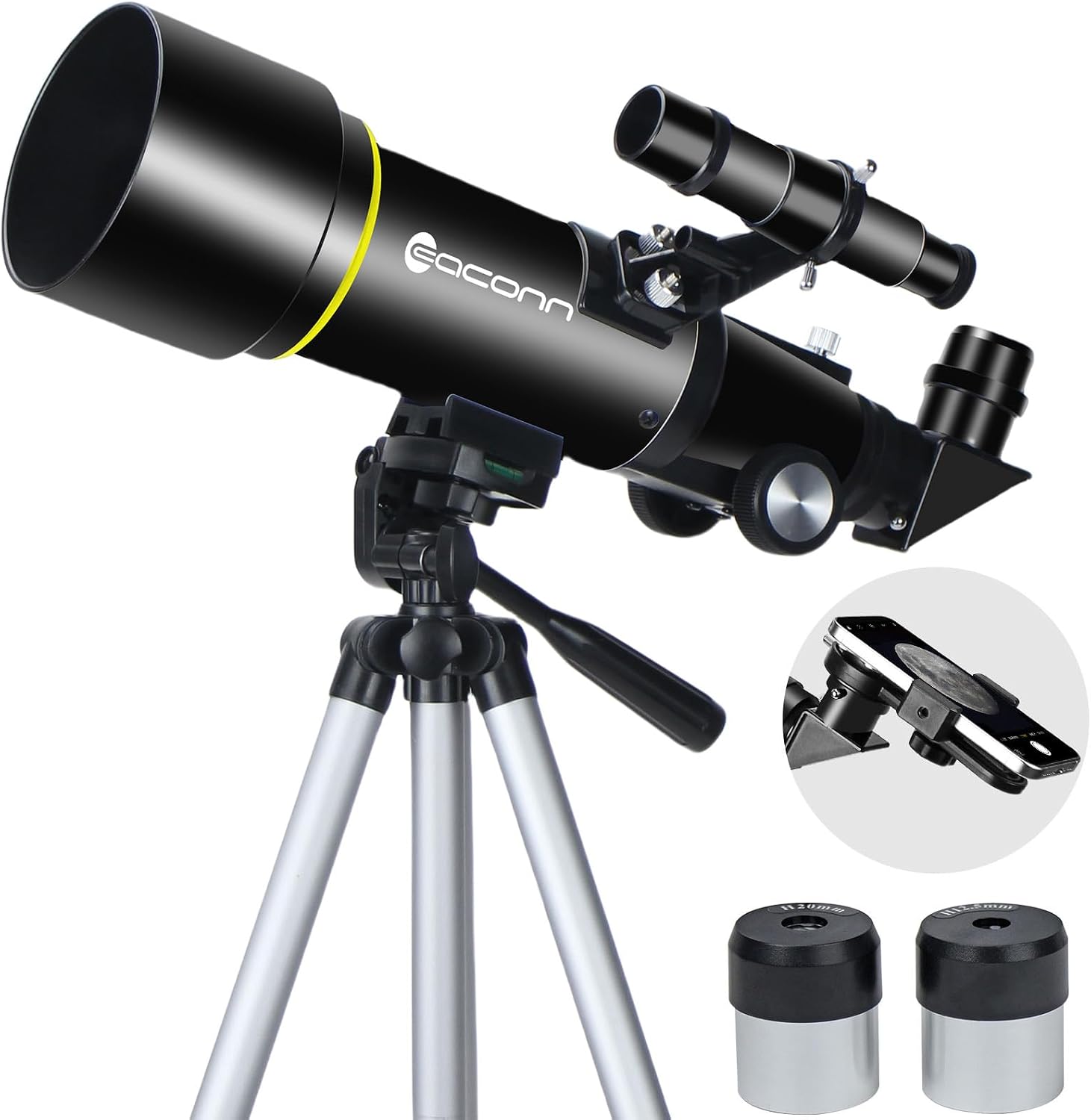
Best for Travel and Kids: 70mm Aperture 400mm Refractor with AZ Mount
A 70mm aperture and a 400mm focal length makes this the smallest and most portable option here, and the alt-azimuth mount keeps the setup simple: one motion up and down, one motion left and right, no counterweights, no polar alignment. For a child, that simplicity matters more than any specification.
Set expectations correctly and this scope is a pleasure. Seventy millimeters is a Moon and bright planet instrument, and the listing is honest about that with its mention of observing the Moon and landscape. Point it at the Moon and you will get craters and a terminator line you can follow for hours. Point it at a faint galaxy and you will get a faint smudge, if anything. That is not a defect. That is physics, and knowing it in advance is what keeps a kid from getting bored and quitting.
Refractors in this price class also show some false color on very bright objects, a thin purple fringe around the Moon's edge or Jupiter's disk. It is normal for the design and it does not mean the scope is broken. You can reduce it by staying at moderate power.
The AZ mount is the selling point, because it is light and it does not need aligning. The catch is the same as above: light mounts move. A short, seated session on a solid table beats a tall, standing session on grass every time.
One listing in this batch is not a telescope
I am not going to pretend this is astronomy gear, because it is not. The HARISON Rowing Machine is a magnetic rower with a 350 pound weight capacity and 16 levels of silent resistance, built for indoor exercise. If you came here to buy a telescope, this is not it.
I am mentioning it because it showed up in the same batch, and because there is one honest connection: long winter nights at the eyepiece are hard on a back, and the observers I know who last decades are the ones who stay in some kind of shape. If you already wanted a quiet rower for the off-season, here it is. If you did not, skip this section and keep reading.
How I judge a beginner telescope
Every scope I recommend gets run through the same four questions, in this order.
Does the mount hold steady at high power? This is the first test, not the last. Steady beats sharp, because a sharp image you cannot hold still is not a sharp image.
Are the optics actually aligned and clean? A reflector's mirrors can drift out of collimation, and a misaligned scope gives soft, blurry views no matter how good the mirror is. If a reflector arrives out of alignment, that is a fixable problem, not a dead scope, but you have to know it is fixable.
Can a beginner use it on night one? I hand the scope to someone who has never touched one. If they can find the Moon and keep it in the eyepiece without me hovering, the design is doing its job.
Would I recommend it to a friend who has never owned a scope? That is the final filter, and it eliminates more telescopes than the other three combined.
Notice that aperture appears in none of those questions, even though it is the most important specification. Aperture is what you get to enjoy after the mount and the alignment and the beginner test are settled. It is the reward, not the requirement.
Analysis: the two numbers that matter most
If you take one thing from this guide, take this: shop the mount first and the aperture second.
Aperture, the diameter of the main lens or mirror, decides how much light you collect and how much detail you can resolve. Going from 70mm to 150mm is not a small step. It is roughly the difference between seeing that Saturn has rings and seeing the gap in them on a steady night. It is also the difference between a nebula being a gray smudge and being a shape with structure.
The mount decides whether any of that reaches your eye. Every telescope has a magnification ceiling set by its aperture and by the atmosphere above you, and the atmosphere in most backyards caps you well below the numbers printed on the box. What actually limits a beginner is not the ceiling. It is the floor: the lowest power at which the image still shakes when you touch the focuser. A steady mount raises that floor and lets you use the scope the way it was meant to be used.
There is one more number worth ignoring, and that is the magnification claim on the packaging. A scope advertising 500x that cannot hold 100x in a real backyard is a marketing problem, not a telescope.
Tabletop Dobsonian versus a tripod refractor
These are the two real choices in this batch, and they solve different problems.
The tabletop Dobsonian, the Celestron in the first section, wins on stability and on light gathering. It is the scope I would take to a dark site. It is also heavier, it needs a table, and it does not fit in a backpack.
The refractors on a tripod win on portability and on simplicity. They are the scopes that go on a car trip, that a kid can carry, and that set up in two minutes in the driveway. They give up aperture to do it.
If you observe from one spot in your yard, take the aperture. If you observe wherever you happen to be, take the portability. The best telescope is the one you actually use, and a 150mm scope that never leaves the garage is worth less than a 70mm scope that gets out every clear night.
About finderscopes and eyepieces
Two accessories decide how pleasant a first year of observing is, and both are afterthoughts on most budget scopes.
The finder is how you aim. If the finder is not aligned with the main tube, every object you hunt for will be somewhere other than where you are looking, and you will blame the telescope. Align it in daylight on a distant chimney or streetlight before you ever try it at night. It takes two minutes and saves entire evenings.
The eyepiece is how you see. The one in the box is a starting point. When you are ready to upgrade something, upgrade that first.
The comparison table
| Telescope | Aperture | Mount | Best for |
|---|---|---|---|
 Visit on Amazon → Visit on Amazon →Celestron StarSense Explorer 150mm App-Enabled Tabletop Dobsonian Telescope |
150mm | Tabletop Dobsonian | Best overall |
 Visit on Amazon → Visit on Amazon →Hawkko 80mm Aperture 500mm Telescope for Kids 8-12 and Adults Beginners |
80mm | Tripod | Best budget first scope |
 Visit on Amazon → Visit on Amazon →70mm Aperture 400mm Focus Length Refractor Travel Telescope with AZ Mount |
70mm | AZ mount tripod | Best for travel and kids |
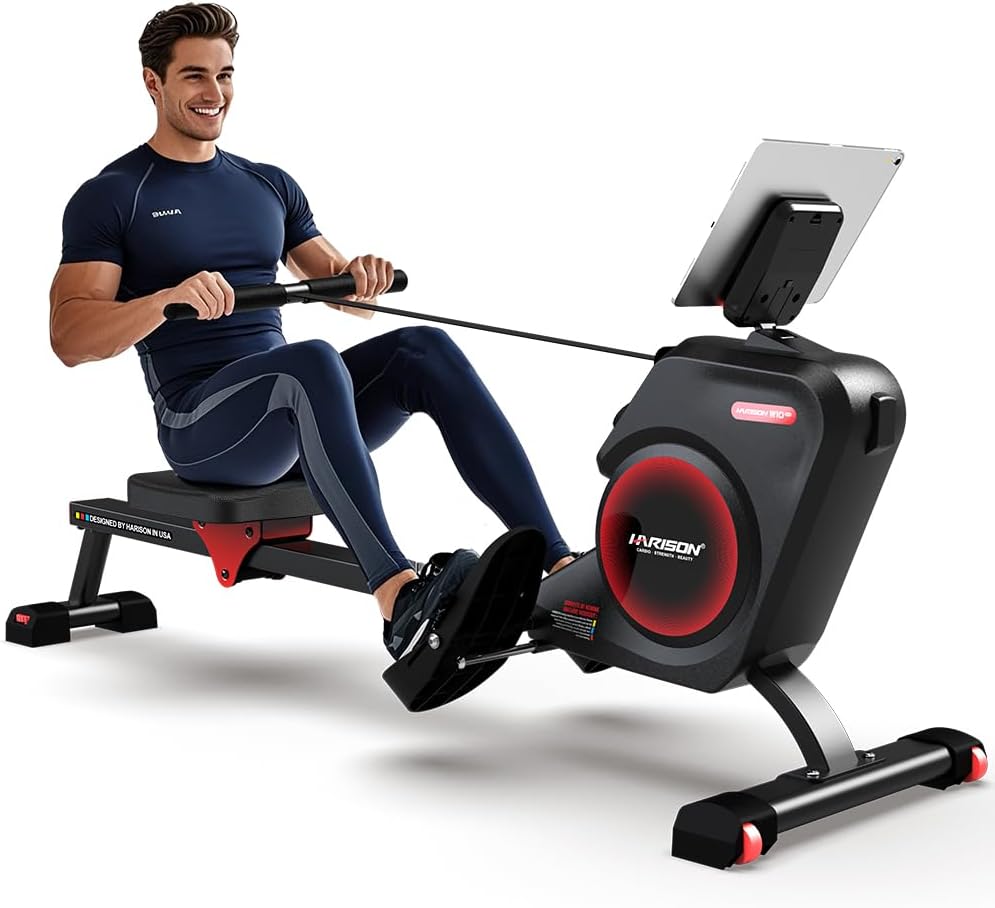 Visit on Amazon → Visit on Amazon →HARISON Rowing Machine, Magnetic Rowing Machine for Home |
Not applicable | Not applicable | Not a telescope |
Read the table by column, not by row. The aperture column tells you what each scope can show you. The mount column tells you whether you will actually get to see it.
Should you buy the Celestron StarSense Explorer 150mm?
If you have a spot in the yard, a sturdy table or stool, and any real interest in seeing deep-sky objects rather than just ticking off the Moon, yes. This is the scope in this batch with the aperture to grow with you, and the Dobsonian mount removes the single most common reason beginners quit.
The app is a nice shortcut. It is not a replacement for a star chart and a red flashlight, and you should not treat it as one. Also budget for a table you can actually stand next to comfortably, because a tabletop scope on the wrong table is a frustrating scope.
Should you buy the Hawkko 80mm?
Yes, if you want a first refractor with a bit more light gathering than the smallest option here, and you accept that the tripod is the part you will learn to work around. It is a sensible Moon and planet scope, and it is a reasonable size for a kid who is ready to be careful with equipment.
Plan on upgrading the eyepiece before you upgrade anything else, and set it up seated with the legs short. That single habit fixes most of what people complain about with scopes in this class.
Should you buy the 70mm refractor?
Yes, if portability is the deciding factor. It is the scope that fits in the car, sets up in minutes, and asks nothing of you in terms of alignment. For a child's first telescope, or for an adult who wants to observe the Moon from a balcony, that is a fair trade for the smaller aperture.
Just be honest with yourself about what it is. It is a Moon and bright planet scope and a daytime spotting scope. It is not a deep-sky instrument, and no eyepiece will make it one. Buy it for what it does well and it will earn its place by the door.