I have spent twenty years teaching people to look up. Twelve of those years I ran a public observatory in Tucson, which means I have watched thousands of people put an eye to an eyepiece for the first time, and I have also watched a lot of telescopes go home and never come back out of the closet. This beginner telescope comparison comes out of that logbook: not the specs I wish mattered, but the scopes that actually get used.
The pattern is never subtle. The telescope that gets used is the one that sets up in under five minutes, holds steady when you touch it, and shows something worth the trip outside. Everything else is marketing. A 60mm department store refractor with 500x printed on the box is not a beginner telescope. It is a reason to quit astronomy, and I have met plenty of people it chased away.
The best beginner telescope in this comparison for most families is the Celestron StarSense Explorer 130mm tabletop, because the app takes the hardest part of night one, finding things, and hands it to your phone while still giving you 130mm of real aperture. If you want to learn the sky on your own terms and spend less, the 114mm Newtonian on the equatorial mount is the better teacher, and the 80mm refractor is the one that actually leaves the closet on a random Tuesday.
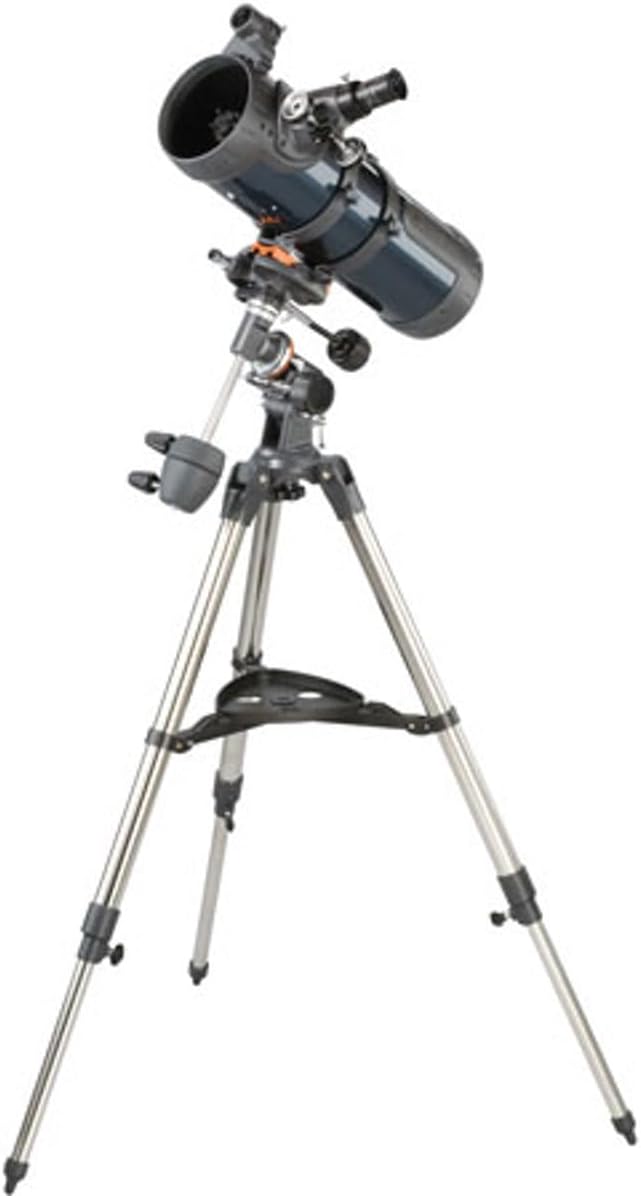
Celestron AstroMaster 114EQ Telescope for Family Stargazing
114mm of aperture and an equatorial mount that moves with the sky, so following a planet is one slow-motion knob instead of a constant chase
The EQ mount is the steepest setup curve here, and the bundled eyepieces are a suggestion rather than a tool
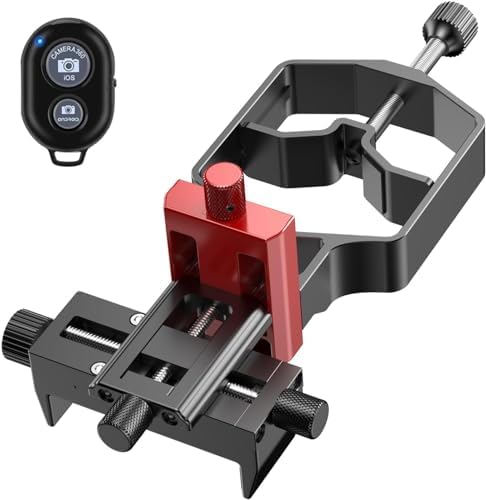
tridaptor Universal Phone Scope Digiscoping Adapter
A rigid metal XYZ mount that holds a phone camera over the eyepiece, fitting eyepieces up to 2.4 inches so it works with nearly any beginner scope
It is an accessory, not a telescope, and it adds a fiddly step to every session
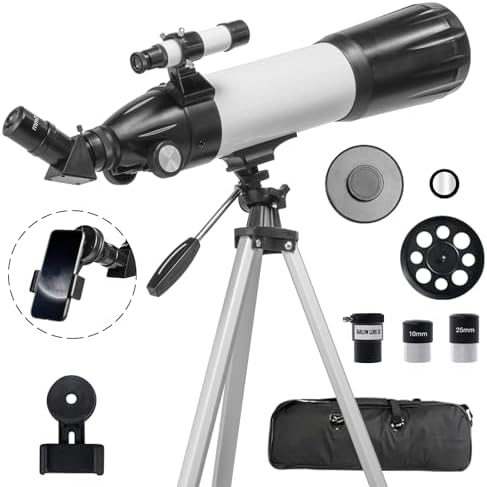
Telescope 80mm Aperture 600mm Portable Refracting Telescope
Lightest and fastest to set up, with an AZ mount anyone can point, fully multi-coated optics, a tripod, a phone adapter, and a carrying bag in the box
80mm is the smallest aperture in this comparison, so faint galaxies and nebulas stay faint
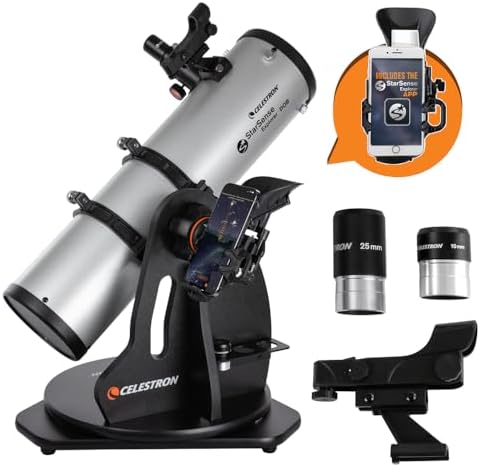
Celestron StarSense Explorer 130mm Tabletop Telescope with Smartphone App
130mm of aperture plus an app that reads the sky and tells you exactly where to push the tube, with no alignment ritual before you start
The tabletop design needs a table or other flat surface, and it is easy to let the app do all the finding for you
Prices and availability were captured from Amazon Creators API and may change.
How I judge a beginner telescope
Four things, in this order, and I do not care what the box says until all four are done.
First, the mount. A great optical tube on a mount that shakes is a great tube you cannot use. I put my hand on the tube and tap it, the way a breeze or a focusing hand will, and I watch how long the image takes to settle. If I cannot focus without the view swimming, the scope fails before it ever sees a planet.
Second, collimation. Newtonians need their mirrors aligned, and a scope that arrives badly collimated will show mush no matter how dark your sky is. I check it, I adjust it if the design allows, and I note whether a beginner could realistically do the same with the tools in the box.
Third, a full night of observing. Not ten minutes in the driveway. A real session, with the scope doing what a scope does: waiting for the sky to steady, chasing focus, changing eyepieces in the dark.
Fourth, the beginner test. I hand it to someone who has never used a telescope and I say nothing. I watch where they grab it, how long it takes them to find the Moon, and whether they ask me for help. That last test has killed more scopes for me than any measurement.
Aperture first: the Celestron AstroMaster 114EQ
The AstroMaster 114EQ is a 114mm Newtonian reflector on an equatorial mount, and the aperture is the headline. Aperture is the diameter of the main mirror, and it is the single most important spec in a telescope, because it decides how much light you collect. More light means more stars in a cluster, more detail on the Moon, and a Saturn that looks like a ringed planet instead of a bright oval.
The equatorial mount is the part people underestimate. An EQ mount is built to move the way the sky moves, so once you understand it, you can follow a planet across the eyepiece by turning one slow-motion control. That is a genuine pleasure on a long session, and it is why so many of these scopes end up in the hands of people who stick with the hobby.
The catch is the first night. An equatorial mount asks you to understand what it is doing before it rewards you. Point it in the wrong direction, or skip the rough polar setup, and you will spend twenty minutes fighting the slow-motion knobs instead of looking at anything. This is the scope in this comparison that most rewards patience, and the one most likely to scare off an impatient beginner.
The eyepieces are the other thing to plan for. The eyepieces that ship with a scope are a suggestion, not a tool. Budget for one decent eyepiece upgrade and this tube gets noticeably better.
The app does the finding: Celestron StarSense Explorer 130mm tabletop
The StarSense Explorer 130mm is the opposite philosophy. It gives you more aperture than the AstroMaster, 130mm, and then it removes the hardest part of the hobby: finding things in the first place.
You set your phone in the dock, the app reads the sky through the phone camera, and it tells you which way to push the tube to land on a target. There is no alignment ritual, no entering dates and coordinates, no star hopping from a bright star to a faint one while your fingers go numb. For a family with kids, or for anyone who has ever stood in the yard wondering why the Andromeda Galaxy is not where the internet said it was, this is a genuine cheat code.
The tabletop part matters too. This is a design that sits on a table, a bench, or a sturdy box rather than spreading three legs, which removes the tripod wobble that ruins so many cheap setups. It also means you need a flat surface, and it means the height you observe at is the height of whatever you set it on.
My one real complaint is philosophical. When the app does all the finding, you learn the app instead of the sky. I have watched people use one of these for a year and still not be able to point out where the Summer Triangle is. That is not the scope's fault, but it is the trade you are making. Use the app, then turn it off once a month and find something yourself with a chart.
Grab and go: the 80mm refractor
The 80mm aperture, 600mm focal length refractor is the smallest scope in this comparison, and I want to be honest about what that means. Aperture is king for visual observing, and 80mm collects a fraction of what 130mm collects. Galaxies and nebulas stay faint smudges. If your goal is faint fuzzies, this is not the tube.
But this is the scope that actually gets used. It is a refractor, so the optics are fully multi-coated and there is no collimation to worry about. It rides an AZ mount, which means you point it and you look, the way a beginner expects a telescope to work. It ships with a tripod, a phone adapter, and a carrying bag, so the entire kit travels in one trip from the closet to the car.
On the Moon, this is a lovely little instrument. Saturn's rings show up. Jupiter and its four bright moons show up. Star clusters, double stars, and the Pleiades all look the way they should. And on a weeknight when you have twenty minutes and no energy, this is the one you will actually carry outside, which is worth more than aperture that stays in the closet.
The accessory nobody thinks to buy: a phone digiscoping adapter
Every beginner eventually tries to hold a phone up to an eyepiece. It does not work. Your hand shakes, the phone never sits square to the lens, and you get a blurry bright smudge where the Moon used to be.
A digiscoping adapter fixes that. This one is a metal, three-axis adjustable mount that clamps the phone camera over the eyepiece and holds it there, and it fits eyepieces up to 2.4 inches, which covers nearly every beginner telescope, plus spotting scopes, monoculars, and binoculars. The XYZ adjustment is the important part, because it lets you line the phone camera up with the exit pupil instead of hoping.
What you get from it is a picture. A decent phone shot of the Moon through an 80mm refractor is genuinely satisfying, and it is the thing that gets a kid interested in the next session. What you do not get is astrophotography. Digiscoping is fiddly, it rewards patience, and a phone sensor is still a phone sensor.
Buy it if you already own a telescope and want to share what you see. Do not buy it instead of a telescope.
Mounts, eyepieces, and the magnification lie
The mount is the telescope. Everything else is optics on top. A wobbly tripod turns a 130mm mirror into a 130mm headache, and a steady mount turns a modest 80mm lens into something you look through every clear night.
The magnification number on the box is the least useful spec in the hobby. A practical ceiling for any scope is roughly twice the aperture in millimeters, and even that assumes a steady atmosphere and a good eyepiece. When you see 500x printed on a small refractor, you are looking at a number chosen by a marketing department, not an optical engineer. You will never use it, and if you try, the image will be an empty, mushy mess.
Eyepieces are where beginners get the most improvement per dollar. Every scope in this comparison will benefit from one better eyepiece, and it is the cheapest upgrade you can make to any of them.
The trade-offs, stated plainly
Aperture against portability. The 130mm tabletop wins on light gathering, the 80mm refractor wins on nights you barely feel like going outside. The 114mm Newtonian sits in the middle and asks for more setup effort in exchange for a mount that tracks the sky.
App against chart. The StarSense app removes the frustration of finding objects, and it also removes the learning. Use it as training wheels, not as a permanent substitute.
Accessory against telescope. The digiscoping adapter makes the scope you already own more fun. It cannot make a scope appear.
Aperture against price. There is no way around this one. More mirror costs more money, and the cheapest way to get real aperture is a Newtonian on a simple mount, which is exactly what the 114EQ is.
Which one should you buy?
If this is a family's first telescope and you want the fewest possible ways for night one to fail, get the Celestron StarSense Explorer 130mm tabletop. The app finds things, the aperture is real, and there is no tripod to wobble.
If you want to learn the sky and you are willing to spend an evening learning your mount, get the Celestron AstroMaster 114EQ. It teaches you the hobby instead of hiding it, and the equatorial mount will still be useful in five years.
If you live in an apartment, observe from a balcony, or want a scope that travels, get the 80mm refractor. It will not show you faint galaxies, and it will be the one you use most.
If you already own any telescope and want to share what you see, add the digiscoping adapter. It is the cheapest way to turn a solo hobby into something the whole family can look at on a phone screen the next morning.
What I'm testing next
The 2026 beginner class is still coming through the bench. I have more units queued for the same four-part test: a full night each, a collimation check, the mount tap, and the beginner handoff. The scopes that survive that will show up here, and the ones that do not will get a paragraph explaining exactly where they fell down. That is the whole point of this logbook. The best telescope is the one you actually use, and I would rather tell you to buy a smaller scope you will carry outside than a bigger one that lives in the closet.