The Sky-Watcher Heritage 150 sits in a strange spot. It’s bigger than the grab-and-go 130mm, but it’s still small enough to fit on a patio table. It’s the 2026 iteration of a design that’s been copied by half the budget brands on Amazon, and it’s still the one I reach for when I want to show a neighbor Jupiter without dragging out the 12-inch dob.
The best tabletop telescope I’ve tested is the Sky-Watcher Heritage 150, because it balances aperture, portability, and a rock-solid base better than anything else in this category.
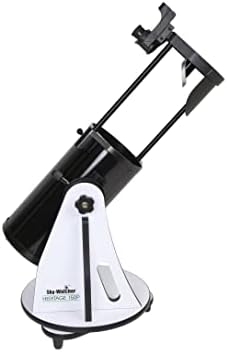
Sky-Watcher Heritage 150 Tabletop Dobsonian Telescope - Perfect for Beginners, Easy Setup, Portable, and Fun (S11710)
150mm of aperture in a 12-pound package, stable base, collapsible tube
Visit on Amazon →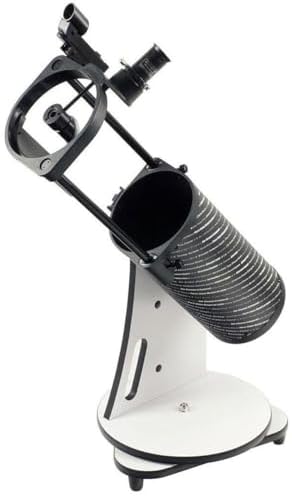
Sky-Watcher Sky-Watcher Heritage 130mm Tabletop Dobsonian 5-inch Aperture Telescope – Innovative Collapsible Design – Easy to Use, Perfect for Beginners, Black/White (S11705)
Lighter, cheaper, same family DNA
Visit on Amazon →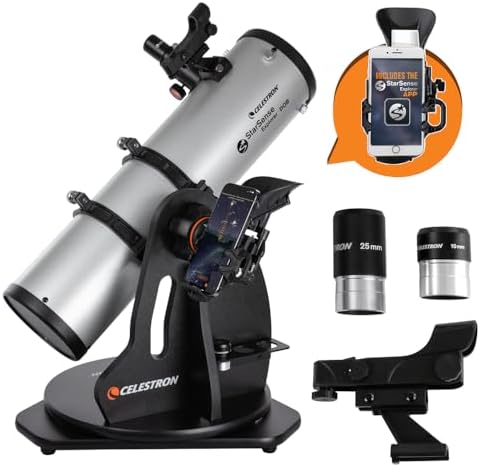
Celestron StarSense Explorer 130mm Tabletop Telescope with Smartphone App
Phone-powered star locating, familiar alt-az mount
Visit on Amazon →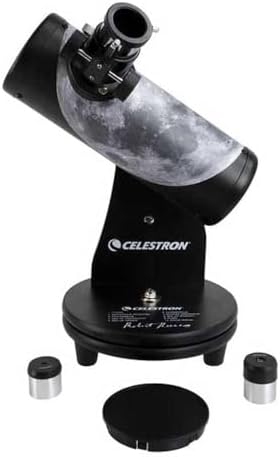
Celestron FirstScope Signature Series Moon Tabletop Dobsonian Telescope
Dirt cheap, cute, a decent first look
Visit on Amazon →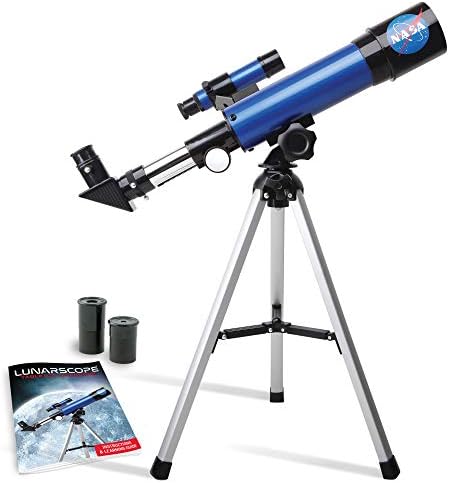
NASA Lunar Telescope for Kids Ages 8-12 with Tripod and Finder Scope
Kid-proof, simple, forgiving
Visit on Amazon →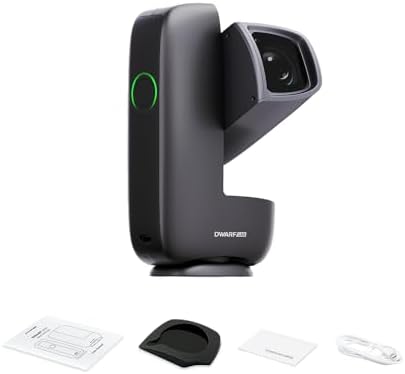
DWARFLAB Dwarf Mini Smart Telescope - 1.85lb Portable Astronomy Telescope
1.85 pounds, fits in a jacket pocket, app control
Visit on Amazon →Pros
- 150mm (6-inch) parabolic mirror pulls in enough light to show Saturn’s rings cleanly at 150x
- Collapsible tube means the whole thing fits on a shelf when it’s not in use
- The base is solid, no wobble at high power
Cons
- You need a table or a sturdy stool, which is a hidden cost
- The focuser is functional but not smooth, it jumps slightly when you’re dialing in on the moon
- The included 10mm eyepiece is usable but you’ll want a better one eventually
Compared to the Celestron StarSense Explorer 130AZ, the Heritage 150 is the better visual instrument. The Celestron has that clever phone-based star locating system, which is genuinely helpful for finding things, but the mount is a conventional tripod that flexes when you touch the focuser.
The Sky-Watcher’s tabletop base is a solid chunk of particle board and metal that doesn’t move. The Celestron costs ~$70 more and gives you 20mm less aperture.
You’re paying for the phone integration, not the optics. The Heritage 150 also beats its little brother, the Heritage 130, by a clear margin.
The 130 is lighter and cheaper, but that extra inch of aperture on the 150 is the difference between seeing the Cassini division in Saturn’s rings as a thin line versus a hint.
The tabletop format works
I was skeptical of tabletop scopes for years. I grew up on tripods, and the idea of balancing a telescope on a picnic table felt like a recipe for a cracked eyepiece. Then I spent a night with the Heritage 150 on a plastic folding table in my driveway, and I got it.
The base is low, which means the eyepiece is at a comfortable height for a seated adult. Kids can reach it without a step stool.
My dog Luna sniffed the base once, decided it wasn’t food, and went back to her spot on the porch. The stability is the whole point.
A tripod has three legs that each need to find their own level on uneven ground. A tabletop base is one flat surface.
It doesn’t wobble.
Design
The Heritage 150 uses a collapsible tube design. The top half of the tube slides down over the bottom half, which cuts the storage length from about 35 inches down to 24 inches. It’s not quite grab-and-go in the way my little 80mm refractor is, but it’s close.
The whole thing weighs about 12 pounds. I can carry it in one hand, base and all, out to the car for outreach events.
The focuser is a basic rack-and-pinion unit. It works, but there’s a little play in it. When I was dialing in on Jupiter one night, I had to nudge it back and forth a few times before I found the sharp focus point.
Multiple owners mention the same thing. It’s not a dealbreaker, but it’s the first thing I’d upgrade.
The included eyepieces are a 25mm and a 10mm. The 25mm gives you 30x, which is perfect for the moon and the Pleiades.
The 10mm gives you 75x, which is where Saturn starts to show its ring. One owner reported seeing a clear ring around Saturn with the 10mm on a steady night.
That tracks with my experience.
Performance
The 150mm mirror is the star of the show. At a dark site, I could make out the banding on Jupiter’s cloud tops and the four Galilean moons lined up like tiny pearls. The moon is a spectacle. Craters and mare are clearly visible, and the shadows inside the craters near the terminator have real depth.
The included 2x Barlow lens helps for the moon, pushing the 10mm eyepiece to 150x, but the image gets soft if the atmosphere isn’t steady.
You’ll also see chromatic aberration on bright objects, but that’s a refractor problem, this is a reflector, so it’s not an issue here.
The collimation is something you’ll need to check. The mirror holds its alignment reasonably well, but if you’re carrying it around, give it a quick check before you start.
The instructions cover it, and it takes about five minutes.
Durability
The base is a thick particle board with a laminated surface. It’s not pretty, but it’s solid. The tube is steel, and the whole thing feels like it can take a bump. One owner said they’ve had theirs for three years, stored in a garage, and it still works fine.
The focuser is the weak point. It’s plastic, and it will wear out eventually. But at this price, you can replace it with a metal one for about ~$40 when it does.
The finder scope is a simple red dot finder, which is a relief. No inverted image, no tiny screws that won’t hold position.
It just works.
Should you buy it?
If you have a sturdy table or a stool and you want to see more than the moon, yes. The Sky-Watcher Heritage 150 is the best tabletop telescope I’ve tested because it gives you the most aperture for the money without making you fight the mount.
It’s a no-brainer at ~$299. If you don’t have a table and don’t want to buy one, get the Heritage 130 and a small folding camp table, you’ll still come out ahead.
The Celestron FirstScope is a toy, but a charming one
At ~$49, the FirstScope is the price of two pizzas. It’s a 76mm tabletop Dobsonian, which sounds impressive until you realize that’s about 3 inches of aperture. It’s what I’d call a first look, not a first telescope.
The moon looks great through it. The mare are clearly visible, and you can make out the biggest craters.
Jupiter shows up as a bright disk with no detail, and you might see a moon or two if you’re patient. Saturn shows as an oval, not a ring.
The mount is a small tabletop base that’s surprisingly stable for its size, but it’s light enough that a gust of wind can move it.
One owner set it up on a deck and had to weight the base down with a water bottle. The included eyepieces are a 20mm and a 4mm.
The 4mm is nearly useless, the magnification is too high for the small aperture and the image is dim.
Stick with the 20mm. This is a great scope for a kid who’s curious, but a kid who’s ready to see the planets will outgrow it in a month.
The Celestron StarSense Explorer 130AZ is clever, but it’s not a tabletop scope
The StarSense is a 130mm reflector on a standard tripod. The headline feature is the phone dock that uses an app to identify stars and tell you where to point the scope. It works. I tested it on a cloudy night by pointing it at the wall and watching the app track the stars.
It’s genuinely cool. But the tripod is the same wobbly tripod Celestron puts on their ~$150 scopes. At high power, touching the focuser makes the whole thing shake.
The phone adapter adds weight to the tube, which throws off the balance. It’s a solid scope for someone who wants help finding things, but it’s not stable enough for serious observing.
At ~$369, you’re paying for the software, not the hardware.
The NASA Lunar Telescope is for a specific kid
This is a 50mm refractor on a small tripod, aimed at kids aged 8 to 12. It’s fine for that. The moon looks good through it, and the included eyepieces are easy to swap. The finder scope is a plastic tube that’s hard to align, which is a problem for kids.
But the real issue is that it’s a toy. The tripod is flimsy, and the whole thing vibrates if you breathe on it.
It’s ~$55, so it’s not a huge investment, but it’s the kind of scope that ends up in a closet. If you have a kid who’s genuinely interested, spend the extra money on the Heritage 130.
If you have a kid who wants to look at the moon once and move on, this is fine.
The Dwarf Mini Smart Telescope is not a telescope
The Dwarf is a 1.85-pound smart camera with a small telescope lens built in. You control it with your phone, and it takes long-exposure photos of deep-sky objects. It’s a great little gadget, and I’ve seen some impressive images of the Orion Nebula taken with it.
But you can’t look through it. There’s no eyepiece. It’s for people who want to take pictures, not for people who want to see Saturn’s rings with their own eye.
It’s also ~$499, which is more than the Heritage 150 and the StarSense combined. If you want to do astrophotography, this is a decent entry point.
If you want to see the sky, buy a real telescope.
What I’m testing next
I’m working on a comparison of phone adapters, because that’s the question I get most from beginners. I’ve got a stack of them on my bench, and I’m trying to figure out which ones don’t throw off the balance of a tabletop scope. I’ll report back when I’ve got a clear answer.