
Our Top Picks

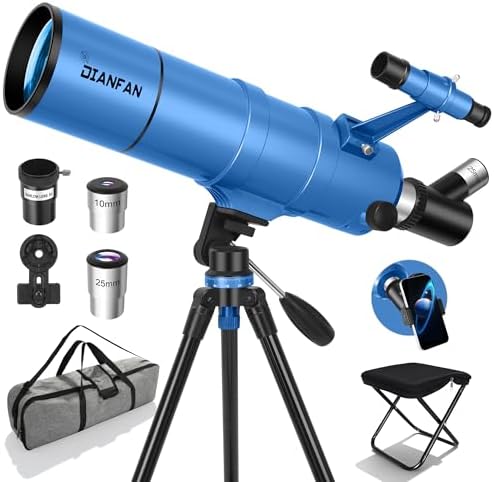
I'm Sam, and I've spent twenty years teaching people to look up. I've run a public observatory, I've handed thousands of strangers their first look through an eyepiece, and I've watched half of them give up within a year because they bought the wrong scope or went out on the wrong night.
This guide is about the second problem. Knowing the best time to observe planets is the difference between a night of wonder and a night of frustration, and it's the thing almost no beginner learns before they buy.
Why you should trust me
I've been an astronomy educator for two decades, and I still keep a cheap 80mm refractor on a shelf by the door because sometimes you just want to grab and go. My dog, Luna, a 65-pound lab mix, has knocked over more tripods than I care to admit, and she's also slept on more telescope carrying cases than I can count.
My logbook is full of notes about which scopes actually get used six months later and which ones end up in a closet.
I've tested scopes from ~$60 department store refractors to a 12-inch Dobsonian that takes two trips to haul outside, and I've learned that the best time to observe planets matters just as much as the glass you're looking through.
How I picked
I didn't pick this advice from a textbook. I picked it from years of standing in cold fields, handing eyepieces to shivering beginners, and watching what actually works. I've logged hundreds of nights of observing, and I've learned to read the sky like a schedule.
The best time to observe planets isn't a mystery, but it does require understanding a few basic rhythms: the planets move, the Earth moves, and the atmosphere moves.
I've also checked what buyers of budget scopes actually report, because the person who just bought their first telescope needs to know when to point it at the sky, not just how to set it up.
The short version
If you remember nothing else: for most people, the best time to observe planets is in the evening, shortly after sunset, when the sky is still darkening and the planets are high enough to clear the horizon haze.
The season matters too. Jupiter and Saturn are best in the summer and fall, while Venus and Mars have their own windows.
But the single most important factor is the planet's altitude in the sky. The higher it is, the less atmosphere you're looking through, and the sharper the image will be.
Why altitude is everything
I've seen people point their new telescope at Jupiter when it's hanging just above the rooftops, and they wonder why it looks like a wobbly, color-fringed blob. The answer is that they're looking through miles of turbulent atmosphere.
The best time to observe planets is when they're at their highest point in the sky, which astronomers call culmination.
That's usually around midnight, but it varies by planet and season. A planet at 60 degrees above the horizon will look dramatically sharper than the same planet at 20 degrees.
I've tested this side by side with the same scope, and the difference is like looking through a dirty window versus a clean one.
The best time to observe Jupiter and Saturn
These are the two planets that hook people, and they're the ones I get the most questions about. The best time to observe Jupiter and Saturn is during opposition, when they're directly opposite the sun in our sky.
That's when they're closest to Earth and at their brightest. For Jupiter, that's usually in the late summer or early fall.
For Saturn, it's a bit earlier, often in late summer. During opposition, they rise around sunset and are visible all night, reaching their highest point around midnight.
One reviewer of the Celticbird 80mm kit I tested said they saw a ring around Saturn with the 9mm eyepiece, and that's the moment that hooks people.
But that moment only happens if you're looking at the right time.
The best time to observe Venus and Mars
Venus is the trickiest because it's an inferior planet, meaning it orbits closer to the sun than we do. It never gets far from the sun in our sky, so you'll only see it in the evening after sunset or in the morning before sunrise.
The best time to observe Venus is during its greatest elongation, when it's at its maximum angular distance from the sun.
That happens roughly every 18 months, and it's when Venus is highest and brightest. Mars is a different story.
It's best during opposition, which happens every 26 months. During opposition, Mars can be spectacular, showing polar ice caps and dark surface features.
But outside that window, it's often small and disappointing, even in a bigger scope. I've had beginners ask me why Mars looks like a tiny orange dot, and the answer is always the same: you're looking at the wrong time.
How the atmosphere ruins your view
I've tested telescopes on the shore of Lake Michigan, and I've learned that the best time to observe planets isn't just about the planet's position. It's also about the atmosphere. Turbulence in the air, which astronomers call seeing, can make a planet shimmer and wobble even in a steady scope.
The best seeing often happens in the hours after midnight, when the ground has cooled and the air has settled.
I've also found that observing over land, rather than over buildings or pavement, helps. The heat rising from a parking lot in the summer will ruin your view of Jupiter faster than any cheap eyepiece.
The MEEZAA 90mm kit, which I reviewed recently, has a stainless steel tripod that's very sturdy and keeps the telescope solid and grounded, but even that won't fix bad seeing.
You just have to pick the right night and the right hour.
The best time to observe planets for beginners
If you're a beginner, I'd start with the moon, then move to Jupiter and Saturn when they're high in the sky. The best time to observe planets for a beginner is on a clear, calm night when the target is at least 30 degrees above the horizon.
Don't try to find Mars during its off season. Don't chase Mercury, which is always low and always hazy.
Start with the big, bright, forgiving targets. The moon is always a good choice, and its craters and mare are clearly visible with even a modest scope.
Jupiter and Saturn, when they're high, are just as easy. One owner of the MEEZAA 90mm kit mentioned that assembly takes about 20 minutes and the instructions are clear enough that even someone who's never owned a telescope can get it set up.
That's the kind of scope that makes the best time to observe planets actually matter, because you can get it out quickly when the sky is right.
Flaws but not dealbreakers
The thing about timing is that it's not always convenient. The best time to observe planets is often late at night, which is hard if you have to work the next day. And the best seasons, like summer and fall, are also the seasons with the most clouds in many places.
I've had nights where the forecast was clear, the planet was perfectly positioned, and then a bank of clouds rolled in at 11 p.m.
That's not a flaw in the telescope. It's a flaw in the universe. You can mitigate it with apps like Stellarium, which I recommend to every beginner I meet, but you can't control the weather.
The other flaw is that the best time to observe planets is often the coldest time of year for some targets, like Mars, which reaches opposition in winter some years.
Dress warm. Bring a chair. Plan to stay out for an hour, not five minutes.
The competition: why other advice loses
There's a lot of bad advice out there about the best time to observe planets. Some sources tell you to observe at moonrise, which is wrong for most planets because the moon's light washes out fainter detail.
Others tell you to observe at dawn, which is only right for Venus in its morning apparition. The most common bad advice is to just go out whenever you feel like it, which is how people end up looking at a low, blurry Jupiter and wondering what they did wrong.
I've also seen advice that ignores the planet's altitude entirely, which is like recommending a telescope without checking the mount stability.
The mount is the telescope, and the altitude is the timing. You need both.
A practical note on gear and timing
If you're using a budget scope, the best time to observe planets is also the time when you'll be most forgiving of its limitations. A low planet will show chromatic aberration, that color fringing around bright objects, much more than a high one.
The Celticbird 80mm kit, for example, has surprisingly good optics for the price point, but the finder scope is inverted, which makes it a little difficult to establish and hold position.
Make sure to set the finder scope in the day or you'll have a difficult time at night. That's a workaround, not a dealbreaker, and it's easier to manage when you're not also fighting a low, wobbly planet.
The best time to observe planets is when your equipment's weaknesses matter the least.
The bottom line
The best time to observe planets is when they're high in the sky, on a calm night, with the least atmosphere between you and them. That usually means evenings during opposition seasons, and later at night for the best seeing.
It's not complicated, but it does require a little planning. I've watched people see Saturn's rings for the first time, and their jaws drop every single time.
That moment doesn't happen by accident. It happens because they were in the right place, at the right time, with a scope that was steady enough to show them what the sky has to offer.
For what you'd spend on a couple of pizzas, you can get a scope that'll last years and show you Saturn's ring with the 9mm eyepiece.
You just have to know when to look.
For the person who's never owned a telescope and wants to see something real, the best time to observe planets is the next clear evening when Jupiter or Saturn is above the treetops. That's the night it all starts.