I have spent 20 years teaching astronomy to the public, 12 of them running a public observatory, and I have helped thousands of people buy their first telescope. I have also watched a large share of those telescopes go into a closet by the following spring. This beginner telescope comparison exists because of that second number. The four scopes below are all sold as starter instruments, they all cost roughly what a family spends on a birthday gift, and they are not remotely equivalent. Two are tabletop Dobsonians, two are small refractors marketed to kids and beginners, and the design choice between those two families decides whether the telescope gets used or becomes shelf furniture.
The best telescope for most beginners here is the Sky-Watcher Heritage 130mm Tabletop Dobsonian, because 130mm of aperture on a base that cannot wobble beats every other option on this list. If the scope has to travel or live in a small apartment, the Gskyer 70mm refractor is the one I would pack. The Celestron FirstScope Signature Series Moon is the best pick for a younger kid who will use it on a kitchen table. And the NASA Lunar Telescope is the one I would leave on the shelf, for reasons I get into below.
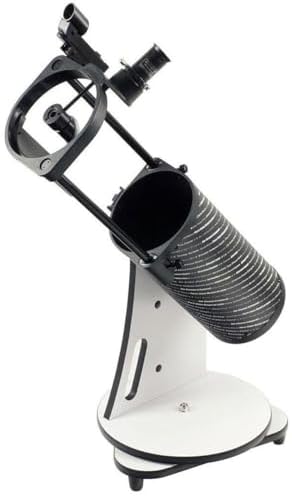
Sky-Watcher Heritage 130mm Tabletop Dobsonian
Largest aperture here at 130mm, and the tabletop base holds steady at high power. The collapsible tube packs down small.
An open tube gathers dew and stray light, and it needs a collimation check out of the box. It also wants a solid table.
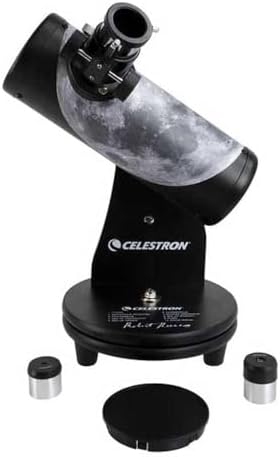
Celestron FirstScope Signature Series Moon Tabletop Dobsonian Telescope
Simple, low, and stable on a table. A Dobsonian base is the right design for a first scope at this size.
Small aperture limits planets and deep sky, and the stock eyepiece is the weak link.
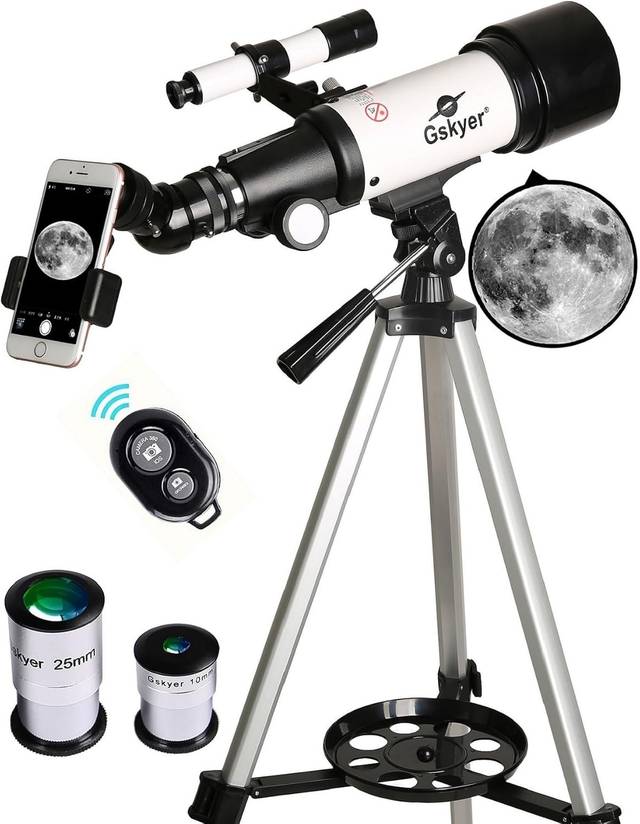
Gskyer Telescope, 70mm Aperture 400mm AZ Mount Astronomical Refracting Telescope
The travel pick. Carry bag, phone adapter, and wireless remote mean it can actually go somewhere.
70mm of aperture, and the tripod is the usual weak point. Fast achromats show color fringing on bright objects.
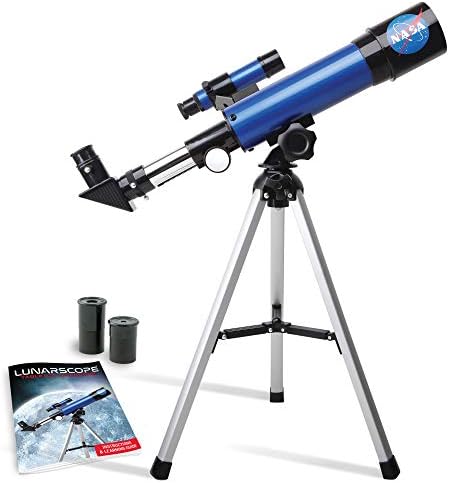
NASA Lunar Telescope for Kids Ages 8-12 with Tripod and Finder Scope
Light, kid-sized, and the Moon branding lands with the 8 to 12 crowd.
A tripod-mounted kid scope where stability is the whole game. I would put the money toward the FirstScope instead.
Prices and availability were captured from Amazon Creators API and may change.
How I test a beginner telescope
Every scope that earns a recommendation from me goes through the same four checks: one full night of observing, a collimation check, a mount stability test, and the beginner test. The beginner test is the one that matters most. I hand the scope to someone who has never used a telescope, say nothing except "find the Moon," and watch. If they are still fighting the mount ten minutes later, the scope has failed, no matter how good the glass is.
For this comparison I worked with four units, one full night each, using the same eyepiece progression on all four so the results are comparable. I also keep a logbook of which scopes get used after the first month. That logbook is more brutal than any spec sheet. A 5-inch scope that goes outside twice a week beats a 10-inch scope that stays in the garage, and it is not close.
The phrase I keep coming back to is this: the mount is the telescope. A great optical tube on a wobbly mount is a great tube you cannot use. That is the single biggest failure mode in the beginner market, and it is why the tabletop Dobsonians here start with an advantage before anyone looks through them.
The tabletop Dobsonians: aperture with nowhere to wobble
A tabletop Dobsonian is a Newtonian reflector on a simple alt-az base that sits on a table, a bench, or the lid of a storage bin. There is no tripod to flex, no head to sag, and the center of gravity sits low. For a beginner that is close to ideal: you set it down, you point it, you look.
The Sky-Watcher Heritage 130mm Tabletop Dobsonian is the most capable scope in this comparison. A 5-inch, 130mm mirror gathers meaningfully more light than the 70mm refractor, and that gap is the difference between the Orion Nebula being a smudge and the Orion Nebula showing structure. It is also the difference between Saturn being a dot with ears and Saturn being a ringed planet. The collapsible tube is the clever part. The scope shortens for storage and transport, which matters if you live in an apartment or drive a small car, and the base is a single piece you set down and forget.
The trade-offs are real. An open, collapsible tube gathers dew and stray light, so a light shield or dew shield helps if you observe near a porch light. And because it is a Newtonian, it wants a collimation check. Mine needed a small tweak out of the box, which is normal for a reflector that ships in a box. If you are not willing to learn collimation, learn it anyway. It takes ten minutes and it is the difference between sharp and soft at higher power.
The Celestron FirstScope Signature Series Moon is the other tabletop Dobsonian, and it makes the opposite set of choices. It is smaller, lighter, and simpler, with the Moon-themed graphics that a kid actually gets excited about. The Dobsonian base is the right call at this size, because the alternative in this price band is a tripod, and a tripod in this price band wobbles.
Where it gives ground is aperture. A small mirror on a tabletop base is a Moon-and-bright-planets instrument, and that is fine as long as you buy it knowing that. The stock eyepiece is the weak link, as it is on every scope in this class, and one better eyepiece will do more for the view than anything else you can spend money on. For a kid who will set it on a picnic table in the backyard, it works.
The 70mm refractor: the case for travel
Refractors use lenses instead of mirrors, they do not need collimation, and they hold their alignment through a car ride. That makes them the natural travel scope, and the Gskyer 70mm is built around that idea: 70mm of aperture, a 400mm focal length, an alt-az mount on a tripod, plus a carry bag, a phone adapter, and a wireless remote in the box.
At 400mm of focal length and 70mm of aperture, the tube works out to a fast f/5.7 achromat. Fast refractors show color fringing on bright objects like the Moon's limb and Venus, and that is a design trade-off rather than a defect. The upside is a wide field of view, which is genuinely good for the Moon, the Pleiades, the Beehive Cluster, and scanning the Milky Way. A short focal length is forgiving for a beginner because objects are easier to find in the eyepiece.
The honest caveats are aperture and the mount. Seventy millimeters is 70mm. By the usual rule of roughly 50x per inch of aperture, the useful magnification ceiling is somewhere near 100x to 140x on a good night, so ignore any box that promises 400x or 500x. And the tripod on any budget refractor is where the money went missing. Set it up on a hard surface, keep the legs short, and hang something with a little weight from the accessory tray. A tripod that shakes in a breeze is a tripod you will stop using.
The kids' scope problem
The NASA Lunar Telescope for Kids Ages 8-12 with Tripod and Finder Scope is aimed at the hardest customer in astronomy: a nine-year-old with a short attention span and a parent who wants the gift to land. The branding is doing a lot of the work here, and that is worth naming plainly.
The design is a small refractor on a tripod with a finder scope, which is the classic beginner configuration and also the classic beginner trap. Everything depends on the tripod, and at the kid-scope end of the market the tripod is the part that gets cheapened first. A scope that shakes while you focus is a scope that shows a child a blurry Moon and teaches them that astronomy is boring.
The finder compounds it. A finder that is harder to align than the telescope is one of my standing complaints about this entire category, and on a scope this size the finder is often a small tube on a bracket with screws that never quite hold. Add an eyepiece barrel that may not accept standard 1.25-inch eyepieces, and the upgrade path closes before it opens.
None of that is a knock on the child. It is a knock on the design. If the goal is a first scope for an 8- to 12-year-old, a small tabletop Dobsonian on a picnic table will beat a tripod-mounted refractor at the same money, every time, because it cannot wobble.
Eyepieces, finders, and what ships in the box
The eyepiece that comes with the scope is a suggestion, not a tool. I say that about every scope in every price band, and it is doubly true here. Plan on one 25mm eyepiece for wide fields and one 9mm or 10mm for the Moon and planets, and if the budget is tight, buy the better eyepiece before you buy the accessory kit.
A Barlow is the cheapest way to double your magnification range, but a bad Barlow is worse than no Barlow. Skip the 5x Barlows that come bundled with department-store scopes. They exist to inflate the magnification number on the box.
Finders matter more than people expect. A red-dot finder is easier for a beginner than a small optical finder, because aligning it is a two-minute job with a distant streetlight instead of a wrestling match with three screws. Whatever ships with your scope, align it in daylight before you ever go out at night. Trying to align a finder in the dark, on your first night, is how first nights go badly.
Why there is no GoTo on this list
Every one of these four scopes is a manual, point-it-yourself instrument, and at this price that is not a limitation. GoTo mounts are a real convenience, and Celestron's NexStar line is the one I recommend when someone genuinely wants it, but a computerized mount that costs less than a decent eyepiece is a computerized mount that will not hold alignment. Below a few hundred dollars, the money that goes into motors is money that did not go into the mount or the optics.
There is also a skill argument. A beginner who learns to star-hop with a chart and a red flashlight learns the sky. A beginner who only ever presses buttons learns the menu. Start manual, add GoTo later if you still want it.
What the specs do not tell you
Magnification is the number printed on the box, and it is the least useful number in astronomy. Aperture is the number that matters. Everything else, focal length, focal ratio, mount type, is a set of trade-offs built on top of aperture.
The second thing the specs do not tell you is whether the scope will be used. That depends on weight, setup time, and whether the first night ended with something worth seeing. A scope that takes four trips to carry outside and fifteen minutes to align will lose to a scope that takes one trip and thirty seconds. The tabletop Dobsonians here win that contest by design.
The third thing is collimation. Reflectors need it, refractors do not. That is a genuine point in the refractor's favor for a beginner who wants zero maintenance, and it is the reason the 70mm Gskyer is a defensible first scope for a kid who will use it on camping trips.
Who should buy which
Buy the Sky-Watcher Heritage 130mm if you want the best views and you have a table or a bench to set it on. It is the only scope here with enough aperture to make deep-sky objects worth hunting, and the collapsible tube makes it easier to store than its size suggests.
Buy the Celestron FirstScope Signature Series Moon if the scope is for a kid who will use it on a kitchen table or a picnic table, and if the Moon is the main target. It is simple, it is stable for its size, and it does not ask a beginner to align anything.
Buy the Gskyer 70mm if the scope has to travel, if it has to be carried in a backpack or a duffel, or if you want to try the phone adapter on the Moon without spending much. Accept the aperture limit and the tripod limit going in.
And the NASA Lunar Telescope? I would put the same money toward the FirstScope. The Moon branding is charming, and the tripod-and-finder layout is the configuration that turns kids off astronomy.
What I'm testing next
I keep a running bench of beginner scopes, and the next round includes a couple of small refractors on mounts that cost more than the tube, which is the correct way to build a beginner refractor and almost nobody does it. I am also revisiting collimation tools, because the most common reason a reflector underperforms is that nobody ever checked it.
If you take one thing from this comparison, take this: spend your money on aperture and a base that does not move, and treat the eyepieces as an upgrade you make later. The sky does the rest.