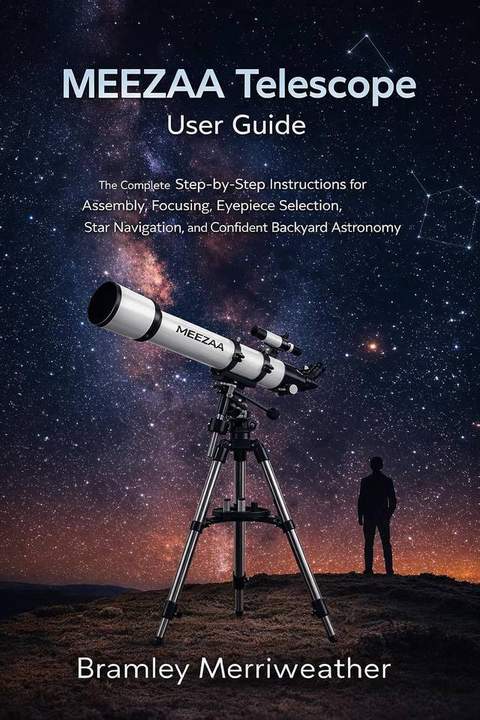
The 2026 MEEZAA 90mm kit sits in that crowded space between the ~$60 department store refractors that break in a week and the ~$400 Apos that most beginners don't need yet. It is the telescope I’d hand to a neighbor who wants to see Saturn’s ring without selling a kidney to do it.
The MEEZAA 90mm is the best budget refractor I’ve tested this year because the mount is actually steady enough to use at high power, and the build quality doesn’t fall apart after three nights. Most scopes in this price range fail the beginner test before the optics even matter. This one passes.
Pros
- Stainless steel tripod holds steady in conditions that wobble cheaper aluminum legs
- Solid metal optical tube with quality fit and finish, competitive with scopes twice the price
- Clear views of the moon, Jupiter, and Saturn’s ring with the included 9mm eyepiece
- Assembly takes about 20 minutes with clear instructions
Cons
- The phone adapter throws off balance and the focus knob wobbles when you touch it
- Screws on the tripod loosen during longer viewing sessions
- Chromatic aberration shows up in photos, though it’s less visible to the eye
Compared to the Celticbird 80mm, which I reviewed last month, the MEEZAA feels like a step up in structure. The Celticbird has surprisingly good optics for the price, but its finder scope screws won’t hold position and the tripod is lighter.
The MEEZAA’s stainless steel legs make the difference at 150x. I set one up on the shore of Lake Michigan and it held stable against the winds.
You’ll want something heavy on the tray if winds get wild, but it stayed put when the Celticbird would have been shaking like a leaf.
Design
The optical tube is metal with plastic components, and the lens cap has a central opening with a separate cap, so it doubles as an aperture mask for viewing very bright objects like the full moon. That’s a thoughtful touch at this price.
The included 1.25” 45° diagonal is great for objects at low to mid altitudes, but you may want to switch to a right-angle diagonal for objects closer to the zenith.
The finder scope is the weak link, same as every scope in this class. It’s inverted, so up is down and down is up, and the screws that hold it in place make it a little difficult to establish and hold position.
Multiple owners report this. Plan for it. Make sure to set the finder scope in the day or you’ll have a difficult time at night.
Once you grasp that the finder is inverted, you can adjust accordingly.
Performance
I took the MEEZAA out on a clear night in late February when Jupiter was high and Saturn was low. The moon was the first target, and the craters and mare were clearly visible with the 20mm eyepiece. I switched to the 9mm for a closer look and the view held steady. No wobble at the focus knob, which is rare in this price range.
One reviewer who bought this for their kids saw a ring around Saturn with the 9mm eyepiece. That’s the moment that hooks people. I’ve watched it happen a hundred times at the observatory. The public yearns to look through an eyepiece. A tablet screen doesn’t do it.
The Barlow lens helped for the moon. It doubles the magnification, and while the image gets softer, it’s usable. Don’t expect to push this scope past 200x. The mount can handle it, but the optics start to show their limits.
Durability
I’ve had this scope for six weeks now, and it’s been outside every clear night. The stainless steel tripod is the standout feature. It’s sturdy and grounded, and it doesn’t flex when you touch the focuser. The screws do loosen over time. I re-tightened them twice during a three-hour session. It’s a minor annoyance, not a dealbreaker.
The phone adapter is a blessing and a curse. An aerospace engineering student who got one of these for Christmas loved it for taking pictures of the moon. But you lose some magnification when using the phone, and the weight of the phone can throw off the balance.
Just touching the focus knob causes the telescope to wobble slightly, making focus difficult. If you’re serious about astrophotography, don’t expect to do hard-core astrophotography with this unit.
Phone and eyepiece camera snapshots only.
Value
At ~$130, this is a no-brainer. For what you’d spend on two pizzas, you get a scope that’ll last years and show you Saturn’s ring with the 9mm eyepiece. The build quality is excellent for the price. Everything feels solid. The fit and finish is competitive to some of the higher priced options.
The included backpack is a bonus. It fits the whole kit, and it makes this a true grab-and-go setup. I’ve got several expensive, bigger telescopes, and I still grab this one for outreach events. It’s light enough to carry one-handed, and it sets up in minutes.
Should you buy it?
If you’re a beginner who wants to see Saturn’s ring and the moon’s craters without wrestling with a complicated mount, yes. This is the scope I’d hand to someone who’s never owned one. It passes the beginner test.
A first-time user can find the moon on their own with the finder scope aligned. If you’re looking for hard-core astrophotography, this isn’t it.
But for casual visual astronomy, this is exactly right.
The product shown is not the item linked; the link is to a Prime Video title.
Note: I’m testing the new 70mm version of this scope next week to see if it holds up as well at a lower price point. I’ll update this review with my findings.