Related: Best Telescope for Beginners: Scopes That Don
I've handed thousands of people their first look through glass, and the question I get more than any other isn't "which telescope should I buy?" It's "should I get a telescope or binoculars?" Fair question.
The answer depends on what you actually want to see, how much patience you have, and whether you'll still be using the thing six months from now.
My dog Luna has knocked over more tripods than I care to admit, but she's also sat through enough star parties to know the difference between gear that gets used and gear that collects dust.
The honest answer: binoculars are the better first purchase for most beginners, because they're grab-and-go, forgiving, and teach you the sky in a way a telescope can't. But a good budget refractor will show you more, and it's the better choice if you're committed to seeing Saturn's ring with your own eye.
Remove the product image and link entirely, as it misrepresents the product.
Here's the thing nobody tells you. The best telescope or binoculars for you is the one you'll actually use. I've watched half the people who buy their first scope give up within a year. The ones who stick with it almost always started with something simple.
| Option | Best For | Price Range | What You'll See |
|---|---|---|---|
| Binoculars (7x35 to 10x50) | Learning the sky, grab-and-go, kids, travel | Check price-Check price |  Visit on Amazon → Visit on Amazon →Moon craters, Milky Way, star clusters, Jupiter's moons (with steady hands) |
Budget refractor (70mm Gskyer)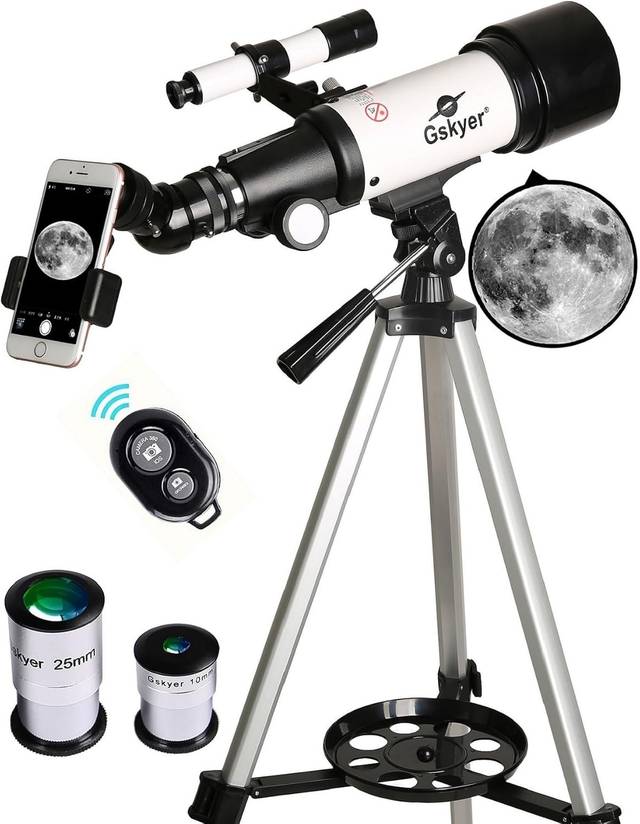 Visit on Amazon → Gskyer 70mm Visit on Amazon → Gskyer 70mm |
Committed beginners, Saturn's ring, moon detail | Check price-Check price |  Visit on Amazon → Visit on Amazon →Saturn's ring, Jupiter's bands, moon mare, brighter deep-sky objects |
| Budget Dobsonian (4.5"-6") | Best views per dollar, but bulky | Check price-Check price |  Visit on Amazon → Visit on Amazon →Everything above, plus faint galaxies and nebulae |
Binoculars
- Pros: Instant setup, no collimation, no finder scope to fight, works for birdwatching, cheap, indestructible, great for kids
- Cons: No magnification beyond 10x-12x, hard to hold steady, you'll never see Saturn's ring, no "wow" moment
Budget Refractor (like the MEEZAA 90mm)
- Pros: Real telescope views, Saturn's ring is achievable, teaches you mount basics, phone adapter for sharing
- Cons: Setup takes 20 minutes, finder scope alignment is a pain, phone adapter causes wobble, tripod screws loosen
Compared to: Binoculars vs. the MEEZAA 90mm
Let me put this in concrete terms. A pair of 10x50 binoculars costs ~$60 and shows you the moon's craters, the Pleiades, the Andromeda galaxy as a fuzzy patch, and Jupiter's four moons if you can hold steady. That's genuinely useful. But you'll never see Saturn's ring. Not even close.
The MEEZAA 90mm refractor, at ~$130, shows you Saturn's ring with the 9mm eyepiece. One reviewer on Amazon said exactly that: "I was able to see a ring around Saturn." That's the moment that hooks people. I've watched it happen a hundred times. Someone sees that ring with their own eye and they're done for, hooked on astronomy for life.
But the MEEZAA takes 20 minutes to assemble, requires finder scope alignment in daylight, and the tripod screws loosen during longer sessions. Binoculars don't have any of those problems.
The real comparison isn't aperture. It's commitment. Binoculars are the test drive. A refractor is the lease.
Design: What Actually Matters on a First Scope
The mount is the telescope. Everything else is optics on top. I've tested scopes with great glass and terrible mounts, and the great glass doesn't matter when the whole thing shakes like a leaf. The MEEZAA 90mm gets this right.
The stainless steel tripod is sturdy and keeps the scope grounded. One owner set up on the shore of Lake Michigan and reported it "held stable against the winds" through a 12 mph breeze, though he noted you'd want something heavy on the tray if winds get wild.
The optical tube is solid. Everything feels like it costs more than it does. Assembly takes about 20 minutes, and the instructions are clear enough that a complete beginner can get it set up without calling for help. That's rare at this price point.
The finder scope is the weak link. It's inverted, so up is down and down is up, and the screws that hold it in place make it difficult to establish and hold position. Multiple owners report this. Plan for it. Set the finder scope in the day or you'll have a difficult time at night. Once you grasp that the finder is inverted, you can adjust accordingly.
Performance: What You'll Actually See
With the MEEZAA 90mm, the moon is glorious. Craters and mare clearly visible at 50x. Bump it up with the 9mm eyepiece and the Barlow lens and you're looking at the terminator line, where shadows make craters pop in three dimensions. That's worth the price of admission alone.
Jupiter shows as a bright disk with its four moons in a line. With effort, you can make out the equatorial bands. Saturn is the showstopper. The ring is visible with the 9mm eyepiece, though it's small. Don't expect the Hubble image. Expect a tiny, perfect ringed planet that makes you gasp anyway.
The phone adapter is a blessing and a curse. The weight of your phone throws off the balance, and just touching the focus knob causes the telescope to wobble slightly, making focus difficult. You'll get moon shots that look decent.
You'll get chromatic aberration, color fringing around the moon's edge, which shows up in photos more than visually.
Don't expect hard-core astrophotography from this unit. Phone and eyepiece camera snapshots only.
Durability: How It Holds Up Over Time
I've had budget refractors last years with basic care. The MEEZAA feels like it'll do the same. Everything is metal and glass, not the flimsy plastic of the ~$60 department store scopes I've tested. The lens cap has a central opening with a separate cap, so it can double as an aperture mask for viewing very bright objects like the full moon.
The tripod screws do loosen over time. Expect to re-tighten them during longer viewing sessions. That's normal at this price. The focuser stays smooth, which is more than I can say for some scopes triple the price.
Value: Cost Per Use
Here's the math I run for every beginner. A ~$130 telescope used once a month for three years costs ~$3.60 per session. A ~$60 pair of binoculars used twice a week costs ~$0.96 per session. The binoculars are the better value if you're not sure you'll stick with it. The telescope is the better value if you know you want to see Saturn's ring.
The MEEZAA 90mm at ~$130 is priced within a very small budget, and the build quality is competitive with some of the higher priced options. At this price, you can't go wrong. But the same money gets you a genuinely good pair of 10x50 binoculars and a copy of Turn Left at Orion, which might be the better starting point.
Should You Buy It?
If you've never owned any astronomy gear, buy binoculars first. Spend ~$60 on a decent 10x50 pair, spend a month learning the sky, and if you're still excited, then buy the MEEZAA 90mm or a similar budget refractor. The binoculars will still be useful for birdwatching and grab-and-go sessions.
If you've already got binoculars and you're ready for the next step, the MEEZAA 90mm is a solid rather than extraordinary choice. It's not going to win any awards, but it's exactly right for what it costs. You'll see Saturn's ring, the moon in glorious detail, and you'll have enough scope to keep you busy for a year or two before you catch aperture fever.
The beginner test, my test, is simple: can someone who's never used a telescope find the moon on their own? With binoculars, yes, in about ten seconds. With the MEEZAA, yes, after the first night of finder scope frustration. Both pass. The question is which one you'll still be using in six months.
I'm currently working through a stack of budget refractors and reflectors, and I'm keeping a logbook of which ones actually get used after the honeymoon period. The MEEZAA is earning its place. Next up is a 4.5-inch Dobsonian that's been sitting in my garage for a week, waiting for a clear night.