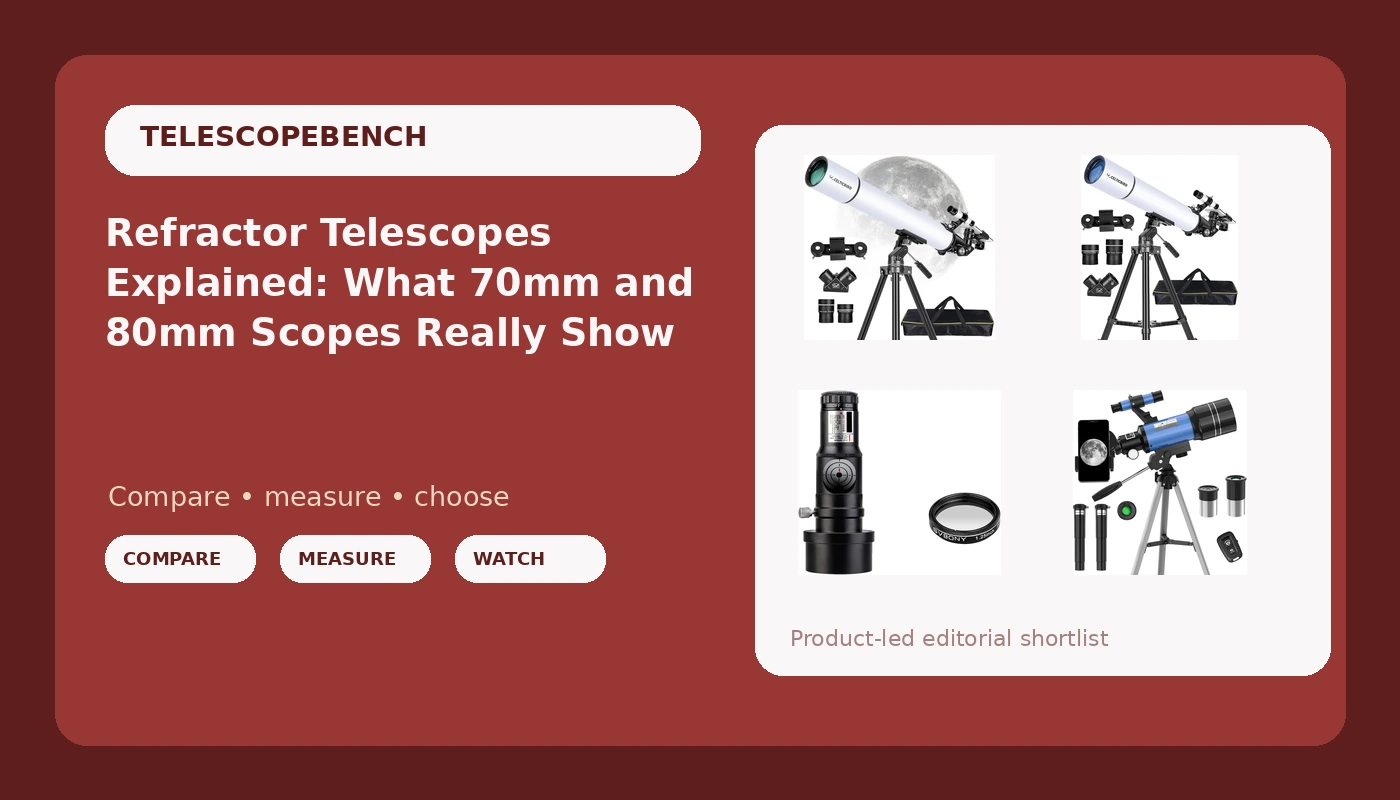
A refractor telescope for beginners almost always looks like the same thing: a long tube, a glass lens at the front, a small alt-azimuth head, and a tripod lighter than you expected. The three refractors and one accessory below are variations on that formula, and the gaps between them are narrower than the product pages suggest. What actually separates them is aperture, focal length, the eyepieces in the box, and how steady the whole assembly stays once you push the magnification up. This explainer walks through what each number does, why the mount matters more than the tube it carries, and where a laser collimator like the SVBONY SV121 belongs in an observing kit.
Related: How to Set Up a Refractor Telescope on Your First Night →
Quick answer
These are small-aperture refractors and one collimation accessory, not deep-sky instruments. Two Celticbird 80mm refractors with alt-azimuth mounts, one 70mm travel refractor with a phone adapter, and one red laser collimator bundle make up the group. If you want the Moon, Jupiter, Saturn, and bright star clusters, an 80mm refractor gathers more light and resolves finer detail than a 70mm at the same magnification, so the 80mm tubes reach further on planets. If the deciding factor is whether the scope leaves the closet, the 70mm package is the smaller and lighter of the three telescopes. The SVBONY SV121 is not a telescope at all: it is a collimation tool and filter bundle meant for owners of reflector designs, and the refractors here do not normally need user collimation.
Four useful options
| Model | Best fit | What stands out |
|---|---|---|
| Telescope for Adults & Kids, 70MM Aperture FMC Optics, 300MM Refractor | Smallest travel kit | 70mm aperture, 300mm focal length, stated 15X to 150X range, phone adapter and tripod included |
| Celticbird Telescope, 80mm Aperture 900mm Refractor | Longer focal length viewing | 80mm aperture, 900mm focal length, AZ mount, carry bag, phone mount |
| Celticbird Telescope, 80mm Aperture 800mm Refractor | Shorter tube, same aperture | 80mm aperture, 800mm focal length, AZ mount, carry bag, phone mount |
| SVBONY SV121 Red Laser Collimator Bundle | Reflector owners | Red laser collimator paired with a telescope filter |
The travel option: Telescope for Adults & Kids 70MM Refractor
A 300mm focal length is short for a refractor, and that shapes everything about how this scope behaves. Magnification equals telescope focal length divided by eyepiece focal length, so a 25mm eyepiece gives about 12X and a 10mm eyepiece gives about 30X. To reach the top of the stated range you need a very short eyepiece, a Barlow, or both, and that is where the honest limit shows up. The long-standing guideline is roughly 2x per millimeter of aperture, which puts the useful ceiling for a 70mm lens near 140X, and only on a night with steady air and a mount that stops moving. Treat the upper end of the printed range as a number the optics can technically reach rather than a magnification you will use every session. The payoff for the short tube is a compact, light package that is easy to carry outside, and 70mm is still enough to show lunar craters, Jupiter's four bright moons, Saturn's rings at small scale, and brighter double stars.
The longer-focal-length option: Celticbird 80mm Aperture 900mm Refractor
Focal length is the quiet spec that decides what a refractor feels like to use. At 900mm, the same 25mm eyepiece that gave 12X on the 70mm scope now gives about 36X, which is already a comfortable lunar and planetary magnification without adding a Barlow. Going up to a 10mm eyepiece lands near 90X. That is a friendlier path to the Moon and planets, and it is the main reason a longer tube appeals to someone whose first targets are the bright ones. The trade-off is physical: a longer tube puts more leverage on the mount, so any weakness in the tripod or head shows up faster as a shake you cannot tune out. Aperture also matters here beyond focal length. The 80mm lens has meaningfully more light-collecting area than 70mm, which helps on dimmer targets and on fine lunar detail, though both remain starter-class apertures that will not reveal spiral arms in galaxies or color in most nebulae.
The shorter-tube 80mm option: Celticbird 80mm Aperture 800mm Refractor
Two refractors with the same 80mm aperture and focal lengths 100mm apart are close cousins, and the difference is one of feel rather than capability. The 800mm tube is marginally shorter and marginally lighter, and it gives a slightly wider true field of view with any given eyepiece, which makes it a little easier to find things and a little friendlier for wide star fields and open clusters. The 900mm tube gives slightly more magnification per eyepiece, which nudges it toward the Moon and planets. Neither difference is dramatic. If you are comparing these two directly, the practical question is not which optical tube is superior, because they share the same aperture and the same mount type. The practical question is which one you will carry outside more often, and whether the small field-of-view difference matches the objects you care about most. Both include a carry bag and a phone mount, so the accessory list does not break the tie either.
The accessory: SVBONY SV121 Red Laser Collimator Bundle
Collimation is the alignment of a telescope's optical elements, and it matters most on reflector designs, where a primary mirror and a secondary mirror have to point at each other precisely. When those mirrors drift out of alignment, stars stop looking like points and start looking like little comets. A laser collimator makes that adjustment faster by projecting a beam down the tube so you can see where it lands. Refractors work differently: their lens elements are fixed in the tube at the factory, and a refractor normally does not need user collimation at all. That means the SV121 is not a companion purchase for any of the three scopes above. It belongs in the kit of someone who owns a Newtonian reflector, or who plans to add one, and the bundled filter is a separate accessory worth evaluating on its own merits. Buying a collimator before you own a telescope that needs collimating is one of the most common ways beginners spend money on gear instead of on the sky.
Prices and availability may change. Product images, names, and retailer links must be matched by verified ASIN. Do not state a current price, rating, stock status, or measured result without current evidence.
What aperture and focal length actually change
Aperture is the diameter of the front lens, and it sets two things at once: how much light the scope collects and how finely it can resolve detail. Going from 70mm to 80mm does not sound like much, but light gathering scales with the area of the lens, not its diameter, so the 80mm lens collects roughly 30 percent more light than the 70mm. That extra light is what lets you push magnification a little higher before the image turns to mush and what makes dimmer targets a bit more visible. Resolution follows the same logic in the other direction: a larger aperture can separate closer pairs of stars and show finer lunar detail, up to the limit set by the atmosphere above you.
Focal length works on a completely different axis. It does not change how much light you collect, only how much the image is magnified before it reaches the eyepiece. The formula is simple: telescope focal length divided by eyepiece focal length equals magnification. A 900mm tube with a 25mm eyepiece gives 36X. A 300mm tube with the same eyepiece gives 12X. This is why a long tube feels planet-oriented and a short tube feels wide-field, even when their apertures are identical.
The third number, the printed magnification range, deserves skepticism. A small refractor can be pushed to very high magnification, but the image gets dimmer and softer as you go, and atmospheric turbulence magnifies along with the target. The guideline of about 2x per millimeter of aperture exists because it describes the point where the view usually stops improving. For a 70mm lens that is around 140X, and for an 80mm lens around 160X, and those ceilings only apply on nights when the air is steady.
The mount is the telescope
An alt-azimuth mount moves in two simple directions, up and down and left and right, which makes it intuitive for a first-time user. There is no alignment routine, no power requirement, and no computer to argue with. The cost is that the sky rotates while you watch, so anything at high magnification drifts out of the field and you nudge the tube to follow it. At low power that is a minor annoyance. At 100X and above it is constant.
That is why the tripod and head matter as much as the glass. Vibration does not care how good your optics are: if the tube shakes when you touch the focuser, or when a light breeze hits it, the sharpest lens in the world will not save the view. The three refractors here all use alt-azimuth heads, which is the right design for a beginner, and the practical differences between them come down to how rigidly the tube sits and how quickly the whole thing settles after you let go.
A short checklist before you buy any starter refractor:
- Decide your first target honestly. The Moon and planets reward focal length, so a longer tube pays off. Wide star fields and open clusters reward a wider field, so a shorter tube pays off.
- Match aperture to your expectations. 70mm and 80mm show the Moon, the bright planets, double stars, and the brighter clusters. Faint galaxies and most nebulae need substantially more aperture than this class offers.
- Inspect the mount description before the optics description. Look at how the tube attaches to the head and whether the tripod has a spreader or brace. A wobbly mount is the single most common reason a first scope gets abandoned.
- Plan for one better eyepiece. The eyepiece in the box is a starting point, not a finished kit. A mid-power eyepiece in the 20mm to 25mm range and a 2x Barlow usually change the experience more than a slightly larger tube would.
- Decide whether you own a reflector. If you have a Newtonian, a collimator like the SV121 is a legitimate part of your kit. If you only own refractors, put that budget toward an eyepiece or a filter instead.
Practical guidance for night one
- Let the scope sit outside for a while before you observe. A tube that is still warmer than the air around it will show soft, wavy images until it settles.
- Set up on grass or dirt rather than concrete or a deck. Hard surfaces transmit every footstep straight into the tripod.
- Keep the tripod legs as short as you can comfortably use. Lower legs mean less leverage and less shake.
- Start every session at low magnification to find your target, then increase power step by step. Finding objects at high magnification is unnecessarily hard.
- Use the phone mount for the Moon first. It is the one target that photographs reasonably well through a small refractor, and it teaches you how the adapter lines up with the eyepiece.
- Keep magnification near 2x per millimeter of aperture in average conditions. That is about 140X for a 70mm lens and about 160X for an 80mm lens, and only when the air is steady.
Which option should you choose?
Choose the Telescope for Adults & Kids, 70MM Aperture FMC Optics, 300MM Refractor when portability is what determines whether you observe at all, and when your targets are the Moon, Jupiter, and bright stars seen at low to moderate power. Choose the Celticbird Telescope, 80mm Aperture 900mm Refractor when you want the most magnification per eyepiece in this group and your interests lean toward the Moon and planets. Choose the Celticbird Telescope, 80mm Aperture 800mm Refractor when you want the same 80mm aperture with a slightly shorter, slightly more forgiving tube and a marginally wider field for clusters and star fields. Choose the SVBONY SV121 Red Laser Collimator Bundle only if you already own or plan to own a reflector that requires mirror alignment.
One limitation applies across all of it. Nothing in this group is a large-aperture instrument, and none of these product pages can tell you how steady the mount feels in your hands or how much light pollution sits over your backyard. Those two factors shape a first telescope experience more than any spec sheet. The refractors here are starter and travel class scopes, and they are honest about that once you stop reading the magnification range and start reading the aperture.
The bottom line
Aperture and focal length do different jobs, and understanding both is what separates a satisfying first refractor from a frustrating one. The 80mm Celticbird tubes collect more light than the 70mm travel scope and reach higher magnification with the same eyepiece, which makes them the more capable choice for the Moon and planets. The 70mm package is the more portable one, and portability is a real optical advantage if it means the scope actually goes outside. The SVBONY SV121 is a tool for reflector owners, not a companion for these refractors, so treat it as a separate decision. Whichever you pick, budget for one decent eyepiece and expect the mount, not the lens, to be the part that decides how much you enjoy the night.